 Lada Klokova
One day in a St. Petersburg tavern, Alexander Pushkin encountered a short, grey-eyed young man sitting alone. Just what could have drawn the great Russian poet to this American is unknown. Yet it was he who, during a lively conversation, gave Pushkin the idea for the poem The Bronze Horseman. The young man’s name was Edgar Allan Poe…
Photos courtesy of M. Zolotarev.
This isn’t even a legend, but a pure fabrication. Yet a rather curious one, since it originated as a hoax. Its author was Edgar Poe himself: in a short autobiographical note written in 1839, he claimed that at the age of 17 he “ran away from home without a penny in his pocket to join the Greeks fighting for their freedom, and, never reaching Greece, wound up in Russia, in St. Petersburg.”
In fact, Poe never visited Russia. But this would not become known until the 20th century, after scholars investigated the writer’s biography. Until then, the hoax stirred the minds of literary critics, who repeated it in their articles on Poe. And not just in articles. In Valentin Katayev’s novel Time, Forward!, an American engineer visiting the USSR tells this tale to one of the characters. Yuri Tynyanov intended to write a short story about a meeting between Poe and Pushkin. But the poet Vladimir Pyast went the furthest in “legitimizing” the hoax. In his memoirs, he claimed that during the February Revolution of 1917 in Petrograd, a fire in the police archives destroyed “a record of the detention of an American citizen, Edgar Allen Poe, on the street in the early 1830s”…
Founder of the School of the Strange

It is hard to find a writer in the history of literature whose fate was as tragic as that of Edgar Allan Poe. In life, he was an unrecognized genius who never escaped grinding poverty. In death, he became a slandered figure denounced as a madman. It may seem unbelievable, but until the second half of the 20th century, almost no one in the United States even attempted an in-depth scholarly study of Poe’s work.
After all, Edgar Poe is one of the pillars of early symbolism and the father of the detective and fantasy genres, the creator of The Raven – a cult poem in world literature. Arthur Conan Doyle, Agatha Christie, H.G. Wells, Arthur Rimbaud, Maurice Maeterlinck, Konstantin Balmont, Valery Bryusov, and Dmitry Merezhkovsky all acknowledged his influence on their work. Fyodor Dostoevsky, Oscar Wilde, Rainer Maria Rilke, George Bernard Shaw, H.P. Lovecraft, and Stephen King were avid readers of his poems and short stories. Alexander Blok dedicated a poem to Poe – It was an autumn evening… Jules Verne wrote that Poe “created a completely unique genre of writing; he might be called the founder of the School of the Strange (l’École de l’étrange). He had imitators who tried to surpass him, but not a single one of them even came close.” The science fiction writer did not hide the fact that he wrote the novel Around the World in Eighty Days under the influence of Poe’s short story Three Sundays in a Week. And his novel An Antarctic Mystery he dedicated to the memory of Poe. Meanwhile, Charles Baudelaire spent half his life seeking reader recognition for Poe’s genius: for 17 years he translated his works into French…
In the 19th century, while Edgar Poe was already widely celebrated across Europe and Russia, Americans regarded him as a madman and a drunkard.
The Voice of the Naiad
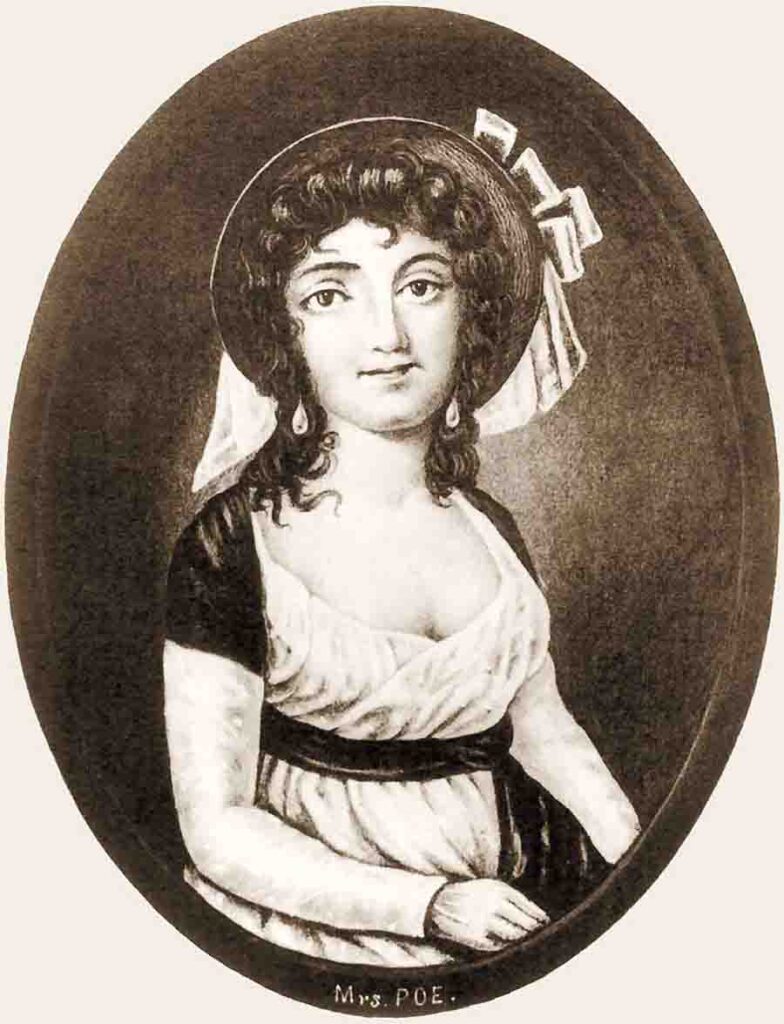
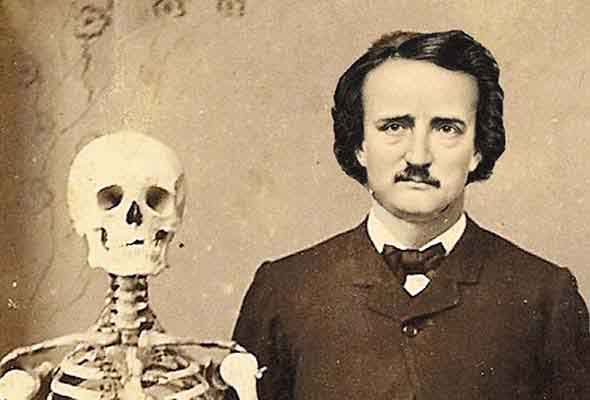
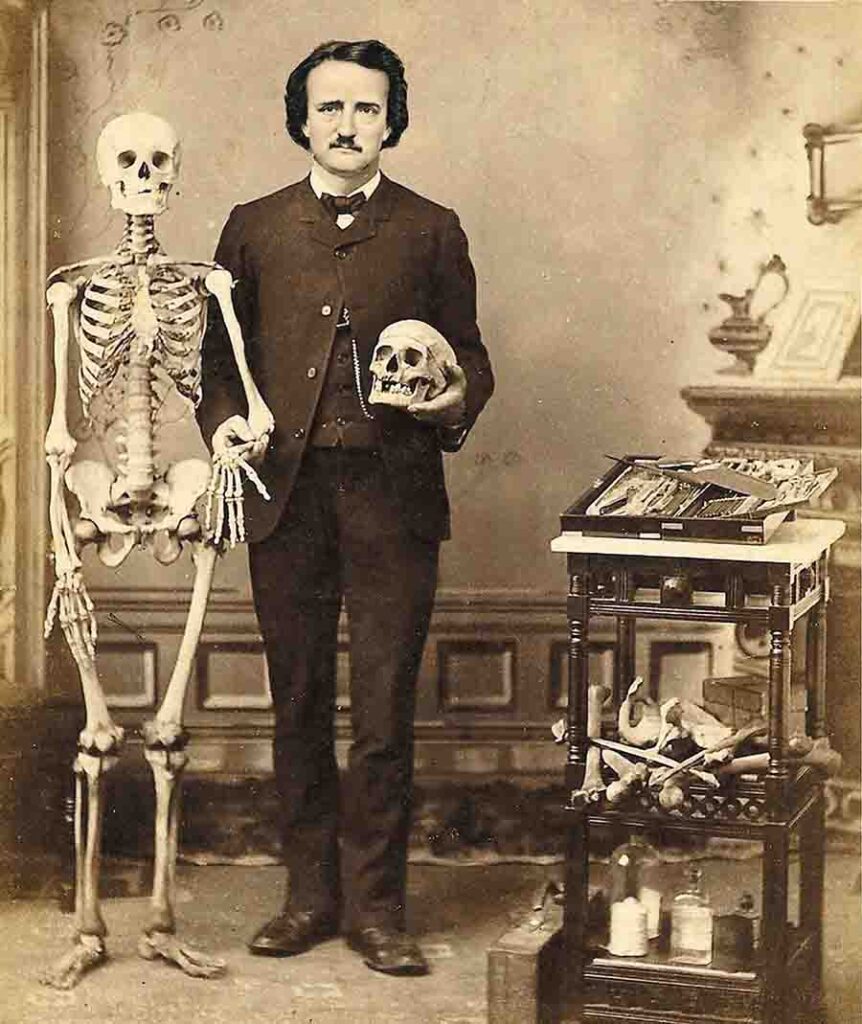
The contrast between the early portraits of Poe and the daguerreotype taken four months before his death is striking: it is hard to believe they depict the same person. The former show a handsome man with a proud gaze. But the daguerreotype reveals a deeply unhappy man: a face lined with wrinkles, one eyebrow noticeably lower than the other, and eyes filled with sorrow. Edgar Poe died in October 1849, having lived only 40 years.
Poe’s biography is so overflowing with misfortune that chronicling it would take dozens of pages. A brief account of his life, however, can be boiled down to a few phrases: early orphanhood, a string of deaths among those he loved, hopeless loneliness, endless poverty, grueling labor, poor health, pride, and a quick temper.
There is a strong temptation to directly link Poe’s short stories to his own fate and troubled mind, and to assume that this alone was the source of his stunning depictions of the borderline states of the human psyche. Such attempts have been made more than once – not only by critics, but by psychiatrists as well. But Poe was not a madman. At least, not while he was writing his stories. Caught up in them, readers often forgot that this was fiction, not documentary prose. Just as they forgot that the characters and the author are not the same person. And they failed to hear the “voice of the Naiad” – Poe’s term for the hidden meaning within a literary work.

Could a madman have created the “tales of ratiocination” – the forerunners of the detective genre? Could a lunatic have written the short stories that gave impetus to the development of science fiction? Could a maniac have analyzed the newspaper reports about the 1841 murder of Mary Rogers and written The Mystery of Marie Roget, which listed the errors of the investigation and stated that the killer was a sailor? When the case was solved, it turned out that Poe’s conclusions had been correct. Even more impressive is the case of Dickens’s novel Barnaby Rudge, which was serialized in 1841 in the London magazine Master Humphrey’s Clock. Poe wrote a review of the novel in which he accurately predicted how the plot would develop. When Dickens read it, he exclaimed: “This Poe must be the devil himself!”
One of the hallmarks of Poe’s short stories is that they seem utterly real. He would copy out facts, descriptions of events, people, and places from books, newspapers, and magazines, and then use all of it in his work. In 1844, his story The Balloon-Hoax was published in the New York Sun, written in the form of a news report: it announced that eight daredevils had crossed the Atlantic in a hot-air balloon in 75 hours. Yes, it was a fabrication. But the story was written with such convincing detail that it made people genuinely worry for them.
And of course, Poe drew on his own memories. For instance, his famous story The Gold-Bug is set on the desolate Sullivan’s Island. This was exactly where Poe spent a year serving as a soldier in the 8th Battery of the 1st Artillery Regiment. And in the short story William Wilson, the description of the protagonist’s school days, tormented by his double, was based on Poe’s childhood memories of attending a private school in a London suburb.
The Death of Beautiful Women

“…I asked myself: ‘Of all melancholy topics, what, according to the universal understanding of mankind, is the most melancholy?’ ‘Death,’ was the obvious reply. ‘And when,’ I asked, ‘is this most melancholy of topics most poetical?’ ‘When it most closely allies itself to Beauty; therefore, the death of a beautiful woman is, unquestionably, the most poetical topic in the world…'” This is an excerpt from Edgar Poe’s essay The Philosophy of Composition, in which he describes the mechanism behind the creation of his The Raven. One could say he knew what he was writing about.
Poe first witnessed the death of a beautiful woman at the age of three: on December 8, 1811, in Richmond, Virginia, his mother died of tuberculosis. She was Elizabeth Poe, an actress, just 26 years old. Edgar had no memory of his father: the actor David Poe is believed to have died of tuberculosis as well, in 1810. Edgar was the second child in the family, born on January 19, 1809, in Boston. His older brother, William Henry, was born in 1807 and lived with their father’s relatives in Baltimore from infancy. Their sister Rosalie was born in 1810.
After Elizabeth Poe’s death, the orphans found homes with local families in Richmond: Edgar went to Frances Allan, the wife of a wealthy merchant, and Rosalie to the Mackenzie family. The Allans had no children of their own. Frances repeatedly suggested to her husband that they adopt Edgar, but Allan did not want an adopted son to become his heir. After all, he had several illegitimate children in Richmond of whom his wife was unaware. As long as Edgar impressed everyone with his abilities and academic success, Allan showed no dissatisfaction. He even paid for the boy’s education at private schools in England, where Allan traveled with his family in 1815 to secure lucrative contracts. After returning to Richmond in 1820, Edgar attended a local school and dreamed of becoming a poet. But Allan decided that his stepson would become a lawyer and therefore go to the University of Virginia.

This period saw Poe’s first infatuations. The first was Jane Stanard, the mother of one of his classmates, for whom he harbored a purely platonic attachment. When she unexpectedly died, Edgar was devastated. Then his affections soon turned to 15-year-old Elmira Royster. Before Edgar left for university, she promised to become his wife. However, Allan made it clear to Elmira’s father that Edgar would not be his heir, after which Mr. Royster hastily married her off.
Relations with his stepfather were deteriorating. Out of Allan’s stinginess, Edgar was forced to leave the university in December 1826: his stepfather refused to pay for his education and demanded he return to Richmond, where Poe’s situation had become unbearable. Using his influence, Allan thwarted Edgar’s attempts to find work and reproached him for being a freeloader. In March 1827, Allan threw his stepson out of the house without money or belongings. With nothing to live on, the young man signed a five-year army contract in May 1827. Within a year, Poe was already sick of the service; literature was drawing him in. But Allan wouldn’t hear of it. Edgar tried to make peace with him and, to that end, promised to enroll in the Military Academy at West Point. And in February 1829, Frances Allan died. His stepfather wrote to Edgar about it too late, and Poe was unable to attend the funeral.
After leaving the army, Edgar went to Washington and submitted his application for West Point to the Department of Defense. He waited for a reply from the department in Baltimore, where he tracked down his relatives: his father’s sister, Maria Clemm, her children Henry and Virginia, and his older brother, who was dying of tuberculosis. Before returning to Richmond in December 1829, Edgar nursed his brother. In May 1830, word came that he had been accepted to West Point. It was around this time that Allan and Poe had their final quarrel. They parted as enemies. Things played out at West Point just as they had at the university: Allan refused to help the young man. On top of that, his stepfather soon remarried. Edgar’s already illusory hopes for an inheritance vanished into thin air. Poe wrote to Allan saying he wanted to leave West Point and once again asked for help. There was no reply. In February 1831, Poe was expelled from the academy.
The Tomahawk Critic

Poe’s literary career got off to a rocky start: the first three poetry collections, published while he was a student at the university and at West Point, went almost unnoticed by critics. Destitute, Poe moved in with the Clemm family in Baltimore. He was unable to find work. In late 1831, Poe entered a competition for the best short story announced by the Philadelphia Saturday Courier (the prize was $100). He submitted the stories Metzengerstein, The Duc de L’Omelette, A Tale of Jerusalem, Loss of Breath, and The Bargain Lost, written in record time. But the jury awarded the victory to another contestant. In the summer of 1833, Edgar sent six new stories to a competition held by the Baltimore Saturday Visiter (the main prize was $50). This time, the jury unanimously named Poe’s story MS. Found in a Bottle the best. This was effectively the first recognition of Edgar Poe’s talent.
Poe’s subsequent life was a succession of newspaper and magazine offices, left behind due to conflicts with his editors. He constantly had to look for work and move from city to city. His colleagues resented Poe’s talent, while Edgar himself often behaved arrogantly. And when it came to literature, he refused to make any compromises. His reviews were known for their devastating criticism. Poe soon made many enemies in the literary world – and not without reason was he nicknamed “the Tomahawk Critic.”
His reputation as a troublemaker did not help his earnings. Poe and the Clemms lived from hand to mouth. Quite often, Maria Clemm had to go around to the neighbors with a basket, begging for a crust of bread, an onion, or a potato. A half-starved existence, exhausting work, poverty, and conflicts with colleagues drove Poe to depression and nervous breakdowns. He turned to the bottle more and more often. Alcohol affected him terribly: a single glass of wine was enough for Edgar to lose all self-control. After each breakdown, he would repent and swear off drinking. At the same time, people who closely knew Edgar recalled that they did not see him drunk often enough to consider Poe an alcoholic.
“Lord, Help My Poor Soul”

In May 1836, Edgar married his cousin Virginia Clemm, who had barely turned 13. The couple loved each other tenderly. But in January 1842, it became clear that Virginia was ill with tuberculosis. It was a shock for Poe: he realized he was losing a beloved woman once again. It is worth noting that in 1845, Edgar met the poet Frances Osgood, and they struck up a romantic correspondence in verse. The relationship was platonic, and Virginia encouraged her husband’s friendship with Frances. Apparently realizing that she did not have long to live, she was looking for a new companion for her husband. But it turned out that Frances was also ill with tuberculosis – she would outlive Poe by only a year. Edgar was not the only recipient of Osgood’s letters: she flirted in a similar correspondence with the critic Rufus Griswold. Keep this name in mind, for Poe had no more treacherous foe than he.
Virginia died in January 1847. After the death of his beloved wife, Poe’s life went off the rails. He was ill for a long time, and his doctor warned him that, given his weak heart and shattered nerves, the writer could soon die. If it hadn’t been for the help of benefactors and Maria Clemm’s begging, Edgar would never have gotten back on his feet. Having recovered from his illness, Poe… fell in love again. This time with the poet Sarah Helen Whitman. It even went as far as an engagement, and Edgar swore off drinking. But someone sent Whitman an anonymous letter claiming that her fiancé had been seen drunk. She broke off the engagement.
In the last year of his life, Poe was engaged once again. This time to a wealthy widow, Mrs. Shelton – the very same Elmira with whom he had been in love in his youth. The wedding was set for October 17. It seemed that things were starting to look up. Poe joined a temperance society, gave lectures, and corresponded with a wealthy admirer from Kentucky who was ready to finance a nationwide magazine. On September 27, 1849, Poe set off from Richmond to Baltimore, from where he was to travel to Philadelphia and then to New York, where Maria Clemm was waiting for him.
On October 3, Dr. Snodgrass, the owner of one of Baltimore’s newspapers, received a note. It stated that at Ryan’s tavern, a “seedy-looking gentleman” had identified himself as Edgar Poe and asked that Mr. Snodgrass be contacted for help. The doctor, who knew Edgar, found the writer at the tavern unconscious. Poe was taken to the hospital and did not regain consciousness until October 5. He was unable to explain what he was doing in Baltimore. On October 6, the delirium began. At around 5 a.m. on October 7, 1849, Poe died. Dr. Moran, who was attending to him, reported that his last words were: “Lord, help my poor soul.”
Poe’s medical records and death certificate have not survived. Snodgrass claimed that Poe was heavily intoxicated. Moran insisted that the writer did not smell of alcohol. Many theories have been put forward as to the cause of Poe’s death: a brain tumor, epilepsy, meningitis, hypoglycemia, a stroke, cholera. And here is another one. In early October 1849, elections to the US Congress were taking place in Baltimore. It is suspected that Edgar fell into the hands of thugs who, over the course of two or three days, would round up potential voters into special locations, get them drunk, and hold them there until the election day. Then they forced them to vote the “right” way. One of the polling stations was located right at Ryan’s tavern…
On October 8, the day of the writer’s funeral, the New-York Tribune published an obituary that began: “Edgar Poe is dead. He died in Baltimore the day before yesterday. This announcement will startle many, but few will be grieved by it.” The obituary was signed with the penname Ludwig – a cover for Rufus Griswold. The scandalous article was reprinted by many newspapers. And Griswold continued to blacken Poe’s name, inventing tall tales and forging his letters. In the article Memoir of the Author, the critic portrayed Poe as a godless madman, and an alcoholic. People who knew Edgar closely tried to expose these lies, but the public preferred to relish the juicy details. Griswold’s conduct was despicable, for during Poe’s lifetime he had posed as the writer’s friend. And he did so successfully that Poe appointed him his literary executor.
Rufus Griswold did not outlive Poe by much; he died in New York in 1857. In his room, they found only drafts of articles and three large portraits: of Edgar Poe, Frances Osgood, and Rufus himself…
The Power of Imagination
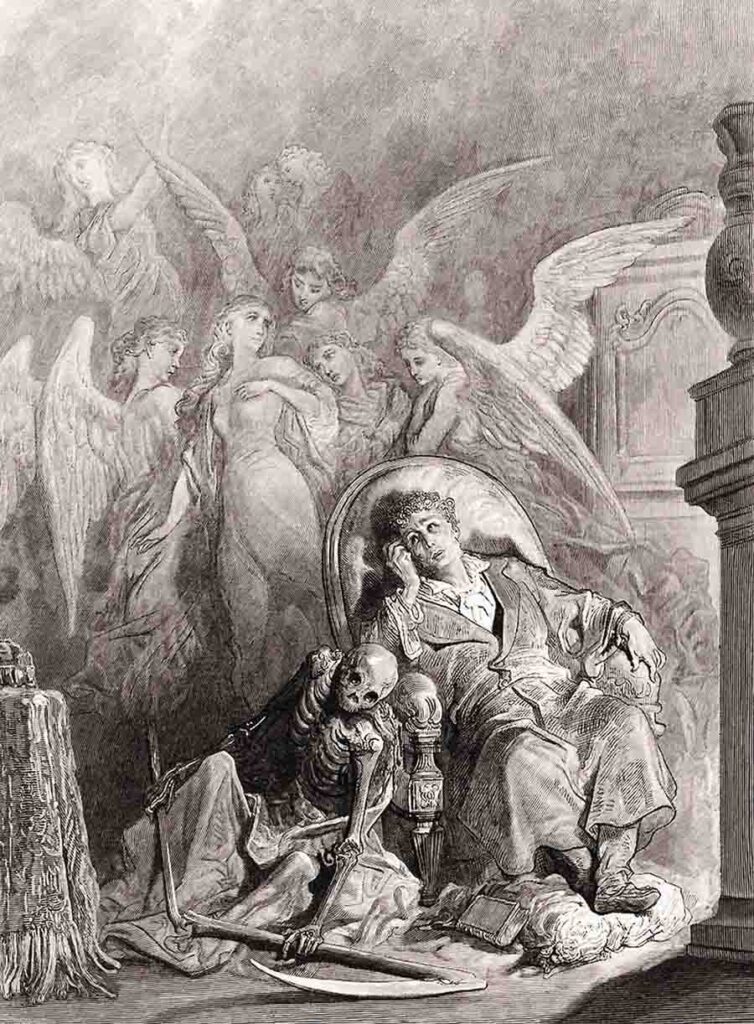
Literary scholars have calculated that no other work has been translated into Russian as often as Edgar Poe’s The Raven. There are at least 22 translations. The poem was first translated by the poet and critic Sergei Andreyevsky in 1878. The best translations of The Raven, however, belong to Konstantin Balmont, Valery Bryusov, and Dmitry Merezhkovsky.
The Russian reader first became acquainted with Poe’s work in 1847. That year, The Gold-Bug appeared in a Russian children’s magazine. Over the following decade, seven more short stories were translated into Russian, as well as Baudelaire’s essays on Edgar Poe.
Russian readers also fell for one of Poe’s hoaxes. In 1859, an anonymous pamphlet appeared. Its author, having read the story The Facts in the Case of M. Valdemar, mistook Poe for a doctor and took the whole thing at face value. The pamphlet was full of outrage against “sacrilege”: mesmerism, magnetism, and the manipulation of the human soul.
In 1861, the journal Vremya (“Time”), published by the Dostoevsky brothers, published three of Poe’s short stories. They were preceded by a review written by Fyodor Dostoevsky himself, in which he noted: “…in Edgar Poe there is precisely one trait that sets him apart from all other writers and constitutes his sharpest distinguishing feature: it is the power of imagination.” In Dostoevsky’s obituary, published in 1881 in the British weekly The Academy, it was noted: “The gloomy colouring with which he shrouds all his stories, and the spell with which he captivates the reader, remind us of Edgar Poe.”
It is hard to list all the translators of Poe’s works into Russian, especially since some translations were published anonymously. But there is no doubt as to who should take the credit. Of course, it is Konstantin Balmont. Today, many forget that it was thanks to him that Russian readers became acquainted with the works of William Blake, Charles Baudelaire and Oscar Wilde… By the way, the novel The Picture of Dorian Gray was created under the influence of Poe’s short story The Oval Portrait. Balmont translated more than 40 works by Poe over his lifetime…
Three Roses
Edgar Poe was buried in Baltimore in the cemetery of the Westminster Presbyterian Church, next to his grandfather. A marble monument ordered by the writer’s cousin was never installed on the grave: it was destroyed by a train that derailed and crashed into a storage building at the cemetery. A remarkable incident in the spirit of Edgar Poe!
In 1873, a local newspaper published a note about Poe’s neglected grave. A fundraising campaign was launched, and in October 1875, the writer’s remains were reburied at the front of the church. An imposing monument was erected over the grave. In January 1885, Virginia’s remains were moved here as well. A grand monument was erected at the grave site. In January 1885, Virginia’s remains were moved here as well.
Every year, starting in 1949, on the night of January 19, a figure dressed in black with a walking stick would come to Poe’s grave – just how Poe would dress. The admirer would kneel, raise a toast, and leave a bottle of cognac and three roses on the grave. His identity was never discovered. Sometimes, after his visits, notes were found on the gravestone. In 1993, a note read: “The torch will be passed.” In 1999, a note stated that the original admirer had died and that his “heir” would continue the tradition. Between 2010 and 2015, no one visited Poe’s grave. But in 2016, a man in black once again came to the grave…
Translated by Grigory Litvinov.