
 Zoya Mozaleva

The country house of Konstantin Korovin in Okhotino has miraculously survived to this day. This very house remembers not only its famous owner, but also Fyodor Chaliapin, Maxim Gorky, Valentin Serov, Sergei Rachmaninoff… Many famous guests came to visit the artist.
Photos by Andrey Semashko.
Okhotino is especially lovely in autumn: the air is clean and cool, the morning mists draw back to reveal the amber and crimson of the groves, the days grow shorter, and the sunsets more vivid. Nor is it any worse in summer, when the greenery is at its most lush and the fields overflow with wildflowers of every colour. And winter is beautiful too: the blanket of snow enveloping the small village gives it a pristine, almost untouched look. And spring in Okhotino, touching and tender, is no less beautiful… On the canvases of the artist Konstantin Korovin, one can see Okhotino in any season – it was here, in the remote countryside of the Yaroslavl region, not far from Pereslavl-Zalessky, that the painter’s beloved dacha stood.
The Merchant’s Grandson

“This is where our classroom was,” says Vladimir Seliverstov, curator of the Korovin Museum in Okhotino, pointing. “My desk stood here…” The fact that after the revolution the Okhotino village primary school was set up in the artist’s dacha saved the house from the usual fate of estates in those years – it was neither burned nor taken apart for firewood.
“Of course, everything had been ransacked, everything carried off, but the building survived. The school moved in here in 1925, three years after the artist left for abroad. And on the outside, the dacha has not changed at all – it remains as Korovin created it,” says Yulia Seliverstova, the curator’s daughter, who helps her father give tours. “I always begin the tour from outside, to draw attention to the facade. A local team of carpenters built this house for Konstantin Korovin from his sketch; he made the drawings himself.”
The semi-arch on the second floor, the improvised columns – the dacha bears little resemblance to the neighbouring village houses. Actually, Konstantin Korovin had not grown up in a peasant hut: his grandfather, the wealthy merchant Mikhail, owned a mansion in Moscow. It was there that Konstantin and his elder brother Sergei (born in 1858, three years before Konstantin) spent their childhood and youth. Sergei also became an artist, and Konstantin often said that his brother was even more talented than he was. In the history of painting, however, the elder Korovin occupies a more modest place.

The brothers were completely different. Konstantin was the life of the party: a ladies’ man, a wag, a cheerful fellow. Sergei was his exact opposite: thoughtful, serious, reserved. Sergei Vinogradov, a friend and fellow student of the Korovin brothers at the Moscow School of Painting, Sculpture and Architecture, wrote: “If one could combine the brilliance and painterly gift of one with the perfection of form of the other, it would be a work of genius.”

Each time he arrived by train in his beloved Okhotino, Konstantin Korovin could reflect on the ironies of fate: after all, it was this very railway that had ruined his grandfather Mikhail, who had been in the carting business. When the railway from Moscow to Yaroslavl was built, cart drivers were no longer needed. The father of the Korovin brothers worked as a mere clerk at a factory.
Until 1901, Konstantin Korovin worked at the Moscow Private Russian Opera, owned by the wealthy industrialist Savva Mamontov. It was from him that the artist bought land in Vladimir province in 1897. When Mamontov went bankrupt, the Private Opera troupe was forced to look for work. Konstantin Korovin became a set designer at the Bolshoi Theatre, also collaborated with the Mariinsky and Alexandrinsky theatres in Saint Petersburg, and taught at the Moscow School of Painting, Sculpture and Architecture.
But let’s return to the house in Okhotino. “If you look at Konstantin Korovin’s sketch of the set design for the Bolshoi Theatre’s production of Eugene Onegin, you can see the outlines of this house. In the surviving photographs from 1908, much is repeated – the same columns, the same semi-arch. That is how Korovin, the Bolshoi’s set designer, depicted the Larin house on stage,” says Yulia Seliverstova. “And he carried much of this favourite set design over into his own country house.”
Northern Roots
“These very floorboards we’re walking on were walked on by Konstantin Korovin himself. They have survived, even though the house has been through a great deal,” says Yulia. “That is because each floorboard is half a log. The ceiling is constructed the same way. This is not a local technique. Apparently, when building his house, Korovin drew on northern building traditions. He probably saw such houses somewhere in Arkhangelsk province – after all, he and Valentin Serov travelled to the Russian North when Savva Mamontov was planning to build a railway to Arkhangelsk.”
Korovin’s house stood out in the neighbourhood, as did its owner – he was a true master here. “The local peasants respected the artist – he was no slouch at hunting, knew a thing or two about fishing, and could talk to people properly,” says Vladimir Seliverstov.
When he was far from the places dear to his heart, Konstantin Korovin recalled: “My dear village folk lived there.” He loved coming to his house; he could spend hours talking with the locals, vividly describing the journey, admiring the treats prepared for him, affectionately describing the heated house, the crackling of logs in the stove, and the smell of pine resin… “It seemed to me that I was arriving in paradise,” wrote Korovin. In summer, the artist happily slept in the hayloft. “No perfume can compare with our Russian hay,” he believed.
“Our parts are all forest and marsh – a stranger won’t get through,” Vladimir Seliverstov says with a smile. That is why Korovin had a sharp-witted guide – Vasily Knyazhev, a master of fishing and hunting. And Korovin learned a great deal from him. His friends, who often kept him company, were Fyodor Chaliapin and Valentin Serov. “The favourite dish of the three merry fellows, as Korovin, Chaliapin, and Serov called themselves, was ukha, a Russian fisherman’s soup. And each had his own recipe, which they kept secret from one another. But they all agreed on one thing: Serov made the best ukha. The ukha always called for its own shot of vodka,” Vladimir Seliverstov continues.

In one of his stories, Korovin recalled those carefree times: “We would drive past a churchyard overgrown with birches, where the domes of a wooden church showed blue, and where Chaliapin would buy up bagels, poppy-seed cakes, mint gingerbread, and nuts at a village shop. He stuffed his coat pockets with nuts and cracked them open with Serov the whole way.” There were occasions when the artist took offence at Chaliapin. This happened when the latter began to sing while out hunting or fishing. His powerful bass could scare off game, birds, and fish…
“The more often Chaliapin came to visit his friend, the more he liked our parts,” says Vladimir Seliverstov. “Eventually Korovin sold him a plot of his land a couple of kilometres from Okhotino. And the famous singer began building a house according to drawings Korovin had made for him. He built the house in the village of Ratukhino, but locals called the place Chaliapinka.”
Alas, Chaliapin’s dacha was less fortunate than Korovin’s. At first it housed a Pioneer camp, then a sanatorium, and in the 1960s the house was dismantled. All that remains is the avenue of linden trees planted by Fyodor Chaliapin.
Ratukhino and Okhotino are only about a kilometre and a half apart, and the two friends visited each other often. Chaliapin was a frequent guest at Korovin’s. He would come with his whole family: his first wife, Iola Tornaghi, and their six children. Here they spent wonderful summer evenings with a guitar. And they, of course, also found their way into his paintings – there is a series of works titled Girls with Guitars. The painting The Terrace shows two young beauties on the terrace of Korovin’s dacha – Chaliapin’s daughters Irina and Lydia. Painted in 1915, this work echoes the theme of Pushkin’s Larin family: the Chaliapin daughters, dressed in Empire-style gowns, appear as Tatyana and Olga.
For those who visited Okhotino in those years, it was probably a place of carefree happiness. But that time is gone, and only memories remain.
After the 1917 revolution, they tried to confiscate Korovin’s house in Okhotino. “Korovin was a friend of Maxim Gorky. The writer visited the artist’s dacha. It was Gorky who helped Korovin obtain permission from Lunacharsky to use this house. He was no longer the owner, but he could live here, which he did until 1918. He left only when it became dangerous to stay. Korovin suffered another disappointment: he was no longer in demand. His paintings were not accepted because they did not fit the spirit of the Soviet era.”
Strange Family Relations
“In the autumn of 1921, Konstantin Korovin comes to his house in the village of Okhotino for the last time. No one comes out to meet him; he walks alone along a rain-soaked road… He arrives and sees broken windows, doors flung wide open, a ransacked house,” says Vladimir Seliverstov. “He found lodging with the cook who had once worked in his house, and the next day he left and never returned to our village. In 1922, he and his family went abroad – as it turned out, forever.”

Korovin received official permission to travel abroad for medical treatment and to hold a solo exhibition. This gave the artist the opportunity to take his paintings out of the country. However, the exhibition never came together – all the works disappeared. “1922… Complete chaos. The impresario who had handled the export of the paintings was blamed for the loss. But what actually happened is unknown,” says Yulia. “To understand what was going on at the time, one only has to recall a scene from the famous Soviet film At Home Among Strangers, when Nikita Mikhalkov’s character stops a train and carries off everything in it. Such things were possible back then. What really became of Korovin’s paintings, we may never know.”
Korovin left by a roundabout route – through Riga, then Berlin. “He wanted to get to Berlin to order a prosthesis for his son, who was disabled: at the age of 18, a tram had cut off his foot,” says Yulia. The severe injury led to deep depression; the young man became very nervous, irritable, and repeatedly tried to take his own life.
Konstantin met his only wife, Anna Fiedler, back in his youth. At the time, Anna was a chorus singer at Savva Mamontov’s Private Opera. The couple’s firstborn died in infancy. Korovin officially married Anna only in 1897 – after the birth of their second son, Alexei. The painter’s relationship with his wife was a peculiar one: Konstantin mostly lived away from home. Everyone who knew Korovin, the fun-loving wag, was puzzled by his choice: it was hard even to picture him and his wife together. Everything that interested Konstantin left Anna completely cold. What particularly wounded the painter was his wife’s indifference to his work – he even wrote about it in his memoirs.
In Korovin’s paintings, one can often see another lady – Nadezhda Komarovskaya, who was called the artist’s muse. They met when the artist was already 46. The 17-year-old aspiring actress charmed Korovin. He didn’t even ask permission to paint her portrait – he simply took it as settled, asking only when she would sit for him. Nadezhda could not refuse the handsome and charming artist. By the time the portrait was finished, they could no longer imagine their lives without each other.
Of course, Nadezhda was troubled by the existence of his legal wife, but she thought that somehow, someday, it would all be resolved. But that never happened. She did not follow Korovin abroad; she stayed in her homeland. She worked in the theatre, taught, and trained radio announcers in correct speech…
Korovin arrived in Paris with his wife, who had tuberculosis, and his disabled son. Konstantin painted and took commissions from theatres in Europe and the USA. But money was short, and the family lived cramped in a small room. The easy life had been left behind in pre-revolutionary Russia. Now everything had changed. Many close friends had already died. His relationship with Chaliapin, who shone even in emigration, had soured. More and more often in his thoughts Korovin returned to Okhotino, warming his soul with memories. “I am in Paris, but in spirit I live in Okhotino,” the artist wrote in 1938 to Chaliapin’s son Fedor. “And I see how the leaves of the garden have now fallen, how it smells of damp, of earth and autumn leaves, while they put chopped cabbage into a barrel and salt milk mushrooms, and it is as if I am eating wild mushrooms in sour cream. By the shed the chickens have ruffled their feathers from the rain. The road is muddy, and in the air, there is the smell of smoke from the barn, and chains clatter – they are threshing rye.”
A New Life for the Old House

And there, in faraway Russia, desks already stood in Korovin’s studio, and children were studying… The artist retained the right to use the house until 1924. And in 1925, the small village school of Okhotino moved in. It remained there until the 1970s, what saved the house from destruction.
“We have a photograph from 1961, taken by a staff member of the Pereslavl Local History Museum. It shows the Okhotino primary school. The house looks exactly as Korovin left it,” says Yulia Seliverstova. “And when the school closed, they wondered who should take over the house. In the end it was given to the Mytishchi Artistic Casting Factory. At first glance such a decision seems odd, yet there is a certain logic: the factory was part of the Art Fund of the Soviet Union, and the dacha belonged to an artist.”
The factory took over the dacha and turned it into a holiday camp for its workers. It remained one until the Soviet Union collapsed. Then the factory went bankrupt, and the camp was abandoned. Part of the roof was torn off by a hurricane, the windows were broken, and rain poured into the house. The dacha stood in this sorry state for many years, until chance changed its fate. Elena Peshkova, then director of a Moscow art gallery, bought a plot of land nearby and learned that Korovin’s ruined dacha was right next door. Other caring people came forward as well, including Natalya Bulakh, executive director of the Union for the Development and Cooperation of the Golden Ring Cities. In the end, the Korovin Foundation “Let’s Save It Together” was created, and the revival of the artist’s dacha began.
The building is now listed in the state register of cultural heritage monuments. The house has been restored, and on 11 September 2015, the day of remembrance of the artist, the museum “Konstantin Korovin’s Dacha” received its first visitors. Not everything has been restored yet, and enthusiasts have mapped out a great deal of work. Even now, anyone who cares about the artist’s work can come to Okhotino.
A World Filled with Memories

In the exhibition at Korovin’s dacha, one can see hunting gear. “Powder horns, a cartridge belt – all these are items from the early twentieth century. In similar boots, Korovin might have walked through our marsh, which often appears in his works,” Yulia Seliverstova points out. “In the period when Korovin lived here, everything was different: from his porch he could see the moss bog – it was about 600 metres from the house.”
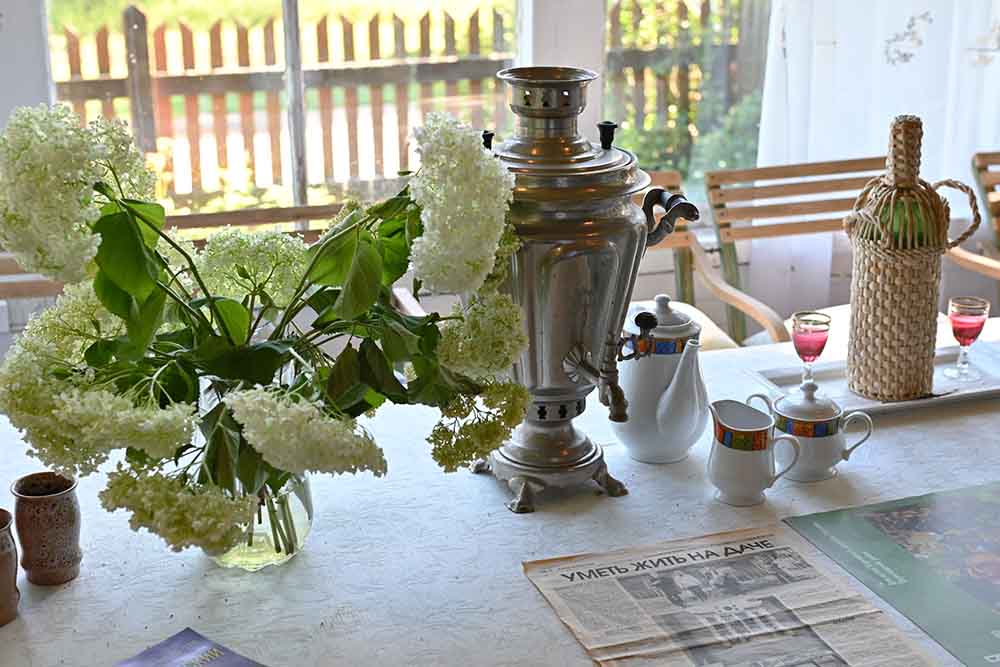
The furniture that belonged to the artist has not survived. The museum’s management is trying to furnish the house with early 20th-century furniture, though it is going rather slowly. “The paintings of the artist Sergei Vinogradov, who often came to Okhotino, helped us recreate the interior. In his paintings one can make out certain details: how the armrests of the armchairs curve, what the tablecloth was like, what kind of kerosene lamp hung from the ceiling,” says Yulia Seliverstova. “In Konstantin Korovin’s paintings we also, of course, see parts of the interior, but his works have fewer details and more emotion.”
Emotions, it seems, were what mattered most in Korovin’s life. They survive in his paintings, his stories, and his memories. And those memories kept drawing the artist’s friends back to Okhotino.
“I was seven years old, it was 1955, I was running up the hill and saw a stranger in a hat with a bouquet of flowers near our school,” recalls Vladimir Seliverstov. “She asked my name, and when she heard it, she stroked my head: ‘How are you, Vladimir?’ And I, a child, felt the sadness that came from her. The woman didn’t go into the house, stood there for about five minutes, and left. Later I learned that she was Chaliapin’s eldest daughter, Irina.”

Korovin’s house was dear to her too, as a memory of carefree times. Irina once visited the painter in Paris. “What I saw shocked me,” wrote the great singer’s daughter. “I could not imagine that one of our finest artists could live like that. A damp room, a bed in the corner behind a curtain, a few chairs.” In Paris, Korovin’s health deteriorated, and his eyesight began to fail him. It became increasingly difficult for him to hold a brush. And so he took up the pen: it turned out that Konstantin Korovin had a gift for writing. The emigrant journals eagerly published his stories and memoirs. “Winter; a grey sky, rain. And there, far away, in Russia, the snow lies thick… Is my wooden house by the great forest still standing? The snowdrifts have buried it up to the windows. The veranda is covered with snow. Frost on the windows. Is my fireplace lit? And my friends are not in my studio, and never will be again – they have all died. Are the beautiful birches still there, and my raspberry garden behind the fence? Do the wolves come to the rubbish heap at night, and does the thoughtful Fyoklin forest still sleep? Perhaps it has already been cut down. And Aunt Afrosinya is gone, and my hunter friends too,” wrote Korovin in the story A Dog’s Soul.
A few days before his death, Konstantin Korovin began painting a winter landscape in Okhotino, but did not manage to finish it. On 11 September 1939, on a street in Paris, the 77-year-old artist suffered a heart attack. He was taken to hospital, where he died. The Russian artist was buried in the West Cemetery in Boulogne-Billancourt (then known as Billancourt Cemetery).
In 1947, Korovin’s wife Anna Fiedler passed away, and their son was left alone. Although Alexei Korovin was making some progress in painting, he still could not earn a proper living. While his father was still alive, Alexei had married a ballerina, a Russian emigrant named Elizaveta Dumarevskaya, and was raising their son Alexei with her. But the marriage did not work out: taking the child, Elizaveta left her husband. In 1950, the 53-year-old Alexei Korovin committed suicide.
That same year, the Russian émigré community raised a substantial sum, thanks to which the remains of Konstantin Korovin and his wife were reburied in the Russian cemetery of Sainte-Geneviève-des-Bois – the same place where their son had been laid to rest.
Fortunately, the Korovin line did not die out. Alexei Gui Korovin, the artist’s grandson, born in 1928, lived a long life and died on 4 April 2026. He was a gendarmerie officer, and after retiring he took up painting. Sadly, he never made it to Okhotino, but until his last days he took a keen interest in the fate of the place. He is also buried in Sainte-Geneviève-des-Bois cemetery, next to his family. His two daughters and five grandchildren make up a large family of Konstantin Korovin’s descendants.
The life of the dacha in Okhotino continues as well. Every September, artists gather here for the “Art of Living at a Dacha” festival. This year, it will show the French film Moscow Nights (1934), one of whose screenwriters was Korovin.
So Konstantin Korovin can rest easy about his beloved Okhotino – a vibrant and interesting life goes on here to this day.
Translated by Grigory Litvinov.