 Ekaterina Zhiritskaya
 The noise in the hall died down, and then a short man in concert tails walked onto the stage. A neatly trimmed beard, curly hair tied back in a bun, an attentive gaze that seemed slightly surprised behind round glasses. He looked like a professor from some Florentine academy of arts, and it seemed odd that he should be here – in this modest hall, where the rows were filled only with plainly dressed women, girls, and children, with hardly a man in sight.
Photos by Alexander Bury.
The hall was filled with the anxious, mournful strains of the “Song of Donbas,” which Nicolas Cheloro had composed himself. For the first time he had seen the city where he was now performing in a completely different state – piles of rubble, blackened walls of fire-ravaged houses, gaping window frames, and the Azovstal plant torn apart by explosions. And so it was that a Frenchman by birth, an Italian by roots, a Russian at heart, and a citizen of Russia by passport – the composer Nicolas Cheloro – was performing his new piano cycle on the stage of the newly rebuilt Drama Theatre of Mariupol.
…We might have met Nicolas and his Russian wife, Ekaterina, on a bench by the Nativity Cathedral in Suzdal, where the Cheloros now live. But in this ancient Russian town, a favourite with tourists, another Cucumber Day was on the horizon, so we met instead in the concert hall of a Moscow art gallery. Nicolas had a performance there that day. It was a convenient opportunity to ask the graduate of the Paris Conservatoire and gold medallist of the Versailles Conservatoire why, after touring more than twenty countries, he chose Russia, preferred Suzdal to the French capital, and was not afraid to come to Donbas – trading concerts in Mariupol for the European tours now closed to him.
– Nicolas, what did you know about Russia before you came here?

– Since my youth, I have had a huge interest in Russia, especially in its history of the late 19th and early 20th centuries. It was a time that gave the world a multitude of great composers – Tchaikovsky, Borodin, Rachmaninoff. For me, two opposing intonations merged in Russian music: it was either very triumphant, or, on the contrary, its sadness was so deep that it turned your soul inside out. Often it combined both qualities, but whether triumphant or sorrowful, it was always incredibly beautiful. Take, for instance, Rachmaninoff’s concertos, which begin with the grief of a minor key and end with the triumph of light. Or Tchaikovsky’s Sixth Symphony – it is impossible to separate the energetic drive from the profound melancholy. Extreme emotions – that is what Russian music has always meant to me.
I remember how struck I was by the 2014 Sochi Winter Olympics. I watched the opening ceremony and was surprised by how much classical music was played there. At the London or Paris Olympics, there was no place for classical music, but in Sochi they performed Rachmaninoff and Tchaikovsky. At that moment I thought: “Why did the Russians choose complex academic music for a mass show?” And I decided that I would definitely go to Russia and see for myself a country that wanted to present itself to the world in precisely this way.
So, you could say that my first interest in Russia came about through classical music. But not only that. I was also drawn to the religious and mystical side of Russian society. I was extremely fascinated by the figure of the last Russian emperor. Nicholas II was for me a European monarch who possessed not merely decorative, but real power. This image cast a mystical aura over the whole country. After all, the tsar is the Lord’s Anointed, and if God had chosen this land for him, then there must be something sacred hidden in the land itself. It seemed to me that Russian society could not exist without an intense inner life of the soul.
That is why I was intensely curious about what today’s Russia lives by – whether it still has something that connects it to the past I held so dear, to its centuries-old roots.
Like most foreigners, I had my own stereotypes about your country. But unlike many, my main stereotype was not vodka and bears, but the fact that I had romanticised today’s Russia too much. I imagined it would still look in the twenty-first century as it had in the nineteenth. So, when I first arrived in Russia, I was in for a disappointment.
– Could you tell us more about your first visit?
– That stay in your country was accidental and brief. I was still very young then and serving in the navy. Our ship called at many foreign ports, one of which was Vladivostok. It was 1993. Like all young people, my friends and I would go to bars and discos. And I was shocked to see that Russian young people were dancing to American rock music, just like their peers in the West.
More than ten years passed, and my interest in Russia – unexpectedly rekindled by the Sochi Olympics – brought me back to your country, this time with a clear purpose. My friend and I spent two weeks in Russia, visiting the cities that tourists usually see first: Moscow and St Petersburg. But while I admired the magnificent architecture of the former imperial capital, I realised that this was not the whole of Russia. So, the following year I decided to travel along the Golden Ring of Russia.
The first city on my new route was Suzdal. I fell in love with it instantly. I was struck by how so many cathedrals could be concentrated in such a small space – I later learned: 51 churches and 5 monasteries on 15 square kilometres. Time seemed to have stopped here. I found myself not in the nineteenth century, but in the fifteenth. Suzdal turned out to be a place that had witnessed historical events five hundred years ago, yet continued to be a living city. There was something special about settling in the capital of historic Russia. Though I was disappointed that the sounds of my beloved balalaika were not coming from every house. Imagine my surprise – when I set off through the historic towns of the Russian provinces, I was convinced that everyone here played the balalaika and listened to “Ochi Chyornye” (Dark Eyes)! But I liked the city so much that I wanted to stay.
Besides, something important happened to me in Suzdal – I met my future wife there. Apart from history, what attracted me to Russia was the Orthodoxy practiced here. In Suzdal, I visited St Nicholas the Wonderworker Church. There I met a priest who painted icons. Although at that moment I spoke almost no Russian, somehow, we got into a conversation. And when he learned that I was a French musician, he mentioned that he knew a woman who worked with musicians, helping them organise concerts in Russia. Of course, I took his number and called her straight away. I said only one phrase to her: “I don’t speak Russian, as you’ve probably understood, and that’s all I can say to you in Russian right now.” But something in that naive and honest phrase struck a chord with her, and it was the start of our communication.
What helped me choose Russia for good was the pandemic. Because of it, I couldn’t leave the country when I was supposed to, I stayed longer than I had planned, and in the end, I stayed for good. We bought a small house in the forest. I learned to chop wood and to ski. And I also fell in love with the Russian winter!
– Foreigners usually complain about it.

– One of the things I like about Russia is the distinct change of seasons. In France, winter means plus 13 degrees Celsius – the only way you can tell it’s winter is by the fallen leaves. By Russian standards, though, that’s more like a rather cold summer.
In Russia all seasons are distinct. In winter, the whole world turns white. In summer – contrary to the stereotypes of Russia being a cold country – the heat can reach 30 degrees Celsius. In spring, every two weeks you get a new landscape. In autumn, everything is covered with golden leaves. I could not get enough of Russian nature. The forest, near which we lived at the time, felt far more natural and mysterious than in France, where it seemed more like a well-kept park. When you live near such a Russian forest, you feel more secluded and start thinking more about the meaning of life.
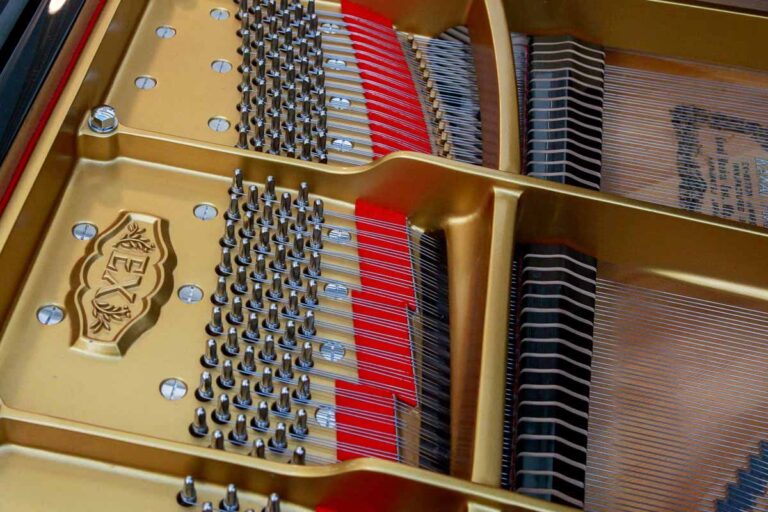
Later we moved to Suzdal, and I brought two grand pianos and thirty boxes of books from France. I compose music and I pray. Everyday hardships don’t get me down at all. On the contrary, they help me take a more philosophical view of life.
It seems to me that today Russia gives an artist more opportunities to find himself than the West does. In France, for instance, you can only count on support if you fit a certain type of culture – what they call contemporary art. In it, as I see it, the ultimate goal has been lost. Our life has an ultimate goal – the salvation of the soul, resurrection. But this horizon, it seems to me, has disappeared from contemporary art. It is like a person who uses a book as a pile of paper to light a fire. Of course, someone might find that this is all the use it has, and fail to see in it a treasure trove of other people’s feelings and thoughts. Yet that is precisely the ultimate purpose of that object. Contemporary art, unlike classical art, seems to erase the final goal of the artist – the ultimate purpose of human life.
And I get the impression that the countries of Europe have gone much further than Russia in this abandonment of life’s true purpose. Russia seems to have lagged somewhat in its movement towards modernity, but if you look more closely, you can see that it has deliberately paused to leave room for God.
If you go to a church in France, you will see that there are no icons, instead on the walls hang works of contemporary art I so dislike. You might want to attend the liturgy, but you will find it is just vaudeville. And what are we talking about when the church in France legalises same-sex relationships as if they were perfectly normal? Yet God created man and woman, and to claim otherwise is a kind of apostasy.
I see Russia as a place of salvation, a Noah’s Ark for people who simply want to have a normal family – a man and a woman – and raise children. In France, by contrast, strange people come to your child twice a week and ask them what they want to be – a boy or a girl. And that is frightening.
– Are you still interested in nineteenth-century Russia today?
– It’s not that I’m such a passionate admirer of the old days. It’s simply that in the music of nineteenth-century composers I see beauty, whereas in contemporary music it is much harder to find it. I don’t love the past for its own sake, but rather the energy it managed to create – the energy that allows us to grow inside, to reach higher. Mass culture, on the other hand, pulls us lower and lower. It is an ugly evolution. I love nineteenth-century Russia because the culture it created allowed to turn one’s gaze towards the heavens.
– You’ve been living in our country for almost six years now. Have you figured out the “mysterious Russian soul”?
– The Russian people are just as contradictory as their music. One moment they are full of enthusiasm, the next they are plunged into deep melancholy. Their emotions are extreme. And what helped me understand the Russian character, oddly enough, were the most ordinary everyday details. For example, if you ask for directions in Russia, people may drop what they are doing and walk you there – in France, no one would ever do that. Or take this incident. Once my wife and I were late for a train, our tickets weren’t valid for the next one, and we didn’t have time to exchange them. The trip was falling apart. When the ticket inspector realised this, she gave us a sympathetic look and said: “All right, I’ll let you through.” Incredible! In France, an inspector would never bend the rules just out of a human desire to help a stranger.
Another example. When I was already living in Russia, I needed to get a residence permit. I arrived at the office too late – it was literally about to close in a minute. Then suddenly one of the women working there opened the already locked door for me. “Why did you do that?” I asked her. It turned out she was waiting for a pizza delivery, and during that five-minute wait she agreed to take my documents, even though her working day was officially over. She too treated me as a human being, not by the letter of the regulations. These are the kinds of details that speak of humanity. I think people in Russia are more often capable of such actions. What particularly surprised me was that complete strangers would treat me this way. The soul is like electricity – current flows only when there is a conductor. It’s the same in human relations. Love for others can only be transmitted through a human soul; without it, there is nowhere for understanding or compassion to come from. I think this, along with strong emotions and contradictory feelings, are the main Russian qualities – the generosity of the soul.
I think that thanks to Orthodoxy, the Russian soul has preserved something mystical. There are not many civilisations on the planet that have managed to keep their core intact. Russia has managed to do it.
– Nicolas, after marrying a Russian woman, you could still have moved to France. Yet you chose to live in Russia.
– Both practical and creative reasons played a part. Paris is a beautiful city, and I still have many friends there, but for me today Russia is the best place to grow. I came to the conclusion that the cultural environment here is more interesting.
Yes, in France the fees are high, there is a well-developed system of support through foundations and producing. But for a composer who wants to write music in the classical tradition, there is almost no opportunity to promote it there. In Europe, there is a dictatorship of contemporary music – dissonance, experimental sounds, chaos. None of that is close to me. In Russia, on the other hand, I have had the opportunity to perform my works, and audiences receive them very warmly. Of course, the pay here is noticeably lower, but for self-fulfilment Russia suits me much better. My compositions are performed in philharmonic halls, and I am free to play my own music, guided only by my own taste.
– Why did you choose the cosy little town of Suzdal over a metropolis?
– Many foreigners want to move to the Russian provinces. They want to discover the real Russia, so they try to settle in towns steeped in Russian culture. Hence their choice – Suzdal, Plyos, Pereslavl-Zalessky. Here you can feel the true Russian roots.
This is very different from living in big cities with their uniform buildings. Once I was performing in Tolyatti, and one detail struck me. I wanted to visit one of the city’s cathedrals, but it was far from the centre. I took a taxi, and for half an hour we drove down a long avenue lined with identical buildings. I barely survived that ride – in such surroundings I feel unwell.
– Our countries are going through a rough patch at the moment. How is Russia viewed in France today? Have perceptions of it changed?

– Yes, there is a major crisis in Russian-French relations right now, and no one knows how it will end. Of course, I still have friends in France who love Russia. But the powerful media are at work, changing people’s mentality. When all the media in France keep repeating the same message, even normal, intelligent people start to absorb it. And there is a great deal of talk now about Russia as a “terrorist state.” It is very upsetting.
There’s one thing I don’t understand. Everyone keeps saying: “Russia violated borders.” But no one explains that borders exist to protect the people living within them. In Ukraine, people who wanted to live in peace with Russia were unsafe, because the Ukrainian state was bombing its own citizens. In that sense, the argument about the “inviolability of borders” does not hold. It’s manipulation. But no one talks about it.
– Were your concerts in Europe cancelled because you live in Russia?
– Yes. As soon as the organisers found out that I now live in Russia, they stopped inviting me to perform. Even though I was simply expressing my opinion freely, saying that I feel good here. But because of that, they no longer offer me to perform.
– Does this injustice offend you?
– It’s a war being transferred into the realm of culture. Why add a crisis where it can be avoided? Who does it benefit?
– The West has set a course to cancel Russian culture. Do you think this new Iron Curtain will backfire on the West itself?
– Yes, political decisions are certainly regrettable. I have already said it: declaring war in the realm of culture is a very bad thing. The West is making a mistake. Yes, in today’s world there is a very powerful media influence that changes people’s mentality, but Russian classical music tells us much about Russia. And it breaks through the blockade!
Translated by Grigory Litvinov.