 Arina Abrosimova
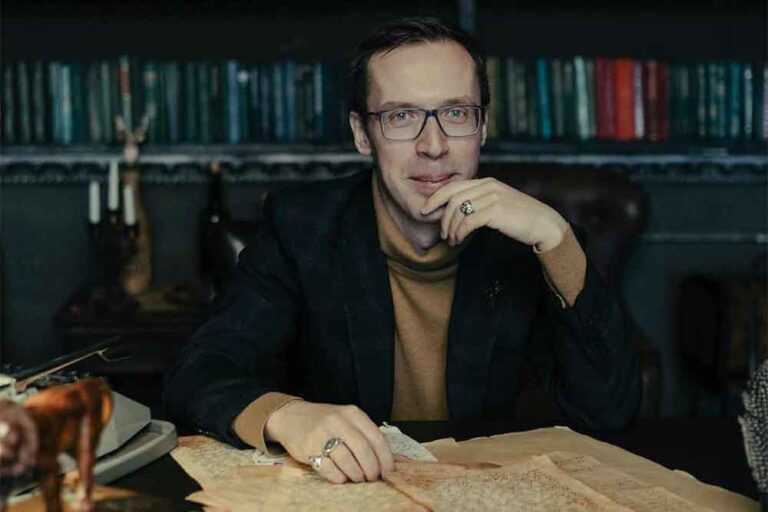
 What place do Slavic mythology and folklore occupy in art and popular culture? How does the modern world “repackage” fairy tales? Who are the Swan Princess and Baba Yaga, really? Russkiy Mir.ru spoke with Fyodor Panfilov – a PhD in History and author of the book Fantastical Rus – about this and much more.
Images courtesy of F. Panfilov
– Your own online project is called “Panfilov FM / Mass Culture Through a Historian’s Eyes.” So, if I understand correctly, you look at cultural developments from two angles – as a historian and as a philologist? Which matters more to you: historical accuracy or literary evolution?

– For the project’s name, I decided to have a little fun with the similarity between my initials – Fyodor Mikhailovich, F.M. – and the FM radio band. But it has nothing to do with radio – the project exists on online platforms, in the form of communities and channels. Let me stress: I’m a historian, a graduate of the Faculty of History at Moscow State University. I’ve never laid claim to being a philologist. Although in the past I even did poetic translations from Old French – for my degree thesis and my dissertation.
As for historical accuracy, in a work of fiction it’s always relative. Rather, it’s a matter of degree – how far something departs from what we know about the past. Of how successful the stylization is. Of how much it’s shaped by stereotypes, personal convictions, and the author’s creative method.
– Chronologically, the earliest records of Russian fairy tales date back to the twelfth century, when in Rus they were called basni or baiki – old terms simply meaning “tales,” and storytellers, bakhars. Why does your book begin its timeline in the eighteenth century?
– The book explores the presence of Slavic mythology and folklore in art and mass culture – which is often called a phenomenon of the 20th century. But I’d argue it actually took shape much earlier – specifically from the 18th century on, luboks – folk prints – were already everywhere across Russia, and popular collections of fairy tales and folk songs were coming out. And this phenomenon embraced a substantial part of society, not just the elite. What’s more, that’s when people in the Russian Empire first tried to make sense of Slavic paganism specifically as a mythological system. As people of the time saw it – comparable to the Greco-Roman system. And that’s also when quite a few armchair myths – that is, invented ones – were born. Many, incidentally, are still alive today. That’s why the timeline begins precisely in the 18th century, though the book, of course, couldn’t avoid touching on pre-Petrine Russia and the Middle Ages.
– Do fairy tales fall into mass or elite culture?
– Originally, fairy tales were part of folk culture. Of traditional culture. Both mass culture and elite culture absorb and reinterpret fairy tales, each in its own way. They borrow elements, plots, and images. Except that the Russian elite mostly ignored folk culture for a long time. Or looked down on it – with condescension, with contempt. With rare exceptions, like Adam Olsufyev (1721–1784; a cabinet minister and state secretary to Catherine II, a collector, patron of the arts, and lover of literature — Ed.), who put together a remarkable collection of luboks. This is where Catherine the Great played a considerable role – a German woman on the Russian throne who devoted immense attention to Russian national culture. In many ways she was reinventing Russian identity – the way she herself imagined it. However, even in the early nineteenth century, a fair amount of prejudice against folk culture persisted – even when it came in stylized form. It took high society a long time to get used to these new images and themes. Pushkin’s poem Ruslan and Lyudmila, for example, was criticized for its low genre and common style.
– In the mid-twentieth century, the noted philologist and folklorist Vladimir Anikin observed, in an article for the collection Fairy Tales by Russian Writers, that in the 1830s, Pushkin was the first to see fairy tales not as a low genre, but as a powerful layer of national culture, full of profound meaning, poetry, and philosophy. But for today’s young readers, Pushkin’s fairy tales are, nonetheless, a challenge: the humor is elusive, and not only the words but also the moral are hard to grasp…
– In my view, Pushkin still reads better than other nineteenth century authors. Yes, some meanings may slip away, and some details remain unclear without commentary and explanation. But Pushkin’s uniqueness lies in the lightness of his style, his gift for creating worlds that never grow old. Although the poet was building his own fairy-tale universe, inventing a great deal that was new, he also drew on both folklore and the works of Western Romantics. For example, in Pushkin’s work, the Swan Princess becomes a positive character. And this image has been making its way from one version of fairy-tale to another for two centuries now. Though, actually, in Russian tradition the White Swan is often a cunning sorceress, a shapeshifter. Pushkin’s works have not dated – they shape how Russian fairy tales are perceived today.
– Pushkin integrates the folk fairy tale into high literature, presenting the fantastical as poetic fiction. Gogol writes as if through the prism of the folk consciousness, where the world is seen through mythology: this is not invention, not allegory, but reality itself, even ontology. What role did these different approaches play in shaping fantastical Rus, and is there a dilemma here – the cultivated Pushkin versus the elemental Gogol?
– There is no dilemma here. All of this is simply different facets of Russian Romanticism – of the Romantic perception of folklore. Pushkin’s work shaped a lighter, fairy‑tale version of Rus. Gogol, together with authors like Orest Somov, laid the foundation for a vivid but darker version – Russian Gothic. And Gogol’s terrifying stories, like Somov’s tales, are not really fairy tales at all; they are closer to bylichki – folk narratives about encounters with the supernatural, told as true stories. Unlike fairy tales, bylichki are grounded in an assumption of authenticity and the reality of events. Pushkin, incidentally, was also drawn to such plots. For example, he conceived a story called The Demon in Love. Its idea was borrowed by his contemporary Vladimir Titov, who published the tale The Lonely House on Vasilyevsky Island under the pseudonym Tit Kosmokratov.
– Catherine II wrote The Tale of Tsarevich Chlor for her grandson, the future Emperor Alexander I, as an educational tool. In your book, you trace the transformation of the “gallant knights” in eighteenth‑century luboks into the comic trio of bogatyrs in the animated franchise. Do you think there is a demand today for a “serious” bogatyr, or has this heroic image gone the way of parody?
– You know, there is hardly anything Russian in the tale of Chlor at all. Well, apart from the mention of Russia and Knyaz Kiy at the very beginning. It’s simply a moralizing story, typical of European classicism. There is far more Russian flavour in the opera‑fairy tale Archideich the Brave and Daring Knight – there Catherine II really does use various fairy‑tale characters like Baba Yaga and forest spirits. Yes, the empress regarded fairy tales as an instrument of upbringing, as didactic works. This idea would largely carry over into the following century, when children’s literature as such began to develop. And the demand for stern, heroic bogatyrs, it seems to me, has not disappeared. It is simply that big‑budget animation and cinematic fairy tales are geared toward family viewing. There are both commercial and censorship reasons for this. A gingerbread‑and‑honey, deliberately good‑natured bogatyr Rus is more profitable, safer. But I think that more formidable and dramatic images of bogatyrs may emerge in comics, video games, and independent cinema – where the budgets are more modest.
– In the fairy tale, a system of values is established: good triumphs over evil, justice is restored, modesty is rewarded, greed and pride are punished, and the positive hero inevitably becomes the victor. But today, in many stories, the emphasis is shifting – villains are being justified, heroes have become morally ambiguous… When society’s ideas about right and wrong change, are we still talking of fairy tales, or is something different?

– The modern system of values has been established relatively recently, and primarily through the literary adaptations and retellings of fairy tales from the nineteenth and twentieth centuries. One may love and respect the fairy tales of pre‑revolutionary and Soviet authors, and their take on Russian folklore. They are often wonderful and have influenced entire generations. But we should not attribute to folklore traits that were not defining for it, nor treat literary works as age‑old wisdom. Our distant ancestors turned to myths as a way of understanding the world. Myths explained why everything was arranged the way it was. Fairy tales, on the other hand, were primarily entertainment – although they could also convey some mythological ideas. And they did not always align with the Christian value system. Or, shall we say, they combined with it in a rather curious way.
In fact, tricksters are quite popular in folklore – rogues who triumph over their enemies not through kindness, purity of soul, or moral qualities, but through cunning, wit, and deceit. These are very ancient figures, rooted in archaic notions of the hero. In traditional culture, no one was troubled by this. It did, however, outrage the censors of the nineteenth century. I would say that today, on the contrary, folklore characters are being made more dull and stereotypical. Take Baba Yaga in the fairy tales – she is complex, ambivalent: both a terrifying threat and a helper to the hero. In cinematic fairy tales, she has been turned into almost a comic figure.
The good that triumphs over evil in fairy tales can be quite ruthless by today’s standards. Take, for example, Ivan Tsarevich in the tale Zverinoye Moloko (The Milk of the Beast) – he leaves his sister, Yelena the Beautiful, naked to die from insect bites. True, she had tried to kill him. But a modern person would hardly see such behaviour on the part of a brother as that of a good character. The same goes for the byliny: how are we to regard a bogatyr who tears his sorceress wife apart with horses? And why is Alyosha Popovich, in a number of byliny, cunning, boastful, seducing another man’s wife and encroaching on a maiden’s honour? So a modern person, as you said, may indeed have a different notion of what a fairy tale is.
– In the history of the Russian literary fairy tale, several stages are usually distinguished. The collecting period – Chulkov, Levshin in the eighteenth century. The early Romantic engagement with folklore – Zhukovsky, Pushkin, Gogol. The emergence of the satirical fairy tale in the second half of the nineteenth century – Saltykov‑Shchedrin, Leskov. The turn of the nineteenth and twentieth centuries, with its Neo‑Romanticism and Modernism – Gorky, Remizov, Sologub. The Soviet era – Alexei Tolstoy, Korney Chukovsky, and others… Which of these stages, in your view, introduced the fundamental contradiction, created a painful rupture in the Russian fairy‑tale?
– First of all, let’s be clear: Fantastical Rus and the fairy tales written by Russian authors are not the same thing. Literary fairy tales often have no connection whatsoever to Russian folklore or Slavic myths. But I don’t see any particularly painful rupture anywhere. It’s simply that different eras made sense of folklore in different ways. And all these periods are valuable in their own right. When it comes to shaping our perception of Fantastical Rus, pride of place belongs to the literature of the Romantic era and to Soviet cinematic fairy tales. And I mention cinema not by accident, even though your question concerns literature. Soviet fairy‑tale films were often made from plays and film scripts by Soviet writers, rather than being adaptations of folklore itself. The fine arts have their own story, and perhaps a more complex one than the literary tradition. Take, for example, Viktor Vasnetsov’s fairy‑tale paintings: the public initially received them coolly. They were criticized, met with incomprehension – unlike the genre scenes and social subjects with which Vasnetsov had begun his career. It is interesting that Alexander Benois, who did not hold Vasnetsov in high regard as an artist, nevertheless acknowledged his merits, calling him a rare storyteller amid the suffocating realism of Russian art in the second half of the nineteenth century. And as a man who managed to change the haughty, contemptuous attitude toward the “Byzantine‑Horde” art of pre‑Petrine Rus.
– Slavic mythology and the Russian fairy tale long existed under censorship – both state and cultural. Did this affect the development of the genre?
– It did, partly because some texts continue to be published in older editions – that is, editions that have passed through censorship and undergone heavy literary editing. On the other hand, many fairy tales, without such editing or censorship, could simply shock the modern reader and leave them completely baffled… In general, traditional folk culture had its own notions of what was acceptable and proper. And fairy tales as a genre were not seen as something intended exclusively for children.
Rather, the problem lies in just how distorted the perception of Russian folklore and mythology has become. They are now viewed through multiple filters: a curious blend of armchair myths and scholarly fantasies from various periods, literary adaptations, Pushkin’s fairy tales, Vasnetsov’s paintings, Bilibin’s illustrations, cinematic fairy tales… This entire mosaic is often mistaken for the authentic Fantastical Rus. For a canon supposedly established by our ancestors. But no such canon actually exists. It is an illusory construct. For centuries, folklore and the fragments of mythological beliefs have been treated creatively – and very freely. And it is precisely this multi‑layered, complex, vivid Fantastical Rus that I examine in my book – the history of its perception and creative reinterpretation.
– What was the most important thing Fantastical Rus lost – and when did it happen?
– Perhaps the events of 1917 marked a kind of rupture in the line of development of Fantastical Rus that had continued throughout the nineteenth century. Much was forced out of the new reality of Soviet Russia and preserved in emigrant journals. At first, the Soviet authorities were generally wary of traditional culture, viewing it as backward, a relic of feudalism. They demanded exclusively new folklore – preferably proletarian. Later, the bogatyrs and Vasilisa the Wise would be rehabilitated, made into folk heroes – all thanks to a speech by Maxim Gorky. But the drive to create new Soviet folklore persisted for some time and even led to the emergence of a variant of the byliny, the traditional Russian epic songs – the noviny (“new songs”), in which the bogatyrs became Lenin and Stalin. I also write about this; it is an interesting page in the history of Fantastical Rus…
Still, I would not say the losses are irreparable. During the Soviet period, the field of folkloristics developed, numerous collections of fairy tales and byliny were published, and cinematic fairy tales were made. Ivan Bilibin returned from emigration – he could not work away from Russia. He died tragically during the siege of Leningrad, having refused to be evacuated. But before the war, he worked and taught in peace. This was, of course, a separate period in the history of Fantastical Rus, in many ways different from the pre‑revolutionary one.
– One of the most contentious questions in folkloristics is that of borrowings. On the one hand, plots have migrated between cultures for millennia; on the other, the similarity of plots is explained by universal archetypes and psychological patterns. What sets Fantastical Rus apart?
– Borrowing plots is a perfectly normal phenomenon. Over the past centuries, different cultural and ethnic communities have constantly interacted with and influenced one another. This process continues today. Across the vast territories inhabited by Russian people, folklore has become considerably more diverse over the centuries, while still retaining a number of common features. A certain distinctiveness can manifest itself at the level of regions, ethnic groups, even individual villages. Fantastical Rus, which my book explores, is only partly connected to folklore and traditional culture: for over three centuries, it has not existed in isolation or preservation, but has been created by writers, artists, and filmmakers. Thus, the Russian Romantics – inspired by German poets – successfully turned to their own roots and Slavic traditions. And the distinctive trait of Fantastical Rus, one inherent to Russian culture as a whole, is its ability to creatively transform borrowed material, to reshape it, and make it truly its own.
– Adherents of Eurasianism view Russia as a melting pot that processes European, Asian, and Slavic elements into something fundamentally new. The idea of Russia’s special path is often invoked. To what extent is the Eurasian paradigm applicable to Fantastical Rus, when for the Westernizers it is a backward province of Europe, for the Slavophiles it is a pure source of strength, and for the Eurasianist it is a complex amalgam of disparate components?
– Honestly, I wish Russian people would stop fitting themselves into some kind of system. There’s no need to slot our culture into any predetermined pigeonhole. Both the “European path” and some imagined “East” are conditional, shaky constructs. They lead to generalizations and stereotypes. And the urge to glue them into some third, alternative entity only leads to the creation of constructs no less fantastical.
If we move away from sweeping generalizations, both the West and the East are many‑faced and cannot be reduced to global templates. They abound in cultural differences, diverse philosophical and religious systems. Incidentally, history shows that attempts to force the whole world into a single Procrustean bed, to remake it according to a single pattern, have failed to eradicate this diversity.
In my view, we first need to learn to love ourselves, to value and respect our own culture. Of course, without going to extremes – without belittling it, but also without mythologizing it. And with a sense of self‑worth and self‑sufficiency, external recognition will surely follow. At least, since the end of the nineteenth century, interest in Russian culture has been evident abroad. We simply don’t need to play by someone else’s rules. And there is no longer any need for us to fit ourselves into the outdated framework of the “West – East” coordinate system…
Translated by Grigory Litvinov