 Lada Klokova
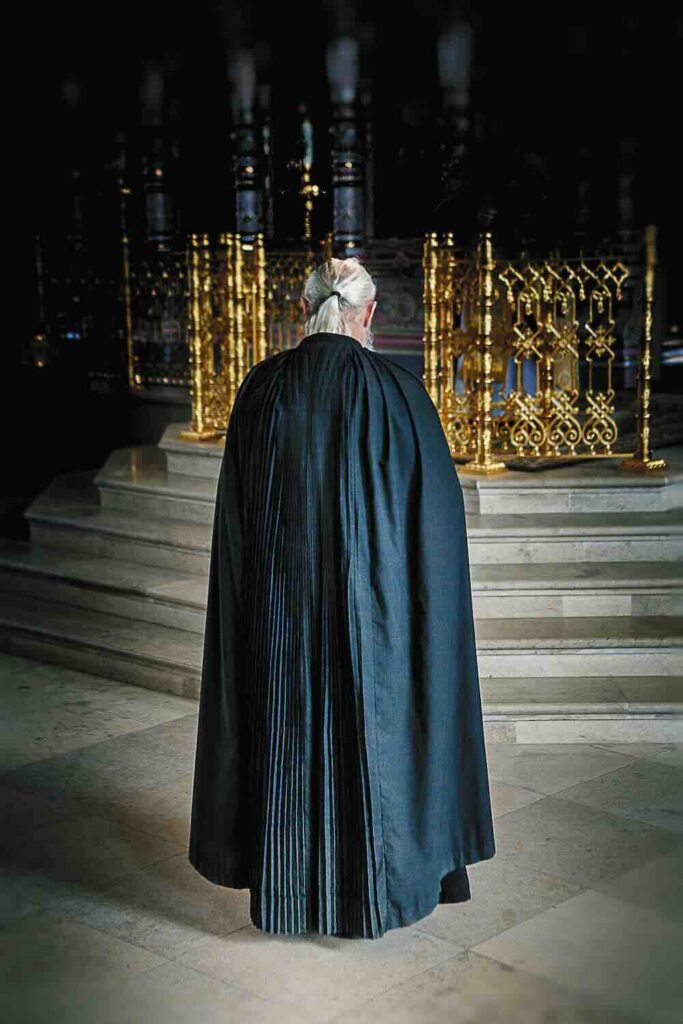
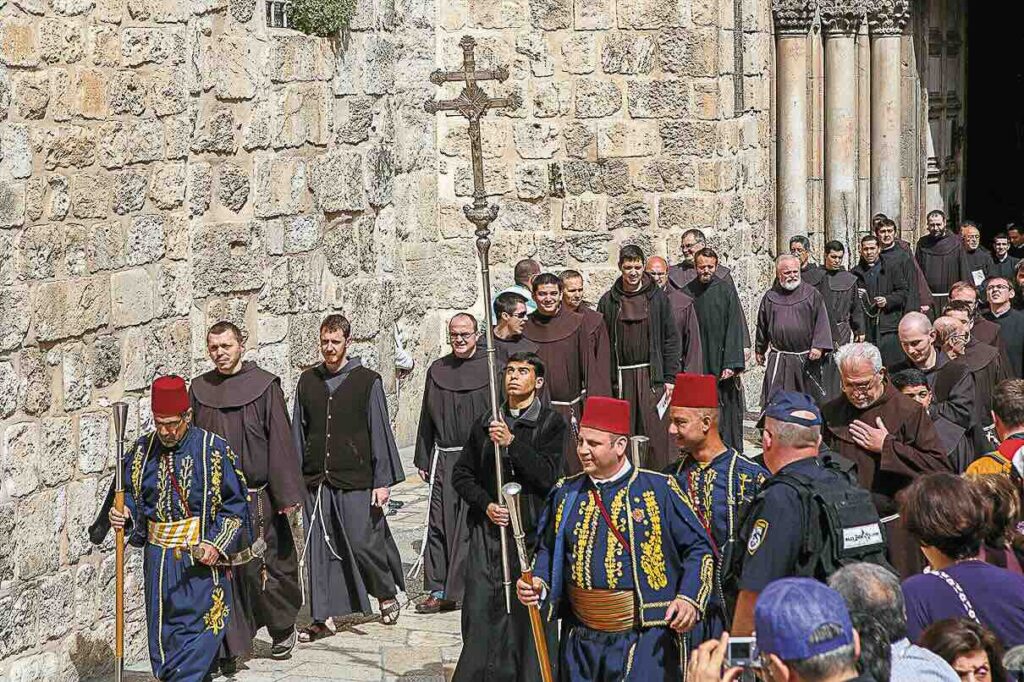
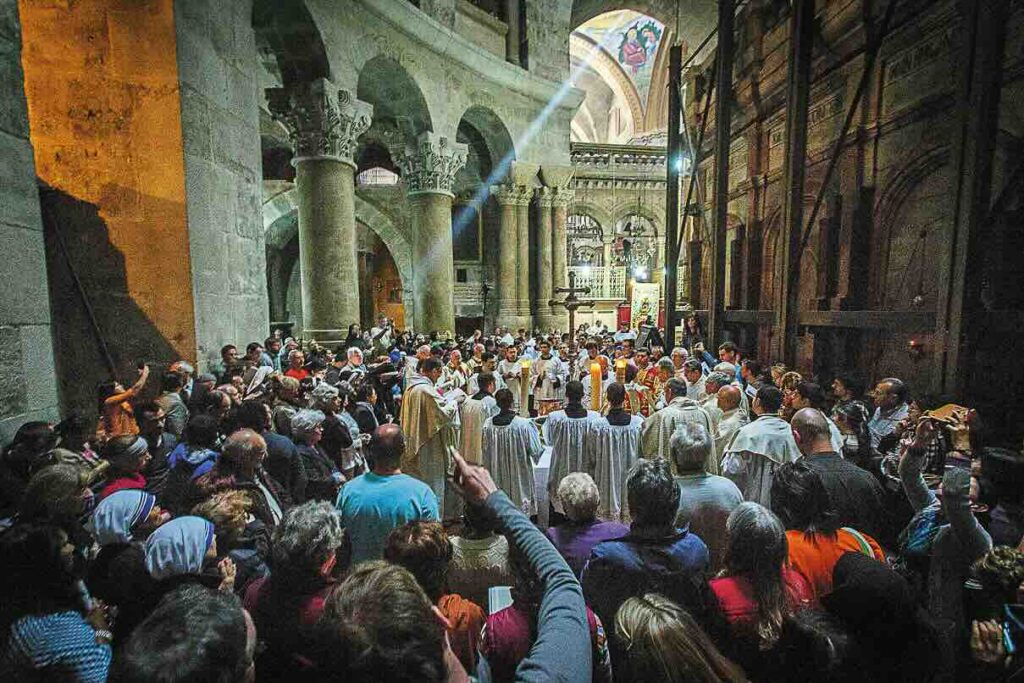
The sun is at its zenith. Beneath its merciless rays, the walls of the Old City of Jerusalem appear white and deceptively fragile. The shadows, which never offered much relief from the heat even before, vanish entirely. Yet the heat cannot overcome the pilgrims — two human streams flow ceaselessly towards each other: one pouring through the gates of the Church of the Holy Sepulchre, the other flowing out of them.
The steps of the staircase leading to the square before the church have been worn smooth over the centuries by millions of feet. Nine hundred years ago, a man named Daniel – “the abbot of the Russian land” – walked upon them. He was not the first Russian pilgrim in Jerusalem, but he became the first Russian traveller to write a pilgrim’s guide to the Holy Land. At the time, in Rus, such books were called khozhenie (a journey account); in the West, they were known as an “itinerary”.
Later, many more accounts of pilgrimages to the holy places would appear in Russian literature; by the eighteenth century, no fewer than fifty such works had been written. The most popular of them would become the Khozhenie of Trifon Korobeinikov, who travelled in the sixteenth century; it survives in several hundred copies. But the Khozhenie of Abbot Daniel was also held in high regard: from the early twelfth century to our own day, about 150 copies of it have been preserved!
We know almost nothing about Abbot Daniel: like all ancient Russian writers, he was excessively modest, revealing to readers only his name and rank. To this day, scholars debate the identity of the abbot and whether his journey to the Holy Land was simply a pilgrimage, or whether he also carried out diplomatic assignments for the rulers of Rus.
A Thorny Road

Today you can fly from Moscow to Tel Aviv in four hours. Another hour and a half by bus along the highway, and you’re in Jerusalem. Taxis, guides, the internet, hotels, cafés, bottles of water in shops on every corner… For us, accustomed to modern comforts, it is hard to imagine what it was like for people to travel in the twelfth century. Hard to imagine, but possible to learn, thanks to the surviving itineraries and khozhenie texts.
“An untold number of human bodies, torn to pieces by wild beasts, lie on the road and beside it… Not only the poor and weak perish, but even the rich and strong: many are killed by Saracens, many die from the heat and thirst, many from lack of water, many from drinking too much” – thus describes the route from Jaffa to Jerusalem in his Travels in the Holy Land the Anglo-Saxon Saewulf, who, like Daniel, made a pilgrimage at the beginning of the twelfth century. But here is what the Russian abbot reports about the road from Jerusalem to the Jordan: “The way is most arduous, dreadful and waterless: the mountains are high and rocky, and there is much banditry on the roads. … Many people choke from the heat and die of thirst.”

In both Rus and Europe, pilgrims were considered immune from secular jurisdiction; during their pilgrimage, their property and families were placed under the protection of the Church, and all Christians were to show hospitality towards them. Yet none of this could save the “wandering pilgrims” from attacks by bandits and Saracens, shipwrecks, disease, famine, or the scorching heat…
In both Rus and Europe, pilgrims were recognised by their appearance. A European pilgrim was distinguished by peram et baculum – a pouch and a staff. From the ninth century, the hats and cloaks of European pilgrims began to be adorned with scallop shells, which the travellers used as spoons. Although medieval guides recommended making the pilgrimage barefoot, pilgrims did not always follow this advice. More often they wore caligae – a simple type of sandal. This unassuming footwear would strike us as extremely uncomfortable: instead of a sole, a scrap of rough leather, strapped at the ankle.

In Rus, pilgrims were called kaliki perekhozhiye (wandering pilgrims). The word kalika may have come either from the caligae themselves, or from the Italian calico (meaning “poor”). The kaliki perekhozhiye were distinguished by their shabby clothing and the pilgrim’s staff. And they did carry a pouch – otherwise how could they have brought their meagre belongings and humble food supplies: rusks, dried fruit and mushrooms, salted fish? However, Vladimir Dal’s Explanatory Dictionary adds that kalika also means a wandering bogatyr (hero). Indeed, Russian byliny (epic poems) describe the pilgrim‑warriors quite differently: they are not beggarly cripples, but “fine young men” in expensive furs and in shoes trimmed with “silks of seven colours.”; their knapsacks are of velvet, and their staffs are richly adorned with “fish tooth” (i.e., walrus tusk).
At first, pilgrimage was considered a “blessed solitude”. However, people soon realised that it was better not to travel alone on such a dangerous journey – that way, they had a better chance of survival. So they set off in groups, walking along the roads, begging for alms and chanting psalms. But after 638, when the Byzantine garrison of Jerusalem, having endured a four‑month siege, surrendered to the Arab caliph Umar ibn al‑Khattab, pilgrims began to hire armed escorts: travel to the Holy Land, now conquered by the Muslims, had become dangerous.
The situation regarding the safety of pilgrims did not improve even after the Crusades began – and it was at that very time that Abbot Daniel set out for the Holy Land.
A Monk of Chernigov

“I, unworthy Abbot Daniel, the worst of all monks, wretched, laden with many sins, … wished to see the holy city of Jerusalem and the Promised Land.” Thus begins the Life and Pilgrimage of Abbot Daniel from the Russian Land.
It is believed that Daniel was most likely a cleric of the Chernigov diocese. In his Khozhenie, he compares the River Jordan to the River Snov near Chernigov four times: “In every way the Jordan resembles the river Snov. In width, and depth, and winding course, and swiftness – in every way it is like the river Snov. … The width of the Jordan is the same as that of the river Snov at its mouth. … the riverside plain also resembles the river Snov.” Daniel was probably the abbot of one of the three monasteries that existed in Chernigov at the time: the Eletsky Uspensky Monastery, the Ilyinsky Monastery, or the Spaso‑Preobrazhensky Monastery.
Earlier it was believed that Daniel made his pilgrimage in 1113–1115; later scholars moved the date to 1106–1108. Today, researchers date the journey of the Russian monk to 1104–1106. And perhaps it is now time to take a closer look at the theory put forward by academician Boris Rybakov, who considered Daniel the author of two other works: The Treatise on Idols and The Tale of the Campaign against Sharukan. Rybakov believed that Abbot Daniel and the Russian epic hero‑pilgrim Danilo Ignatyevich might have been the same person. The boyar Danilo Ignatyevich, according to the theory, asked the prince of Kiev for permission to become a monk; and on his way back from the Holy Land, he found his son wounded on a battlefield – the son had taken part in the battle against the Polovtsians on the Sula River in 1107.

What else can be said about Daniel? He knew Greek, had a lively imagination, and was a keen observer. Judging by his Khozhenie, he was physically resilient and strong: he endured long walks on foot, climbed rocks, dived to the bottom of the Jordan River to measure its depth, and measured distances in a manner unusual for a monk – for example, “from the Church of the Resurrection to the Holy of Holies is a little over two bowshots,” or “the distance between the monuments is two stone’s throws.” Nor does he resemble an ordinary black‑robed monk, considering that he had no shortage of money; he was accompanied by a retinue of men from Kiev and Novgorod, “and many others”; and in Jerusalem he twice had an audience with King Baldwin I. Is this something one would expect of an ordinary pilgrim‑monk?
In the Promised Land

Daniel begins his account of the route to Jerusalem from Constantinople. The group he led most likely travelled along the route familiar at the time – the one “from the Varangians to the Greeks.” Daniel either did not stay long in Constantinople, or chose not to mention it in his book. However, he devotes a separate chapter to the city of Ephesus, noting that it is here that the tomb of Saint John the Evangelist is located, along with the cave of the Seven Sleepers, and that the remains of Mary Magdalene are also preserved there. Further along the way, the abbot visits the islands of Chios, Samos, Patmos, Rhodes and Cyprus, where he was struck by the Cypress Cross: “It is fixed to the ground by nothing at all, but is held in the air by the Holy Spirit alone.”
At last Daniel reaches Jaffa – the traditional staging point for pilgrims, from which the journey through the Holy Land began. From there, the first leg: “ten versts [about 10.5 km] to the church of Saint George. … There is plenty of water here. By this water the pilgrims rest, but with fear: the place is deserted, near the city of Ascalon, from where the Saracens raid and kill travellers on the roads…”

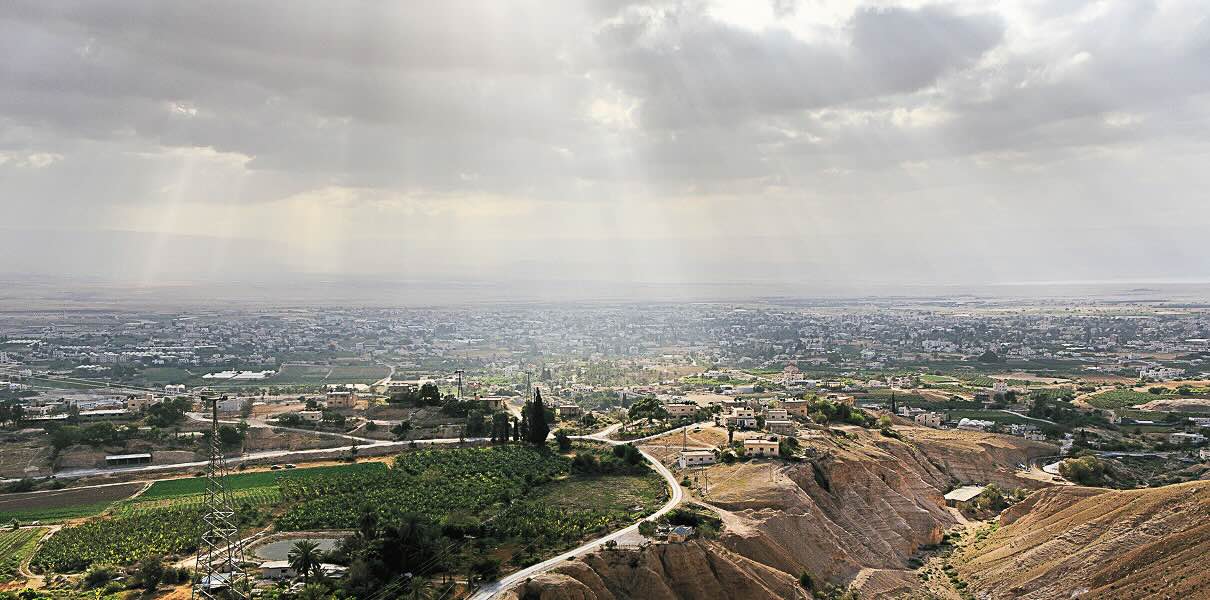
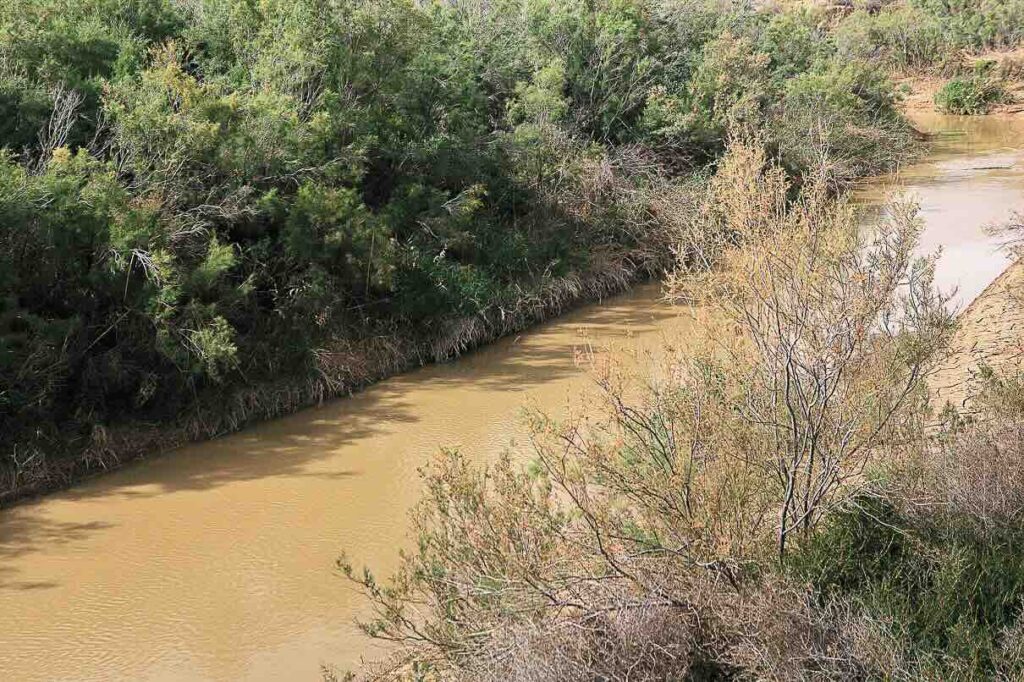
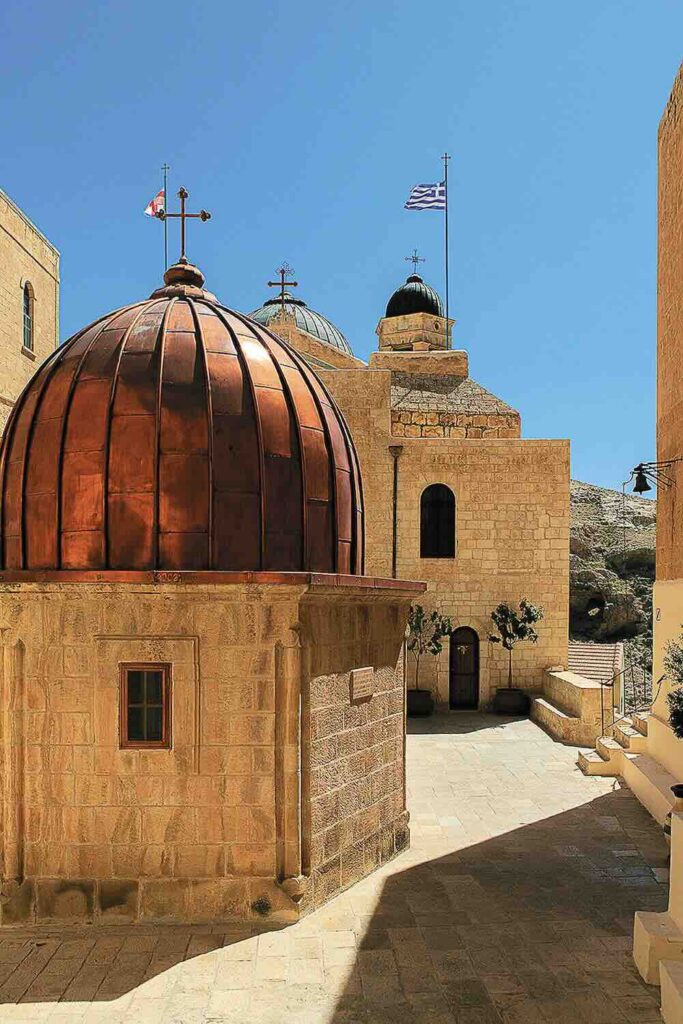
And so Daniel is already in Jerusalem. Here he stays at the Lavra of Saint Sabbas the Sanctified, where he lives for sixteen months and finds “a holy man, elderly and very learned, well‑educated”, who becomes his guide. The abbot describes in detail everything he sees in Jerusalem, Bethlehem, Nazareth, Jericho, Hebron, Acre and other cities; he vividly portrays the River Jordan, noting that “in the thickets there are many wild beasts: a great number of wild boars, many leopards, and even lions.”
One can only marvel at Daniel’s tirelessness: he visited every possible place, prayed at practically all the holy sites, and measured the length and width of the Holy Sepulchre in order to take these measurements back to Rus. Moreover, as Daniel writes, “God and the Holy Sepulchre are my witnesses that in every place I never forgot the rulers of Rus and their families, the abbots, the boyars, and my spiritual children, and all Christians. But in every place, I commemorated them…” And all the while, he never stopped describing everything that happened to him.
The Banner of the Cross
The events that unfolded in West Asia at the turn of the twelfth century threatened to reshape the political landscape of both East and West. The bloody struggle that the Byzantine Empire had been waging against the Arabs and Seljuk Turks for five centuries; the Great Schism of 1054 between the Eastern and Western Churches; the weakening of the Constantinopolitan throne; the ambitions of the Roman popes, who dreamed of uniting all of Christendom under their authority – all of this ultimately resulted in the age of the Crusades.
For centuries, Rus had close ties with Byzantium. And it was not only a matter of shared faith, dynastic marriages between the rulers of Rus and Byzantine princesses, and lively trade. Many Byzantine emperors readily employed Rus troops in their wars, and some of them even had Rus warriors serving in their personal guard.
The 11th century also saw a strengthening of Rus’s ties with European countries. It is enough to recall that Knyaz Yaroslav the Wise married his daughters to the kings of Norway, Hungary and France. The popes of Rome began to establish contacts with the rulers of Rus – they corresponded and sent embassies. It should be noted, however, that the Russian metropolitans – usually Greeks sent from Constantinople – strongly disapproved of this and threatened the rulers with excommunication.
Rus stood apart from the Crusades: on the one hand, it was torn apart by internal conflicts among the knyazes and raids by steppe nomads; on the other, it was simply too difficult to navigate the political intricacies of Byzantium and Rome. The First Crusade (1095–1099) began as a joint war between the Byzantines and the Europeans for the liberation of the Holy Land, but it soon became clear that each side pursued its own interests. The Byzantine emperor Alexios I Komnenos regarded the war as a means of recovering territories conquered by the Muslims, while Pope Urban II, who blessed the crusaders, and the leaders of the campaign hoped to establish new Catholic states in the Holy Land.
There were several leaders: Godfrey of Bouillon, Duke of Lower Lorraine; Robert, Duke of Normandy; Counts Raymond of Toulouse, Stephen of Blois, and Robert of Flanders; and finally, Hugh the Great, Count of Vermandois and Valois, the younger brother of King Philip I of France. It is worth noting that both Philip and Hugh were cousins of Knyaz Sviatopolk Iziaslavich, who at the time occupied the Kievan throne – their mother was Anna Yaroslavna, Queen of France, daughter of Yaroslav the Wise.
Putting the cities of the Holy Land to fire and sword, the crusaders took Jerusalem in 1099. According to the chroniclers, after the slaughter they carried out in the city, blood flowed through the streets and in some places rose “to the knees of the horsemen and the bridles of their horses.” Afterwards, having dressed themselves in sackcloth, the crusaders entered the Church of the Resurrection, weeping and wailing as they went, to prostrate themselves before Golgotha and the Holy Sepulchre. The first ruler of the new Kingdom of Jerusalem was Godfrey of Bouillon. He refused to call himself king in the city where Christ had suffered, and took the title Advocatus Sancti Sepulchri – “Defender of the Holy Sepulchre.” When he died in 1100, his successor was his own brother, Baldwin, Count of Edessa. He was less troubled by such concerns and immediately took the title of King Baldwin I of Jerusalem.
A Pilgrim with a Mission?
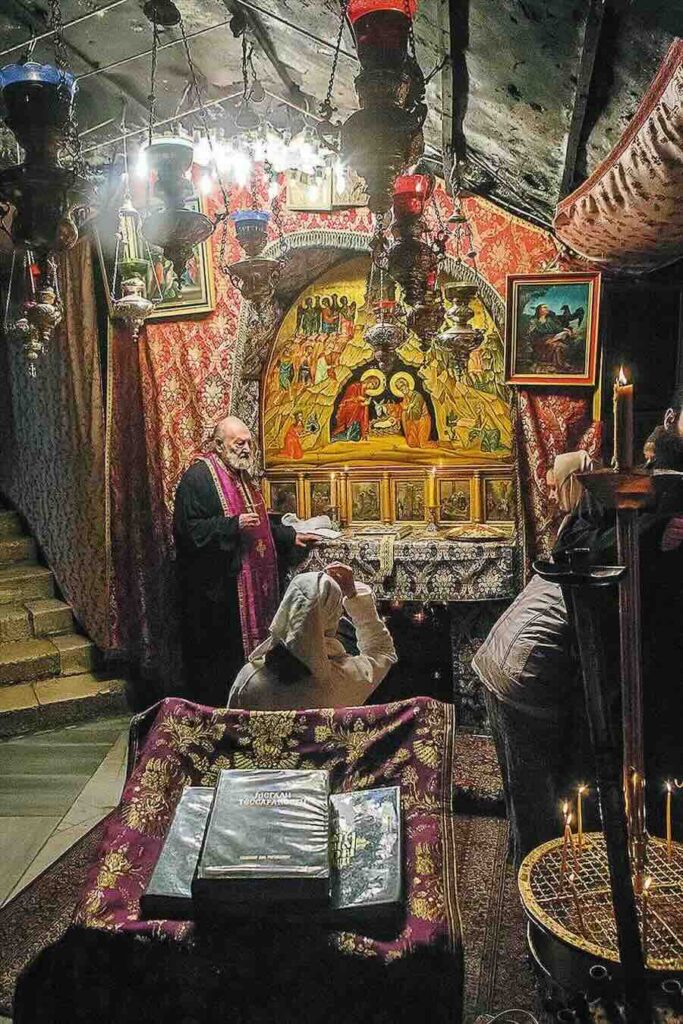
In Rus, the news of the Crusaders’ capture of Jerusalem was greeted with joy. So it may well be no coincidence that Abbot Daniel set out on his journey immediately after the Crusaders’ authority was established in the holy city. If it were not for the strange attention paid to the Russian abbot by the King of Jerusalem, one could have no doubt that Daniel was an ordinary pilgrim. Moreover, it is not only Baldwin who extends his protection to him. Daniel travels to Bethlehem under Saracen escort: “The Saracen elder himself, armed, led us almost to Bethlehem, and through all those fearsome places he likewise led us. … And we reached the city of Bethlehem alive and well, and there we bowed before the place of Christ’s Nativity…” Does not such strange care on the part of both the Crusaders and the Saracens for Russian pilgrims seem remarkable?
Daniel twice had an audience with Baldwin I. Moreover, the king showed the Russian abbot extraordinary signs of favour. On Good Friday, “at one o’clock in the day I went to King Baldwin and bowed to the ground before him. He, seeing me, a wretched man, called me to him lovingly and asked: ‘What do you wish, Russian abbot?’ … I said to him: ‘My lord, I beg you, for the sake of God and the Russian knyazes, to allow me to place my censer at the Holy Sepulchre on behalf of all the Russian land.’ Then he graciously and lovingly allowed me to place the censer at the Holy Sepulchre…” To clarify the situation, let us add that when the crusaders captured Jerusalem, they were perplexed to find Orthodox Greeks in the Church of the Holy Sepulchre, since they had been certain that it was in Muslim hands and that there were no Christians there. In the end, however, they anathematised the Orthodox clergy and drove them out of the church. So the permission to place a censer, granted to Abbot Daniel, appears to be a very gracious concession.
On Holy Saturday, Abbot Daniel is at the square before the Church of the Holy Sepulchre from early morning, where “a multitude of people from all ends of the earth gathers on this day.” “And when the seventh hour of the day arrived on that Saturday, King Baldwin went with his troops to the Holy Sepulchre… The king sent word to the guesthouse of the Lavra of Saint Sabbas and summoned the abbot and the monks, and they went to the Holy Sepulchre, and I, the wretched one, went with them. We came to the king and bowed to him. Then he also bowed to the abbot and to all the monks, and ordered the abbot of the Lavra of Saint Sabbas and me, the wretched one, to walk near him … We passed to the eastern doors of the Holy Sepulchre; the king went ahead and stood in his place, on the right side, by the enclosure of the great altar… There was the king’s place, built on a raised platform. … As for me, the wretched one, he ordered me to be placed high above the very doors of the Sepulchre, opposite the great altar, so that I could see through the doors of the Sepulchre.”
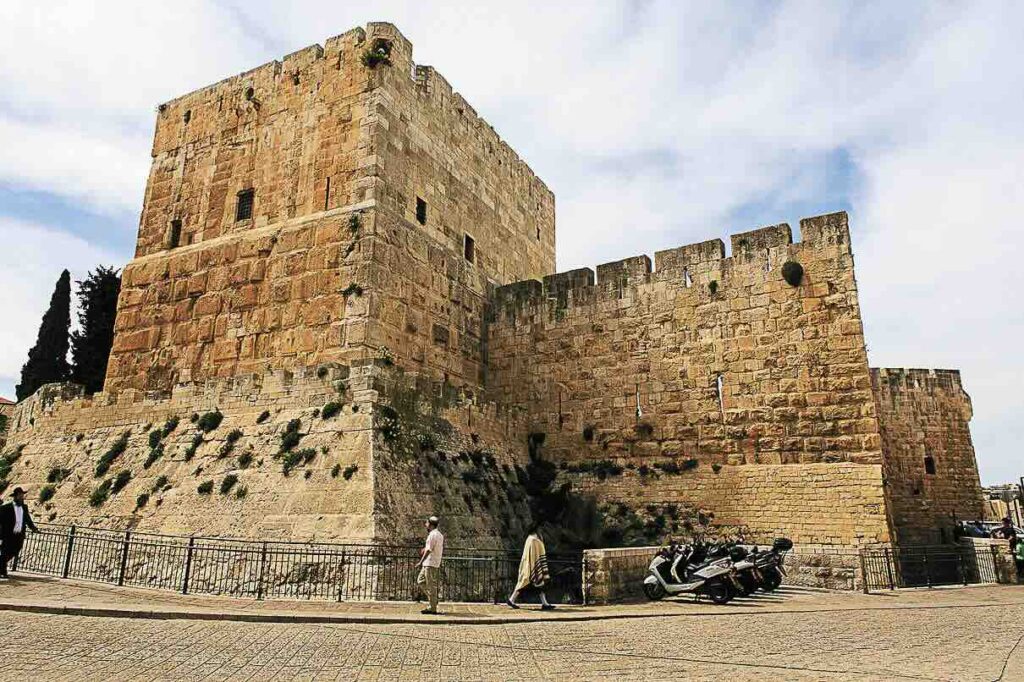
But this is not all. The Russian abbot was also allowed to visit the “Tower of David” – the main citadel and arsenal of Jerusalem! “Wondrous is this tower: built of great stones, very high, square in shape, solid throughout, firm in its foundations; in the middle of the structure there is much water. It has five iron gates and two hundred steps leading up, and bread is stored there in countless quantities. … This building is the head of the entire city; it is carefully guarded, and no one is permitted to enter it. But I, wretched and unworthy, was permitted to visit this tower…” It seems that King Baldwin wanted, for some reason, to demonstrate to Daniel the security of the strength of the crusaders’ hold on Jerusalem.
Moreover, “Baldwin I set out with his crusaders on a campaign against Damascus, past Lake Tiberias. I came to him, bowed, and said: ‘I would like to go with you to Lake Tiberias, so that I may visit all the holy places around the lake. For God’s sake, take me with you, King.’ Then the King, with great joy, ordered me to go with him and assigned me to his personal guard.”
If Abbot Daniel was indeed an envoy of the Kievan knyaz Sviatopolk Iziaslavich, one can only guess at the purpose of his diplomatic mission. Perhaps the Kievan ruler wanted to gain an understanding of the situation in Palestine in order to better assess the precarious position of Rus’s main ally, Byzantium? And, at the same time, to find out something – about his cousin, for example, whose fame for military exploits might well have reached Rus? If so, alas, Daniel would not have been able to find the Count of Vermandois, since during the battle in Cappadocia, Hugh the Great was wounded and died in October 1102…
But why did Baldwin I receive the abbot from such a distant northern country with such warmth and attention? After the triumph in Jerusalem, many participants of the First Crusade considered their vows to liberate the Holy Sepulchre fulfilled. Before the campaign, they had been promised that in Palestine a land flowing with milk and honey awaited them; they had been painted pictures of an earthly paradise and promised countless blessings. Reality proved far harsher: waterless deserts, barren rocks, sand and blood, famine, epidemics, Saracen arrows and swords. So many of the survivors chose to return home. And Baldwin I faced an unexpected problem: only about 300 knights and a few thousand infantrymen remained in his army. Meanwhile, the Muslim rulers thirsted for revenge. And so, from Jerusalem, messengers were dispatched to Rome and the European capitals with letters in which Baldwin appealed for new defenders of the Holy Sepulchre. And what did it matter where the fresh troops came from – from France, England, or Rus?
First Among Many
Quite a few books about pilgrimages to Palestine by Russian travellers were written. But the most important of them remains for us the Life and Pilgrimage of Abbot Daniel from the Russian Land. Because he was the first of the Russian pilgrims to honestly and meticulously record everything he saw and heard on his journey. And it seems that in every subsequent khozhenie one can find echoes of this very first account of a visit to Palestine, belonging to the pen of a Russian abbot.
“May all who read this description of the Holy Sepulchre and all the holy places with faith and love receive their reward from God, equal to that of those who walked the holy places. Blessed are those who saw and believed; thrice blessed are those who did not see, yet believed. … For God’s sake, my brothers and lords, do not condemn my poor understanding and my ignorance. Do not revile this account because of me, but for the sake of the Holy Sepulchre and the holy places. Whoever reads it with love will receive his reward from our Saviour Jesus Christ. And may God grant peace to you all, forever and ever. Amen.” — these words conclude the Khozhenie of Abbot Daniel…
Translated by Grigory Litvinov