 Irina Ivina
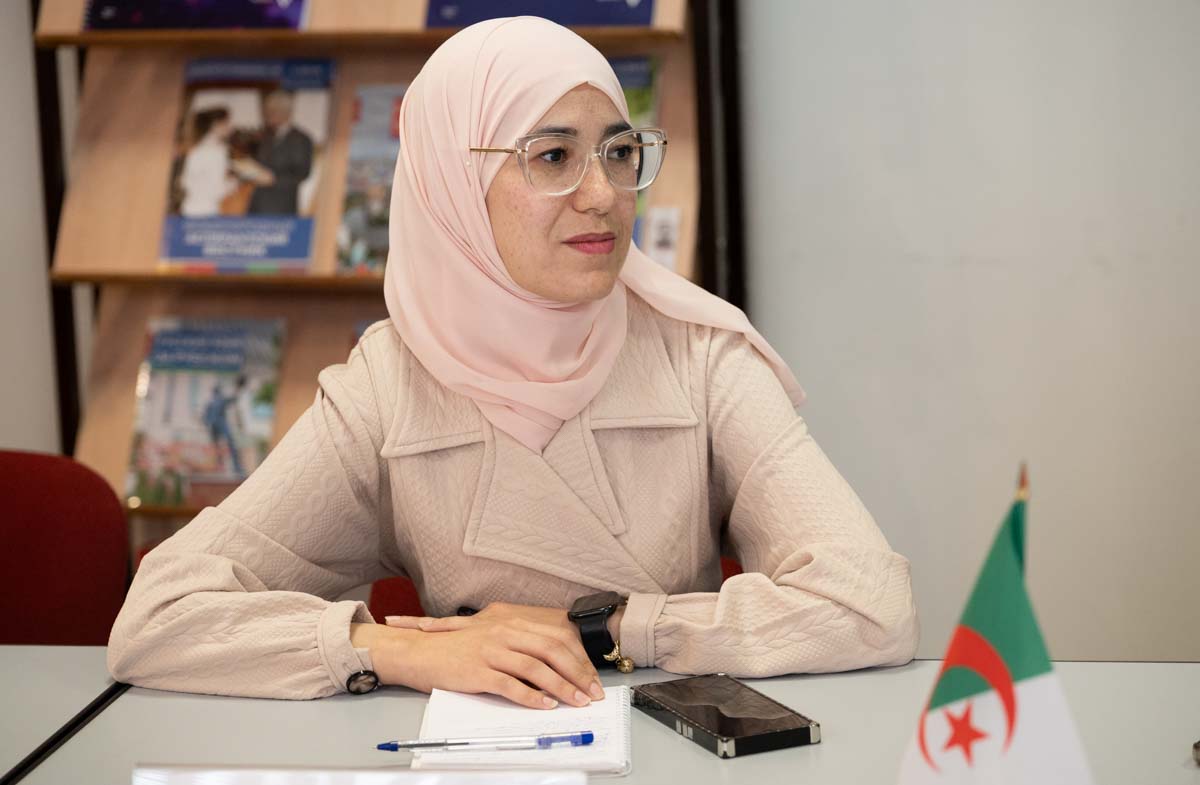
 Algeria, in North Africa, is something of an enigma to Russians. Meanwhile, the number of Algerians wanting to learn Russian as a foreign language is growing year by year. We interviewed Fahima Haddouche, a lecturer at Algiers 2 University, to find out why Russian appeals so much to the people of this Arab country.

– Fahima, you speak Russian with almost no accent. Where did you pick it up?
– My bachelor’s was at the University of Algiers 2 – Abou El Kacem Saad Allah, and my master’s at the University of Oran 2 named after Mohamed Ben Ahmed. In our city, you can major in Russian at only two universities. Later, I returned to Algiers 2 to pursue my doctorate, and now I teach here as well.
– How many students at your university are currently studying Russian as a foreign language?
– This year we’ve enrolled over four hundred first‑year students – ten study groups. That’s a lot! Last year, there were about three hundred. Over the past couple of years, more and more people in Algeria are willing to learn about Russia and the Russian language. Russian has been taught at our university since the 1950s, and there have never been so many students before.
– Do students choose Russian as their major themselves, or are they assigned to it?
– When applying, applicants list ten preferred specialisations, and then they are assigned just one of them. Some people put Russian on the list just to fill all ten spots – and ended up with it. But there are also many who genuinely love foreign languages and want to study Russian in particular. The reasons vary: some dream of continuing their studies in Russia after their bachelor’s in Algeria, others simply want to move there, marry a Russian woman, and start a new life. Our bachelor’s graduates know Russian roughly at a B1 level – enough to hold a conversation. But to become a true professional, you need to continue studying, ideally with native speakers in the country of the language you are learning.
– Compared to the other languages taught at Algiers 2, is 400 students a lot or a little?
– Of course, there are more students who get English or French. Those languages are very widespread in our country. Almost everyone in Algeria speaks French – often at a native level; and even if they don’t speak it, they at least understand it. The country’s establishment still uses French, even though it is not an official language. There are many French words in our dialect of Arabic. But if you compare it with, say, Turkish or Chinese, the number of students in the Russian programme is significantly higher. We have about 180 first‑year students in Turkish, and we only started enrolling students in Chinese at our university this year – just 40 of them.
– What do you think is behind the growing interest of Algerians in the Russian language?
– It’s hard to say for sure. What’s certain is that people want to know more about Russia. Unfortunately, there is no full‑fledged Russian House in Algeria – only a representative office of Rossotrudnichestvo, which deals with student admissions to Russian universities. However, in 2023, lecturers from the Pedagogical University in Naberezhnye Chelny set up an Open Education Centre for Russian language at our university, and later two more – in the cities of Biskra and El Oued, which are located in the Sahara Desert. Delegations of lecturers from Naberezhnye Chelny regularly come to Algeria for a week or two, offering courses, seminars, and round‑table discussions. On a permanent basis, these centres employ Russian citizens. They may not be professional teachers, but they are qualified enough to teach students at least basic conversational Russian. In addition, in November, the Chuvash State University held a Russian language festival in Algeria, in which our students took part, and they later spoke about it with great enthusiasm.

– Last year, the Russkiy Mir Foundation also opened a Russian Language Classroom in Algeria.
– Yes, but not at our university – at Algiers 1. They are two different institutions: ours is more focused on the humanities, while Algiers 1 specialises in the exact sciences, medicine and technology.
– You teach students in their first years of study. When they are just starting to learn the language, what do they know about Russia?
– They know that it’s the biggest country in the world, that the capital is Moscow, and that the president is Vladimir Putin. They know that Russian girls are very beautiful. They are convinced that Russians never smile, never speak any language other than their own, that it’s very cold there and it snows all year round. Some think that Russia has no access to the sea, and they are very surprised when I tell them that this is not true at all. And some don’t see any difference between Russia and the Soviet Union, which collapsed many years ago. They have a vague memory from their school history lessons: in the east there was the USSR, in the west the USA, and those two mighty countries were constantly at odds with each other.
On the whole, most Algerians are positive about Russia. They ask many questions about it and speak warmly of it.
– Do they know more about the EU or, say, China?
– About China, they know nothing at all: for Algerians, it’s a very distant country in every sense. But there is plenty of information about Europe, and many Algerians dream of moving there – especially, as you might guess, to France. Russia, however, is not considered part of Europe; for them it is Asia, or a separate civilisation altogether. Our first‑year Russian majors even have a special course, simply called ‘Russian Civilisation’. It’s an additional subject that provides general knowledge about Russia and introduces them to its culture. The course starts with the basic state symbols – the flag and the anthem – and students learn something about the country’s history. So Russian language lecturers don’t have to cover that in their own classes.
– Do you have a special course on Russian history?
– No. Even in the senior years, Russian history is not taught as a separate subject. But some teachers may give history texts to translate into Arabic – that’s how it was for me when I was studying for my bachelor’s. In the senior years, teachers use their own materials and methods; there’s no unified curriculum beyond the first year. Some teachers think their group wouldn’t be interested in texts about Russian civilisation, so they don’t give them to their students.
– What else do Algerian students majoring in Russian study?
– In the first year, the programme includes only basic subjects: grammar, phonetics, an introductory course in linguistics, oral and written speech, the already‑mentioned course ‘Russian Civilisation’, and also methodology – a course on academic writing. From the second year onwards, literature, translation, and linguistics are introduced. This set of subjects remains unchanged until the very end of their studies.
– Do students find it hard to learn Russian, a language so different from their own?
– Most students come to university already speaking another European language – French, English or Spanish. That does help them learn Russian, but they still say that Russian is unique, special.
By the way, I think Russian and Arabic are somewhat similar grammatically. We also have cases, and although the case systems are not identical, it’s easy for me to explain to students why a word can take different endings in different phrases.
– You have written several academic articles on multimedia methods of teaching Russian as a foreign language. Could you tell us more about that?
– Right after I finished my bachelor’s degree, I started working at the Military Institute of Foreign Languages and Translation. It is a very prestigious institution – the only military university in the country – and it is well equipped: language labs, audio equipment, computers. Meanwhile, at my home university, no multimedia tools were used; everything was traditional – blackboard, chalk, a textbook, nothing more. Obviously, when a lecturer uses modern technology, students become more engaged. Unfortunately, even now the University of Algiers 2 lacks proper multimedia equipment. I try to use online resources, video lessons, various blogs – for instance, the channel ‘O russkom po‑russki’ (‘About Russian in Russian’). If a student doesn’t understand something in class, they can always listen to the explanation again. There are websites where you can create exercises on different topics and then send students a link – the results come straight back to me.
– What textbooks do you use in your work?
– Previously, first‑year students used the textbook Road to Russia. Now we have switched to Let’s Go! by Stanislav Chernyshov. That is the main one, but far from the only resource I use. All of our teachers of Russian – there are twenty of them at Algiers 2 – have their own materials and teaching resources.
– What works of Russian literature do students study? What do they prefer to read?
– When students begin to understand Russian, we gradually give them excerpts from Russian classics – usually from the Golden Age: Pushkin, Dostoevsky, Gogol, Tolstoy. Sometimes we recommend that they explore authors of the Silver Age. In civilisation classes, students may also read works about the Great Patriotic War. Contemporary Russian literature is neither known nor studied in Algeria at all.

– What is the state of translations of Russian literature into Arabic in your region?
– Unfortunately, very few translations are being published. Only recently, two of my colleagues and I were officially recognised as translators from Arabic to Russian and vice versa. People did work as translators in our country before, but those were few and modest in scope. Our colleagues in Tunisia – Algeria’s closest neighbour – have been far more successful. I met several of them when I came to Russia for advanced training courses at the Pushkin Institute, and later we met at the Kostomarov Forum and the Russkiy Mir Assembly. At those events, I also got to know Egyptian specialists in Russian.
We all share a similar mindset, and it’s very interesting to discuss each other’s experiences and teaching methods. In Tunisia, for example, Russian is taught in about twenty secondary schools, and they even have their own textbooks for school‑level education. We also wanted to get Russian introduced into the curriculum of Algerian secondary schools, but, alas, that hasn’t happened yet.
In Egyptian universities, Russian is very popular, and we often receive new translations of Russian classics from our colleagues there. They are actively translating Dostoevsky, Lermontov, Pushkin, Chekhov and Turgenev. Turgenev and Chekhov have so far been translated into Arabic very little; Pushkin’s works have so far been translated only about halfway – only his most famous pieces. Translators from Russian into Arabic still have a lot of work ahead of them.
Moreover, there are talented contemporary writers in Algeria. But in Russia, almost nothing has been heard about them. I believe we should now also work on this – so that Russian readers can discover the works of our Algerian writers.
– Are you working on any particular translation at the moment?
– I want to finish my PhD first. I’ll take up translation only after that.
– Could you tell us more about the courses you took at the Pushkin Institute?
– I did an internship there while I was working at the Military Institute – that was essentially my introduction to Russia. While studying there, I used the textbook Road to Russia and practically memorised entire passages and dialogues: about metro stations, museums, landmarks. I had it all in my head. So getting around the city was fairly easy.
We attended seminars and lectures, and we could observe students learning Russian at different levels of proficiency, from beginners upwards. We learned what methods and textbooks the lecturers used. And every week we met colleagues from other countries, shared our experiences, and discussed what we had found particularly useful, what we would like to apply in our own teaching.
Translated by Grigory Litvinov