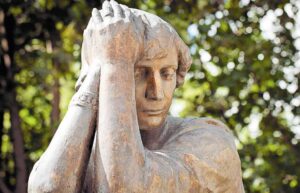
 Olga Dyatko
“Dmitri Shostakovich’s music is like Pushkin’s The Prophet. He possessed a profound foresight and an immense power of feeling. His divine music must be performed more often. It is life itself.”
Images courtesy of the Boris Yeltsin Presidential Library.
These words were written in 1992 by the monumental sculptor, teacher, and public figure Mikhail Anikushin. He was echoed by the writer and literary scholar Irakli Andronikov: “If you want me to say the most important thing I think about Shostakovich, I will say this: Dmitri Shostakovich, the great composer of the 20th century, is a phenomenon even broader than his brilliant music – a phenomenon integral to our understanding of modernity, of the future, of Soviet art, of national Russian art, of an art that unites humanity.”
Grandson of a Revolutionary
120 years ago, on September 25, 1906, Dmitri was born in St. Petersburg to an engineer and a pianist. The future composer’s parents hailed from Siberia. His grandfather, Boleslaw Shostakovich, had a revolutionary past. The 1869 document The Case of the Political Exile Boleslaw Shostakovich states: “A non-serving nobleman, the son of a collegiate assessor, Boleslaw Shostakovich was brought before the Supreme Criminal Court in 1866, along with others. By its decision, dated September 24 of that year, for harboring a state criminal sentenced to penal servitude, he was sentenced—in consideration of his sincere confession—to the deprivation of all special rights and privileges assigned to him personally and by estate, and to exile in the Tomsk or Tobolsk provinces…”
The composer’s father, Dmitri, graduated from the Faculty of Physics and Mathematics at St. Petersburg University in 1899. His mother, Sofya, studied piano at the St. Petersburg Conservatory. It was she who recognized her son’s extraordinary musical gift. The boy learned to read music very quickly and soon began playing duets with his mother.
A Thirteen-Year-Old Student
The Conservatory at that time was very different from the one we know today. Instead of preparatory music schools and colleges, future musicians were trained through three Conservatory levels: junior, intermediate, and senior. Students advanced from one level to the next based on an assessment of their readiness.
Dmitri Shostakovich enrolled at the Petrograd Conservatory in 1919, at the age of 13. The Conservatory marveled at his perfect pitch and phenomenal musical memory.
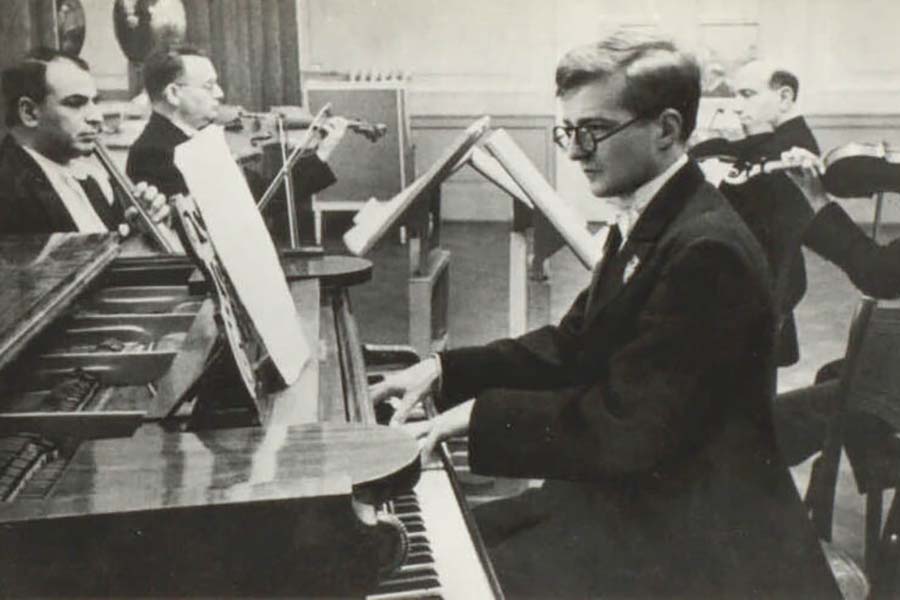
At 19, he was already taking his final exams. His graduation piece, the First Symphony, brought Shostakovich his first taste of fame. It premiered in May 1926 at the Great Hall of the Leningrad Philharmonic. This is how Irakli Andronikov recalled the event:
“At the time, I was a first-year university student, and I had the good fortune to be at the Leningrad Philharmonic when Shostakovich’s First Symphony was performed for the first time, and when Dmitri appeared before the general public for the very first time. It was May 1926. Renowned musicians were there, among them Alexander Glazunov (the head of the Conservatory). The regulars of symphony concerts were there too – including quite a few devotees of only the familiar music, who sincerely regarded any new musical language as an offense against common sense and good taste. […] Opinions about the symphony varied in temperature. But no one in the hall, it seems, doubted the outstanding talent of the 19-year-old author – not even those who had come to hear the works of other Leningrad composers scheduled in the second half of the program, and who were jealously awaiting the outcome of the First Symphony. The applause was unusual as well – not the kind an artist receives in gratitude for a pleasant experience; no, many in the audience understood that they were witnessing an outstanding event. They applauded long and steady, and kept calling him back.”
An Exam Interrupted by War
After his father’s sudden death in 1922, the Shostakovich family faced financial hardship. Dmitri was forced to play the piano for silent films to make ends meet. In the early 1930s, he gave concerts as a pianist, mostly performing his own works. Around the same time, his first opera, The Nose, based on the novella by Nikolai Gogol, premiered.
In 1932, Dmitri Shostakovich composed the opera Lady Macbeth of Mtsensk, based on the novella by Nikolai Leskov. It premiered in 1934. However, after a critical article was published in 1936, the opera was denounced as “anti-people.”
Symphonies took center stage in Shostakovich’s work. One of them became a symbol of the courage of besieged Leningrad. In her article This Is How the Leningrad Symphony Began, published in the newspaper Muzykalnye Kadry (No. 3, 1985), Doctor of Art History Sofia Khentova writes:
“Sunday, June 22. The chime of a clock woke Shostakovich at six in the morning. It was a wonderful morning, one that remained in his memory for the rest of his life […] After working a little in the morning, Shostakovich arrived at the Conservatory at ten o’clock with his characteristic punctuality for a state exam in the Small Hall named after A. Glazunov. Talented graduates were expected to perform that day. In the corridors and the hall, people were discussing their merits, shortcomings, and prospects. Everyone awaited Shostakovich’s marks with eager anticipation. Suddenly, the music stopped. Turning impatiently, Shostakovich saw a hand raised in alarm. Someone had placed a note on the table with a single word: ‘War.’ A break was announced, and the hall emptied instantly as people rushed to find out the details of the terrible news. Only a few returned, but the exam continued.”
It was the first graduating class of wartime musicians, with only an examination sheet surviving under the signature of Professor D. Shostakovich.
Post No. 5
In June 1941, Dmitri tried to enlist in the army. His request is preserved in the Leningrad Party Archive among applications to be sent to the front. He was told to wait. He submitted a second application on July 3. When the formation of the people’s militia began, Shostakovich immediately joined its ranks.
“By early July, the Conservatory’s professors and students who had not been called up to the front had formed brigades to work on defensive lines,” writes Sofia Khentova. “With his characteristic thoroughness, Shostakovich equipped himself with the necessary gear – a zip-up coverall and his own shovel.”
“He took the work extraordinarily seriously,” recalled Shostakovich’s student Abram Lobkovsky. “What he lacked in physical agility, he made up for with diligence. Keeping pace with the younger ones, he dug with striking precision and care – methodically, I’d say – despite the exhausting July heat.”
Shostakovich then joined the fire brigade to stand watch on the roof of the Conservatory. He was issued a helmet and fireproof overalls. He learned to move across the roof, handle fire tongs and hooks, and put on a gas mask (the July 1942 cover of Time magazine featured his portrait in a fireman’s helmet. — Editor’s note.).
Shostakovich never actually had to put out an incendiary bomb, though he would rush to the roof whenever the siren sounded. But he had other work to do. Concert brigades were beginning to be formed to perform at the front.
Conservatory brigades typically consisted of a singer, a violinist, and a cellist. A truck bed served as their stage. Dmitri Shostakovich put together their performance programs. Relying on his phenomenal musical instinct, he selected pieces that the musicians could learn quickly or sight-read on the spot.
The Birth of the Seventh Symphony
When Shostakovich was finally denied permission to go to the front, he set about composing a major work.
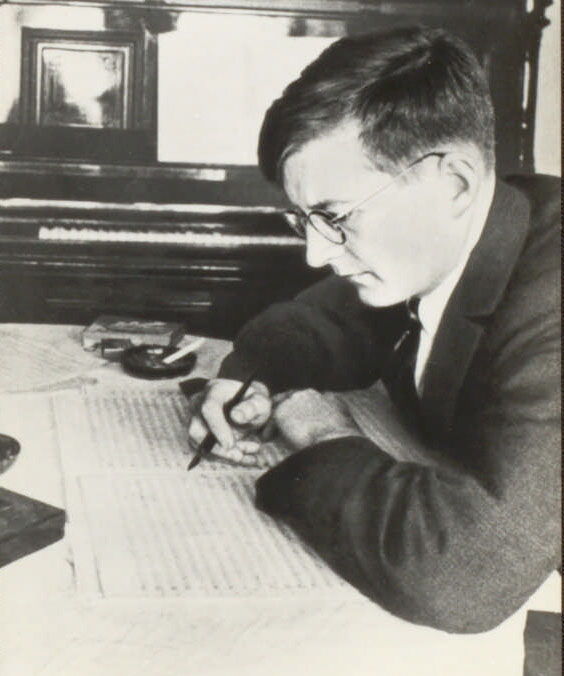
“He wrote with pain and with a creative fury that suffering and cruelty always provoked in him. July 15, 1941, is the date of the first rough sketches for the Seventh, the Leningrad Symphony,” notes Sofia Khentova in her article This Is How the Leningrad Symphony Began. Shostakovich composed both at the Conservatory and at his apartment. Two movements of the symphony were written in besieged Leningrad, and the rest were completed in December in Kuibyshev, where he had been evacuated.
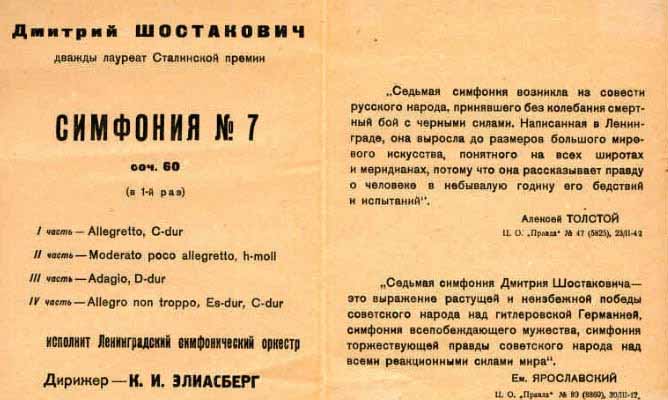
The writer Alexei Tolstoy attended a rehearsal of the Seventh Symphony in Kuibyshev, where it premiered on March 5, 1942, at the City Opera and Ballet Theatre (that same year, the symphony was performed in Moscow, Leningrad, London, and New York. — Editor’s note.). After returning to Tashkent, he wrote in an article for the newspaper Pravda Vostoka: “The Seventh Symphony was born of the conscience of the Russian people, who took up a mortal fight against the dark forces without hesitation. Written in Leningrad, it grew into a work of great world art, understood across all latitudes and meridians, because it tells the truth about man in an unprecedented time of hardship and trial. […] Shostakovich pressed his ear to the heart and played a song of triumph” (quoted from the publication in the newspaper Muzykalnye Kadry No. 8, 1961).
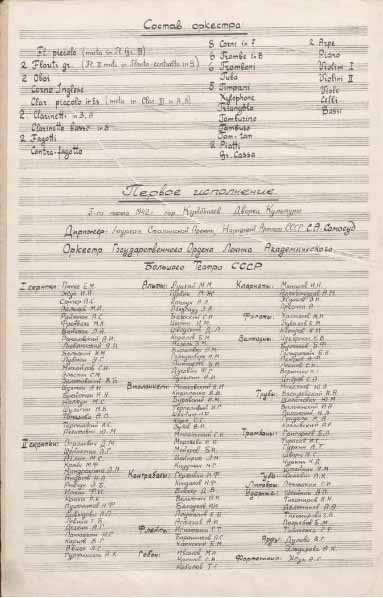
The full score was delivered to besieged Leningrad by a military plane. Conductor Karl Eliasberg later recalled how, one summer evening, four notebooks with the Seventh Symphony ended up in his hands, and how a feeling of anxiety swept over him – would the orchestra’s musicians, utterly exhausted by the siege, be able to tackle this monumental work? Specifically for the performance, by order of the Leningrad Front command, musicians were seconded to the orchestra straight from the front lines. People collapsed from hunger, they scraped together whatever food they could find for them, they went back to their music stands, and the rehearsals went on.
The legendary score of the Leningrad Symphony bears the markings of its conductors. It was used first by Samuil Samosud in Kuibyshev, and then by Karl Eliasberg in besieged Leningrad. The back of the title page in the first notebook lists the orchestral makeup and details of the premiere. A concert programme printed in Leningrad in August 1942 features the composer’s own words: “I dedicate my Seventh Symphony to our struggle against fascism, to our coming victory over the enemy, and to my native city, Leningrad.”
“As Long as My Heart Beats…”
After the war, Dmitri Shostakovich continued to write symphonies and composed various other works, including songs: some cheerful and life-affirming, like the once-popular Counterplan Song; others psychologically contrasting and profound, like his score for Grigory Kozintsev’s film Hamlet, which became a vivid, emotional expression of the profound meaning of Shakespeare’s tragedy.
The composer experimented extensively, exploring new structures in both large and small musical forms. He feared being trite. Shostakovich said: “As long as my heart beats, as long as blood flows in my veins, I will compose music for the good and prosperity of my Motherland.”
During his lifetime, Dmitri Shostakovich was awarded the titles of People’s Artist of the USSR and Honoured Art Worker of the RSFSR, became a laureate of the Stalin, Lenin, and USSR State Prizes, and received an impressive array of foreign awards, diplomas, and honorary titles from numerous universities and musical societies in Great Britain, Austria, Finland, and the United States.
Dmitri Shostakovich died in Moscow on August 9, 1975.The editors wish to thank the Boris Yeltsin Presidential Library for their assistance in preparing this material.
Translated by Grigory Litvinov/