 Ekaterina Zhiritskaya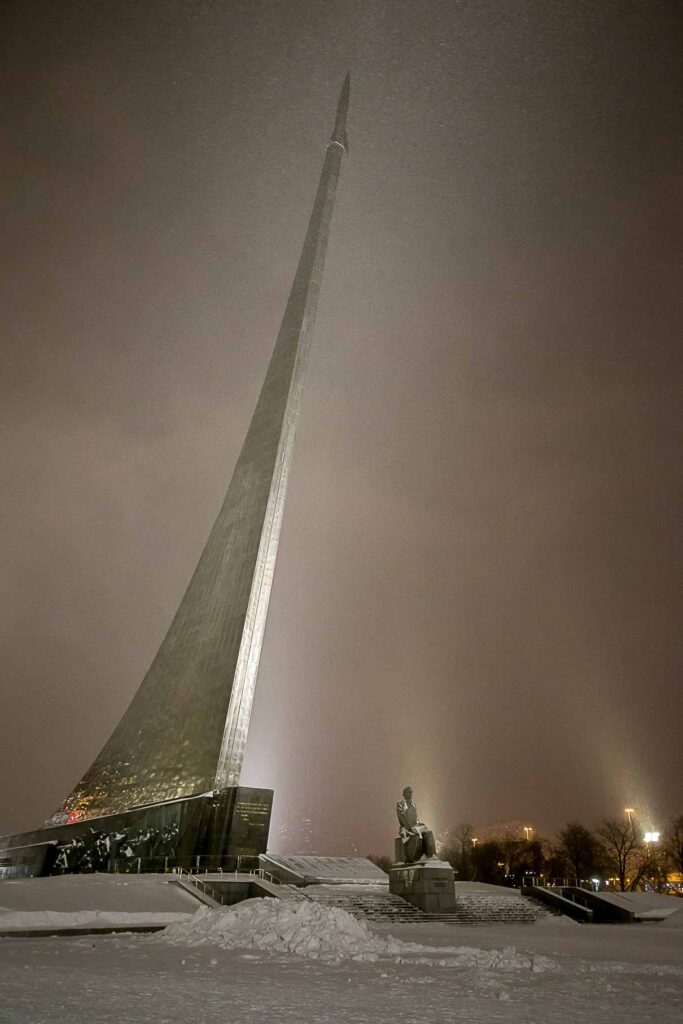
A silver rocket soars into the sky, as though breaking free from the stone pedestal beneath it. Along its base are bas-reliefs of engineers, designers, workers and cosmonauts — the pioneers of space to whom this monument was dedicated. Behind the glass doors set into the pedestal, an area opens up where visitors learn about the spacecraft that once overcame Earth’s gravity and carried them into the depths of space. This is the Moscow Museum of Cosmonautics.
The Russian State Archive of Scientific and Technical Documentation preserves a 1961 letter calling for the creation of a museum dedicated to the pioneers of space exploration. It was signed by members of the USSR’s first cosmonaut detachment: Yuri Gagarin, German Titov, Andriyan Nikolayev and Pavel Popovich. The work to establish the museum was overseen by the chief designer of Soviet rocket and space systems, Sergei Korolev. The monument was opened on the seventh anniversary of the launch of the first satellite — 4 October 1964 — and the Museum of Cosmonautics on 12 April 1981, the 20th anniversary of Gagarin’s flight.
According to Tatiana Gevorkyan, head of the scientific‑exhibition department at the Museum of Cosmonautics and the wife of cosmonaut Vladimir Dzhanibekov, from the very first days the museum received support from enterprises of the country’s rocket and space industry, which donated unique exhibits. Another important source of acquisitions was the personal belongings donated by cosmonauts, designers and engineers.
Dawn of the Space Age
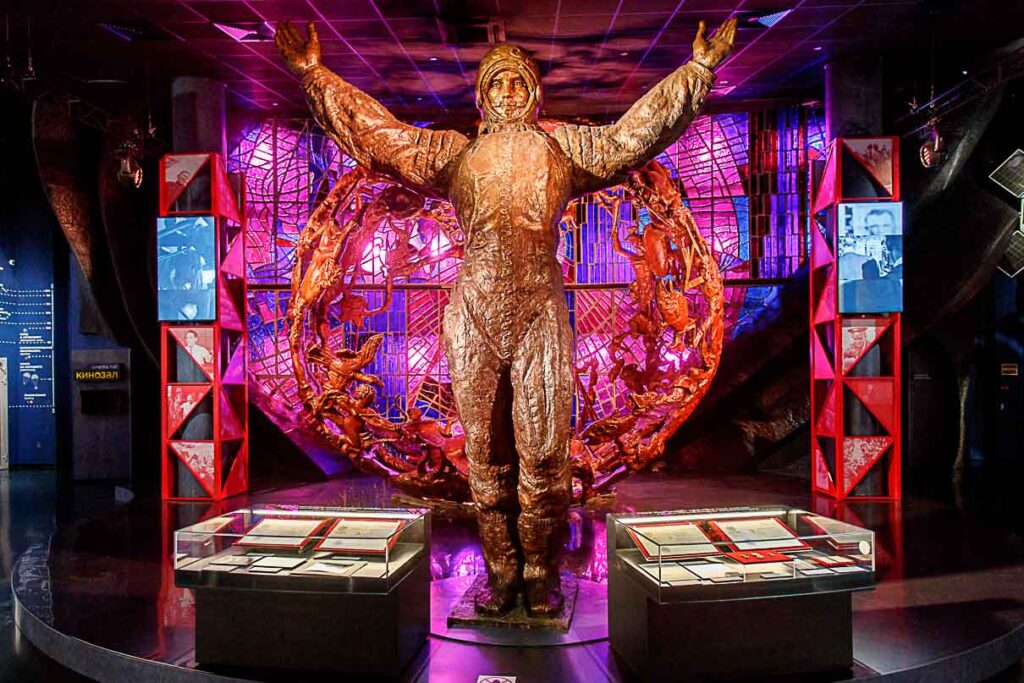
Lilac and blue light plays across the majestic figure of a cosmonaut, shimmering with a golden sheen, who greets visitors at the entrance to the museum’s first hall. On the right wall is a space dictionary, helping visitors not to get lost in space terminology. On the left are the words of cosmonaut Vladimir Dzhanibekov: ‘Doubt and believe! — this formula is not in any textbook, but without it, no challenge in life can be overcome. Doubt that all islands, stars and laws have already been discovered. And believe that you are destined to discover them.’
On either side of the golden cosmonaut are display cases with documents. A sheet of paper with Tsiolkovsky’s formula, written in his own hand, lies in one of them. Derived by the scientist back in 1897, it made it possible to calculate the velocity a vehicle can achieve under rocket propulsion. This principle was later used in the development of the rocket engines that launched the first Earth satellite into orbit. In his books and articles, which seemed like science fiction in the early 20th century, Tsiolkovsky put forward the idea that interplanetary space would be explored by means of orbital stations. According to many designers, engineers and pilots, it was their fascination with Tsiolkovsky’s theory that led them into cosmonautics.
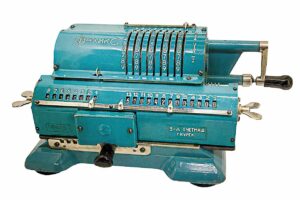
The unassuming objects in the neighboring display case are in fact proof of the extraordinary sophistication of Soviet engineering. Before powerful computers existed, the spacecraft that orbited Earth and reached the Moon, Mars and Venus were designed with little more than drafting instruments and the Felix mechanical calculator. Calculations were performed with a simple slide rule.
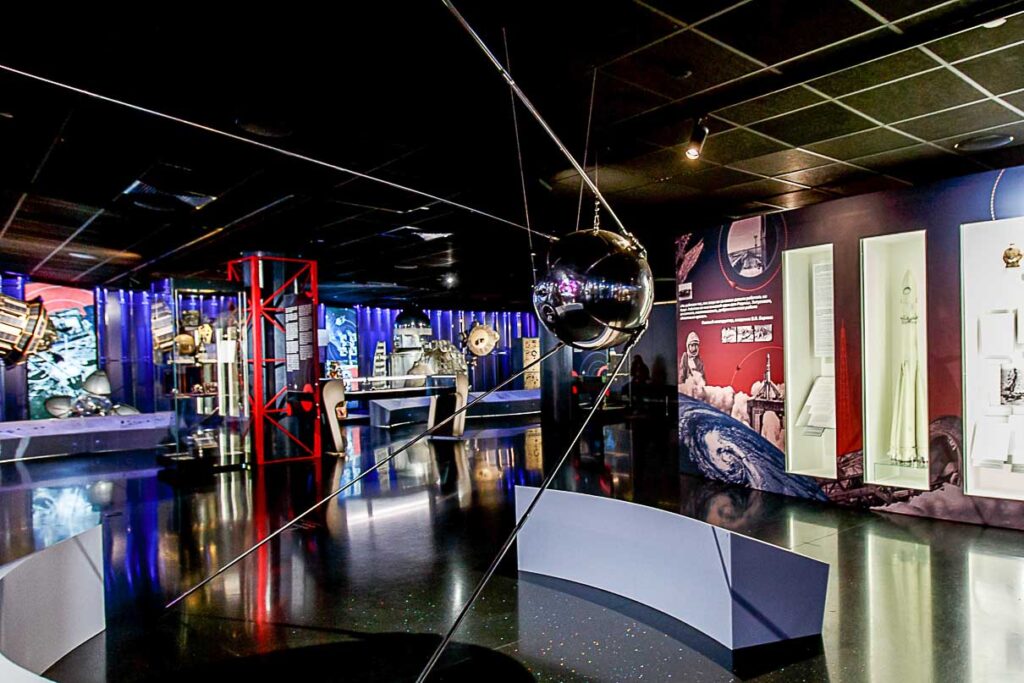
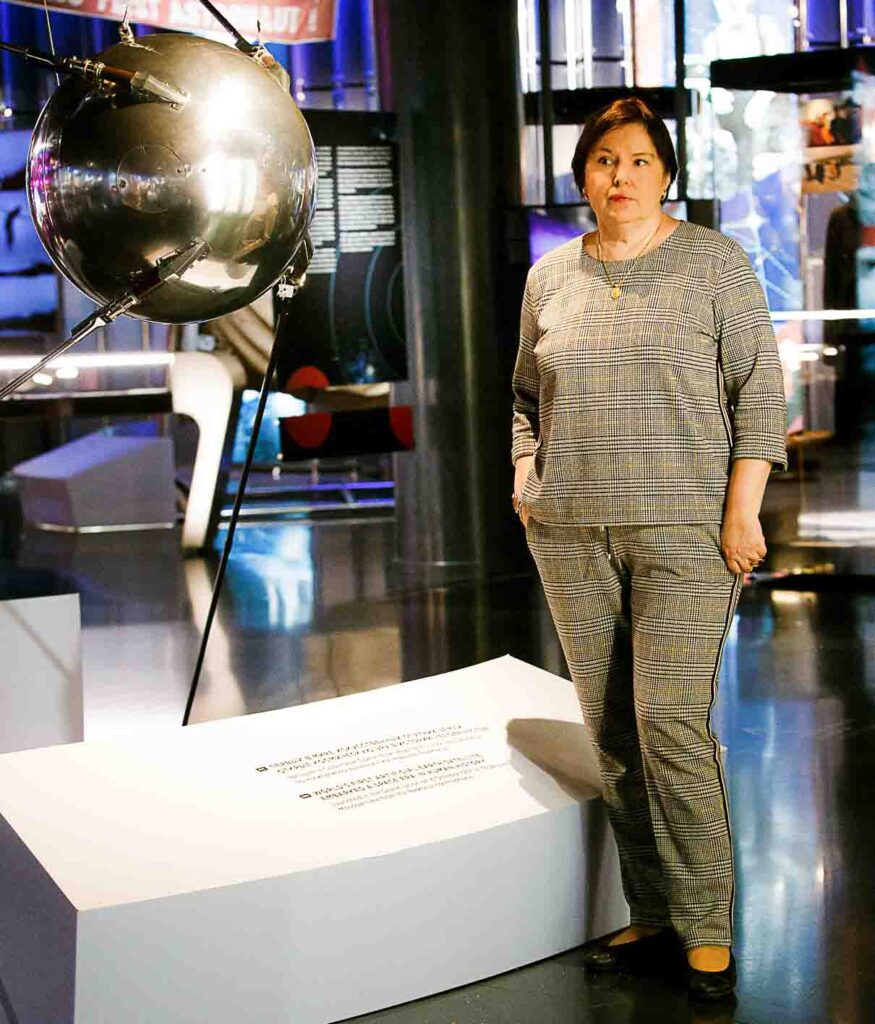
On 13 May 1946, the USSR Council of Ministers issued a decree to develop jet weapons and to organize research and experimental work in this field. And already in 1957, a fully‑fledged two‑stage intercontinental ballistic missile, the R‑7, was built in the USSR. The ‘Seven’ successfully passed five tests, after which it was decided to launch the first artificial satellite into space. And on 4 October 1957, the spacecraft Sputnik‑1 entered orbit. Today, that metal sphere with its antennas is one of the central exhibits in the first hall. The copy that came to the museum is an engineering mock‑up.
First Dogs in Space: Laika, Belka and Strelka
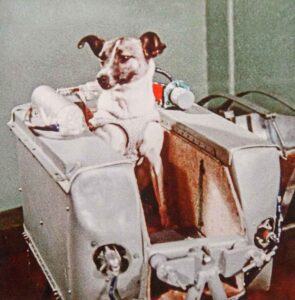
The story of the second artificial satellite is a tragic one. It was on this satellite, in November 1957, that a dog named Laika flew into space – her photograph lies in the display case. Laika’s flight was always intended to be one‑way: the satellite was not designed to return from space. In this harsh experiment, scientists needed to find out what happens to a living creature in orbit. It was assumed that weightlessness would have a negative effect on the mammal’s body. Laika proved that this was not the case – but she paid for it with her life: the dog died just seven hours into the flight, from overheating in the capsule. The results of the experiment were taken into account, and so‑called heat shields were introduced into satellite design, allowing spacecraft to cool down and return to Earth.
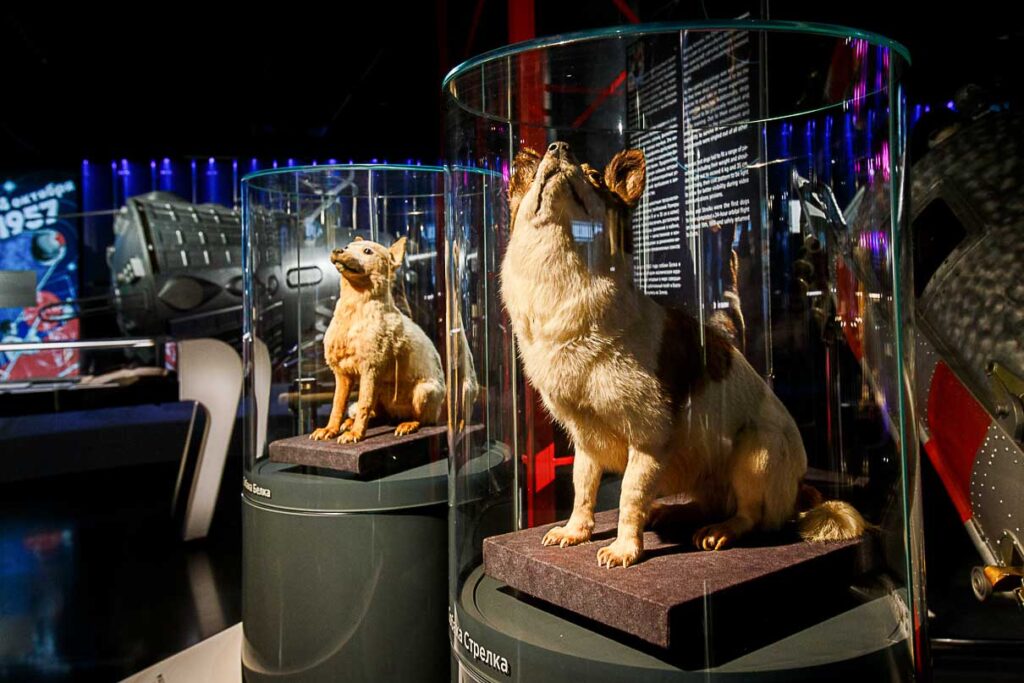
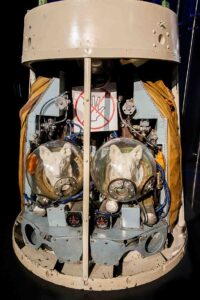
The next step was prepared persistently and patiently: sending a human into space. First, a spacecraft capable of returning to Earth had to be built. The most famous test flight was that of the dogs Belka and Strelka on 19 August 1960.
The canine cosmonauts spent 25 hours in orbit, completing 17 revolutions around the Earth. Belka and Strelka were not the only living creatures aboard the Sputnik‑5 spacecraft. There were also 12 laboratory mice, two large rats and a container of insects. All of them were sent into space so that, after their return to Earth, scientists could study the changes that had occurred in their bodies after exposure to weightlessness. The research showed that the muscle degradation initially expected did not occur in the dogs, and after returning from space Belka and Strelka lived a long and happy life. Their taxidermied remains became part of the museum exhibition.
The First Human in Space
Before Gagarin’s flight, there were 7 test launches with dogs, and only 3 of them were successful. That was Korolev’s condition: he would give the go‑ahead for a human space flight only after three successful test flights. After Belka and Strelka, the dogs Chernushka and Zvezdochka went into space one after another. They tested the future flight trajectory.
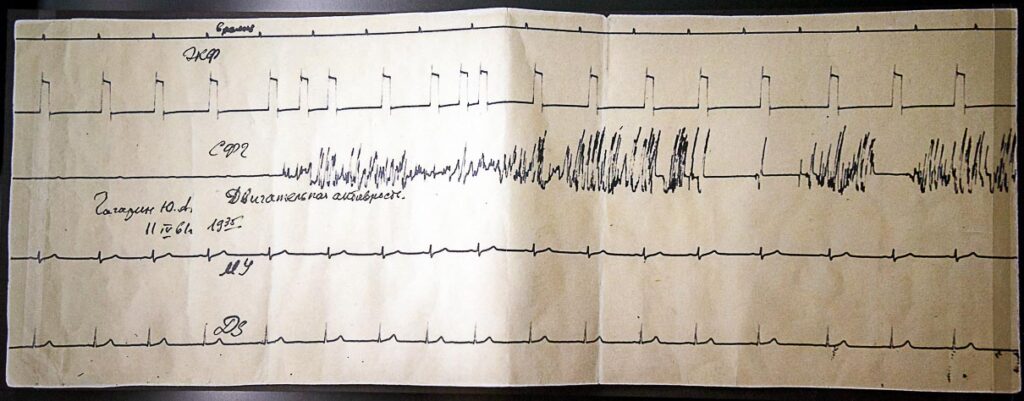
The Museum of Cosmonautics holds an interesting document: a cardiogram of Gagarin’s heart taken the evening before the flight. The second line from the top shows the activity of an accelerometer. It can be seen that the cardiogram was recorded during physical exertion – when Gagarin was pedalling an exercise bike or running on a treadmill. Yet his heart rate hardly changed – Gagarin was completely calm.
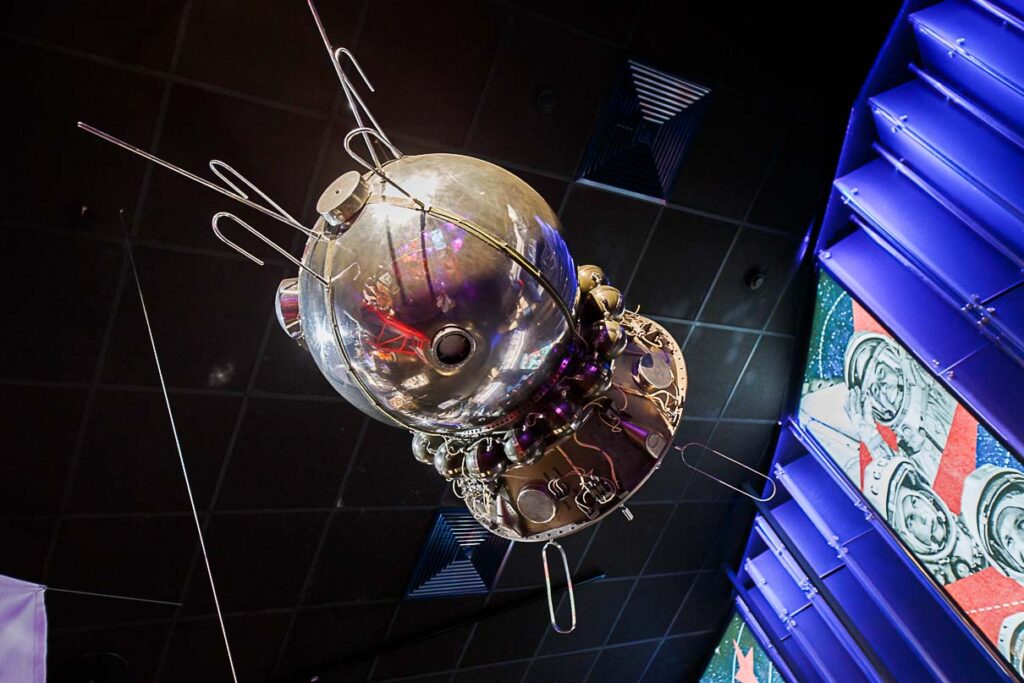
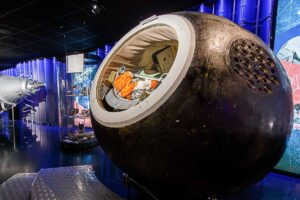
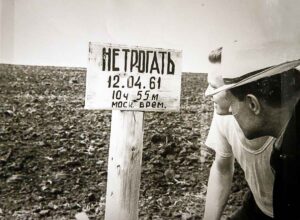
Gagarin’s first flight aboard Vostok‑1 was brief – just 106 minutes. Today, the black sphere of the descent capsule, complete with its orange pressure suit, also stands in the museum hall. After landing, the charred module of Vostok‑1 was taken to Podlipki near Moscow – to the design bureau OKB‑1. Later it became the main exhibit in the museum of the Energia Rocket and Space Corporation, which grew out of OKB‑1, where it remains to this day. The Museum of Cosmonautics preserved the original interior of the spacecraft, while the outer shell was replaced with a replica.
Thin Armor
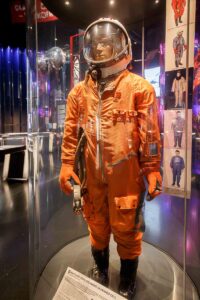
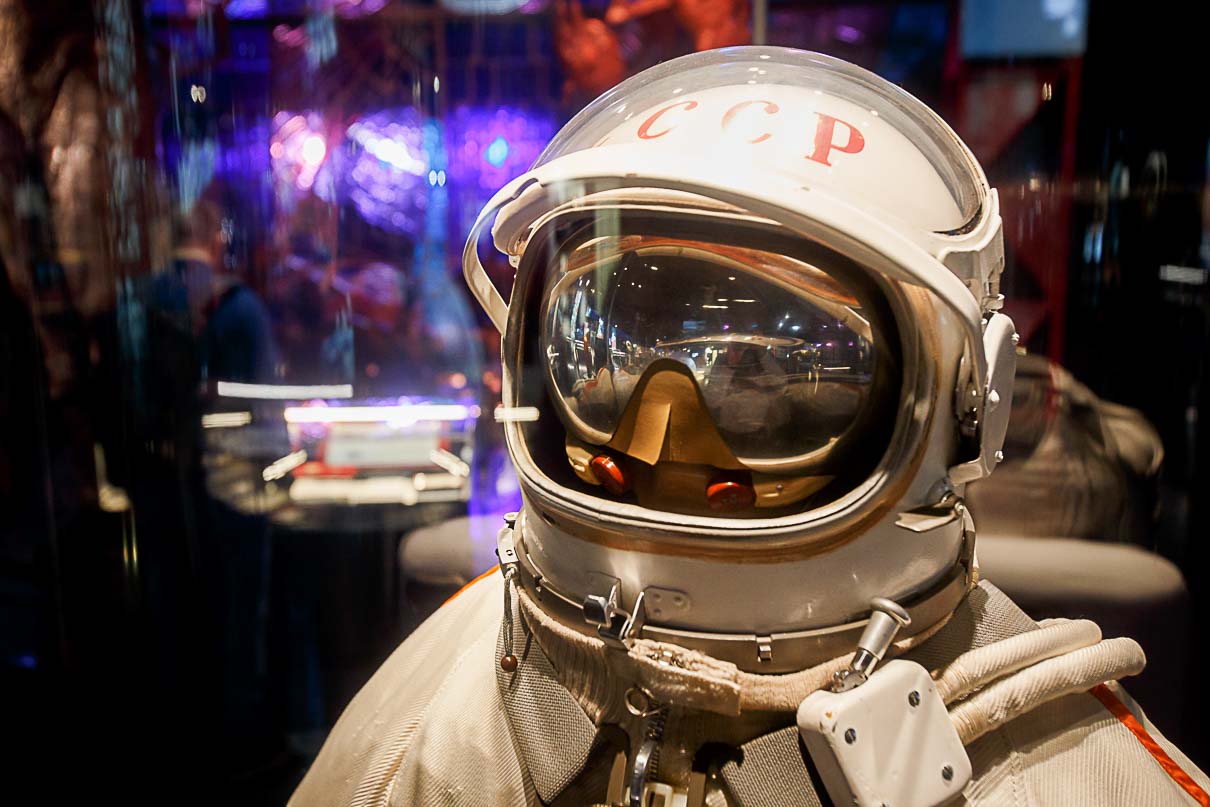
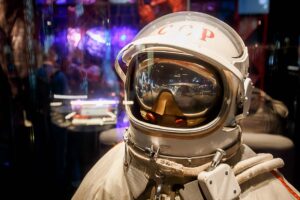
Spacesuits are an indispensable part of the Museum of Cosmonautics exhibition. Here is an engineering mock‑up of Gagarin’s suit: the outer part of the original is kept at the Zvezda enterprise that built it, while the inner part is in the museum of Zvyozdny Gorodok. Next to it, in a neighboring display case, stands Alexei Leonov’s training suit, the snow‑white ‘Berkut’. The original suit in which Leonov performed his spacewalk was burned. The reason is that during the return of the Voskhod‑2 spacecraft – on which Pavel Belyaev and Alexei Leonov flew into space on 18 March 1965 – the automatic landing system failed. As a result, for the first time in history, the cosmonauts had to pilot the ship manually. They did not land at the prepared site where the military and medics were waiting for them. The spacecraft crashed in the Perm forests, near the village of Berezovka. It was early spring, and to keep warm the cosmonauts burned anything that could burn – including their own spacesuits.
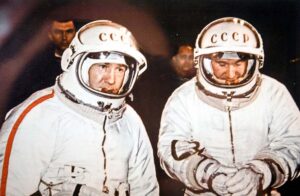
Alexei Leonov became the first human to walk in outer space. Under the influence of internal pressure, his spacesuit began to inflate, turning into a cumbersome balloon. In such conditions, to bend his arm, Leonov had to apply 25 kilograms of force. With such a strain, he could not carry out the necessary scientific programme. Moreover, it turned out that the spacesuit prevented him from re‑entering the spacecraft. The airlock had a hatch just 70 centimetres wide. It would have been difficult to crawl into such a ‘burrow’ even without a spacesuit. Leonov’s oxygen supply was limited. By an extraordinary effort, he managed to reduce the pressure in his suit, decrease its volume and get back inside the spacecraft. By the time he finally made it into the airlock, his pulse had reached 180 beats per minute and his body temperature had risen to nearly 39 degrees Celsius.
Such a series of malfunctions put an end to Voskhod flights. From April 1967, cosmonauts switched to the Soyuz spacecraft.
By the door to the next hall stands a massive piece of equipment that looks like a metal locker. This is the unique long‑focus camera Agat‑1. It was used on the Salyut‑2, Salyut‑3 and Salyut‑5 orbital stations and made it possible to take high‑quality photographs from low Earth orbit. It is one of the largest film cameras ever used in space – its height is 4 metres 20 centimetres. Each time, the 25‑tonne Agat camera had to be aimed manually, which required at least two cosmonauts to work in outer space.
Amid the huge machines, you might miss a bottle of champagne from the French winemaker Henri Mère. Once, at the Soviet embassy, Mère made a bet that humanity would never see the far side of the Moon and that he would wager a thousand bottles of his champagne to whoever could do it. Mère lost the wager: in 1959, the Soviet satellite Luna‑3 flew around the Moon and photographed the eastern part of the lunar hemisphere invisible from Earth. Mère sent the champagne to the USSR. Since no one was sure whom to give it to, the bottles were sent to the Academy of Sciences. Academician Mstislav Keldysh, the official recipient of the package, distributed the champagne among all the participants of the space programme. A large part of the gift went to Sergei Korolev, who gave the champagne away to his staff. In the end, out of the thousand bottles sent, only one survived.
Creators of the Space Age
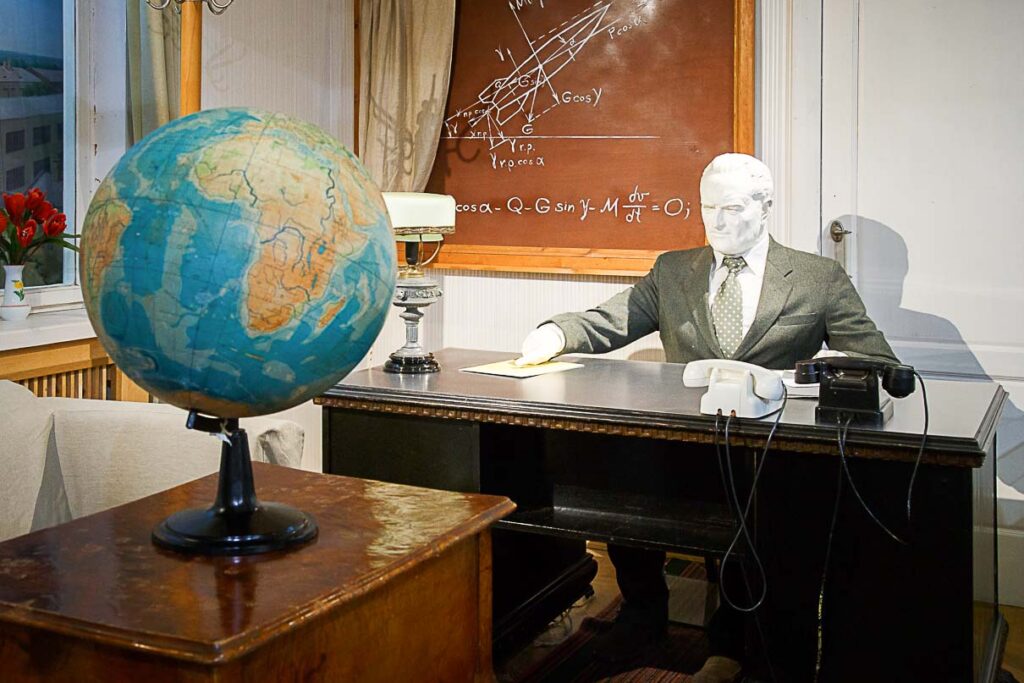
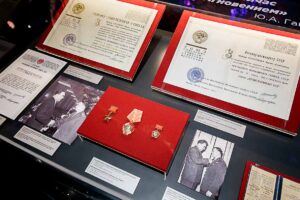
That is the name of another hall in the museum. It tells the story of the people whose work made rockets and spacecraft possible. From a photograph, a tired‑looking man in military uniform gazes out. This is Georgy Langemak. One display case is devoted to two scientific organizations whose developments later made space exploration possible: the Leningrad Gas Dynamics Laboratory and the Moscow Group for the Study of Reactive Motion (GIRD). In 1933 they were merged into the Reactive Scientific Research Institute. But in 1937, the institute’s directors, Ivan Kleymenov and Georgy Langemak, were arrested and, in January 1938, shot. Only in 1955 were the designers rehabilitated, and in 1991 they were posthumously awarded the title of Hero of Socialist Labour for their work on the operating principles of the legendary Katyusha, a multiple rocket launcher.
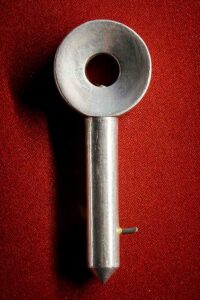
In the hall, there are six individual display cases, each dedicated to one member of the ‘golden six’ of Soviet designers.
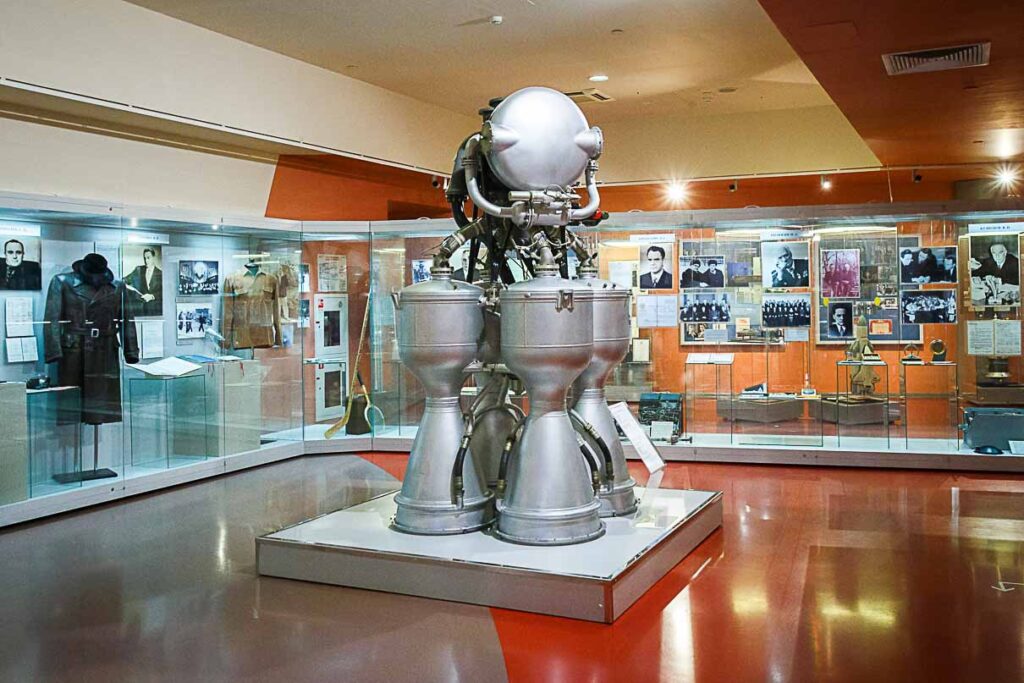
Sergei Korolev was not only the chief designer of spacecraft, but also a talented manager. He succeeded in creating a rocketry empire in the USSR. Valentin Glushko is known as the creator of the most powerful liquid‑fuel rocket engine in human history. Vladimir Barmin designed jet launch systems, rocket‑space and combat launch complexes. Three other cases are dedicated to Mikhail Ryazansky, Nikolai Pilyugin and Nikolai Kuznetsov. Ryazansky worked on space radio communications. Pilyugin’s specialization was the development of control systems for the R‑7 rocket, which launched the first Sputnik and the first cosmonaut into orbit. He also led the development of control systems for many interplanetary stations, the Proton rockets and the Soviet space shuttle Buran. Nikolai Kuznetsov was engaged in the development of rocket engines.
In one of the display cases is a graduate badge of the Riga Polytechnic Institute that belonged to Friedrich Zander, one of the creators of the first Soviet liquid‑fuel rocket. The badge is missing the silver element from its central part. It had been melted down for metal: the scientists and engineers of GIRD were so absorbed by building rocket models that they brought metals from home, including silver, to make the prototypes. Zander contributed his student silver badge.
Space Home in Orbit
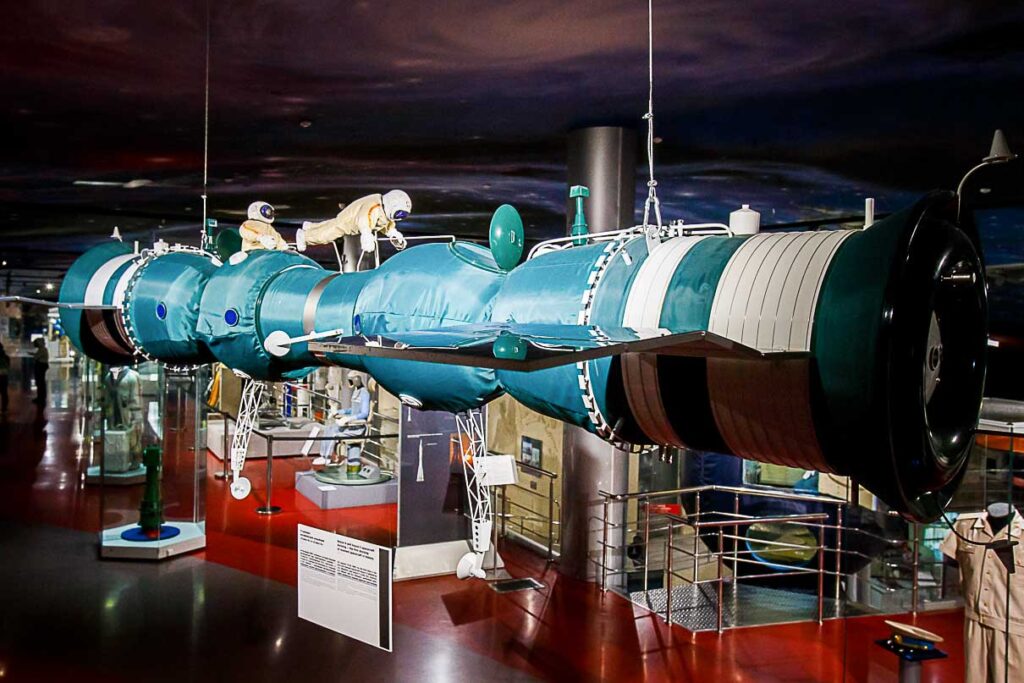
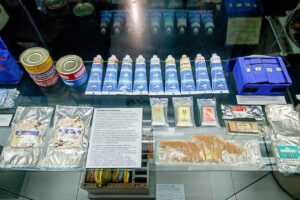
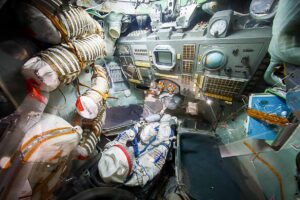
The next section of the museum displays a fragment of a Soyuz spacecraft. Its upper part is the orbital module, the lower part the descent module. The surface of the exhibit is slightly scorched – a sign that it has been in space.
Far more spacious than a spacecraft is an orbital station, where cosmonauts live and work for months. In the hall stands a model of the core module of the Mir space station, and looking at it, you can understand what a ‘space home in orbit’ looks like. The main module of the Russian segment of the International Space Station – Zvezda – is currently in use. This model reproduces its interior exactly. There is a sleeping place, a toilet, a treadmill, a kitchen. You can see what space seats used to look like – they were designed to be straddled rather like a saddle. They are no longer used because it was decided that it’s easier to stand while strapped in.
A power supply unit is fixed to the wall – you can plug in the necessary devices and conduct experiments. Beside the wall stands an aquarium – once there were small fish, guppies, on the station. It did not end well for the fish, however. They adapted to the conditions of space, but their swim bladders, which regulate buoyancy and depth control, atrophied. And when the guppies returned from space to Earth, they simply… drowned.
Conquest of Venus
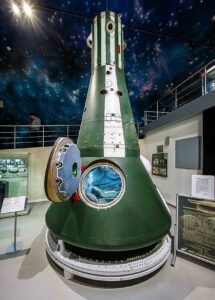
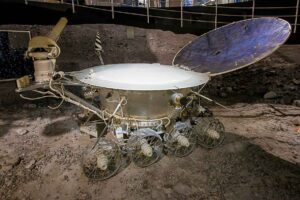
Manned interplanetary spacecraft are not a core focus of Russian cosmonautics. However, it was the USSR created the first robotic lunar exploration vehicles: the first wheeled, remotely controlled vehicle in history, Lunokhod‑1, sits in the museum hall. Lunokhod‑1 was essentially a ‘camera on wheels’: it was designed to record everything happening on the satellite of Earth and to study the soil.
Lunokhod‑1 flew to the Moon in November 1970; in January 1973, Lunokhod‑2 landed on the Moon. A launch of Lunokhod‑3 was planned for 1977, but it was never sent. The last Soviet automatic interplanetary station for studying the Moon was called Luna‑24; it was launched from Baikonur in August 1976. A sample of lunar soil is also kept in the museum.
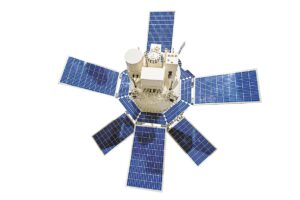
The USSR was the first to explore Venus, but the Soviet Martian programme was less successful. Yet there were some victories. Mars-3 achieved the first soft landing on Mars – its engineering mock‑up can be seen in the museum. But it managed to operate on the planet for only 14 seconds. There were also the Mars‑4, Mars‑5, Mars‑6 and Mars‑7 stations, but they were orbital vehicles. Their descent modules crashed onto the planet’s surface. Attempts to reach Mars continued after the collapse of the USSR, but they were unsuccessful: neither the first nor the second spacecraft of the Phobos‑Grunt project managed to leave Earth orbit.
The Soviet Venus programme was among the USSR’s greatest scientific successes. The flights of Venera‑2 and Venera‑3 can be considered the first successes. They did not manage to transmit data about Venus itself, but they did obtain scientific data on interplanetary and circumplanetary space, studying magnetic fields, cosmic rays, low‑energy charged particle fluxes and solar plasma. Venera‑4 sent the first signal from the atmosphere of Venus. It turned out that the pressure on the planet was 10 times higher than expected. The data transmitted by these probes made it possible to create Venera‑10 – a station that landed on Venus in 1975, withstanding a pressure of 100 atmospheres and a temperature of 500 degrees Celsius. Later, the probes were so improved that Venera‑13 and Venera‑14, launched in 1981, learned to photograph the surface and transmit pictures.
However, Russia remains strong in manned spaceflight: it built one of the most powerful launch vehicles in the world, the Proton, and put the International Space Station into orbit. An ambitious project started in the 1980s and cancelled in the 1990s was the Energia launch vehicle, which carried the Buran space shuttle into orbit.
Today, more than 30 countries have their own space programmes, but the exhibits of the Museum of Cosmonautics will not let anyone forget that the first human being to venture into space was Russian.
Translated by Grigory Litvinov