
 Anastasia Zabrodina
 Sven, call sign ‘Diplomat’, looks every bit the biker: bandana, a stud earring, colourful tattoos. Yet the members of the motorcycle club he belongs to, in defiance of Western trends, now call themselves Russian motorcyclists. And Sven looks nothing like a German teacher at a private school — yet that is precisely what he is today.

Sven Svensson was born in Hamburg. In 2001, he went to Egypt for temporary work, fell in love with a Russian woman, then followed her to Russia, and has now been living here for 23 years. We met at a session of the Russia Today festival devoted to the reintegration of soldiers returning from the Special Military Operation into civilian life. Since 2022, Sven, having come to share the concerns and pain of his new homeland, has been delivering humanitarian aid to civilians in Donbass and to Russian army soldiers. For this, he could be sent to prison in at least 13 European countries.
– Sven, what were your impressions when you first came to Russia?
– What image of Russia does Western cinema create? Mafia, cold and bears. But even in my youth I paid no attention to such stereotypes. My principle is simple: go and see for yourself. And if for some Russia is Pandora’s box, for me it is a treasure chest.
– I first met real Russians in Egypt. My new friends were ordinary tourists, but what struck me about them was a kind of spiritual purity I had never encountered before. I immediately felt as if I were one of them – that was unexpected, because in Germany I felt like a bit of an outsider. It was fun being around Russians; you could speak openly with them. Now I know what Russians are like: it’s not easy to build a relationship with them, but if they call you a friend or brother, it’s for life.
Then I flew to Moscow, met my girlfriend’s parents, and from the very first moment they accepted me as one of their own. It was the best possible start to a new life. In Russia, things are more straightforward: if they like you, they’ll be friends with you; if not, they won’t. That way of looking at the world resonates with me. In the West, you can’t tell how people really feel about you. They smile to your face, but when things get hard, they’ll turn their backs on you. In Germany, if you are a foreigner, you will almost certainly remain an outsider forever. Many Russian Germans who left Russia long ago say that they still feel a barrier between themselves and the local people. But in Russia, I have never felt like a foreigner. Russia is home to many nationalities and religions, and people have learned to live together in peace. We are all Russians.
In 1990, the Soviet Union allowed Germany to unite, but an invisible wall still exists between eastern and western Germans. Eastern Germans lived alongside Russians for more than 30 years; western Germans had no such experience. There were British, French and American troops stationed there. And today the difference between the two Germanies is not only in salaries but also in mentality. Eastern Germans, in my view, try to get to the truth, much like Russians. Western Germans are more arrogant. And I would say that their worldview is more distorted by propaganda.
Germans have been forbidden to love their country, to know their history well: the more you know, the more dangerous you are. In Germany today, the result of this approach is evident. The country’s history has been rewritten, and the Germans haven’t even noticed it. The residents of Dresden, which was bombed by Britain and the United States and where tens of thousands of people died, remember the war, but in Germany as a whole people know nothing about the Second World War and don’t want to know. They don’t care. They believe only a couple of television channels. And if the programmes on those channels say that Russia is an ‘aggressor’, then that’s the way it is. When the massacre in Odesa happened in 2014, all the state channels showed that tragedy. And then, after a couple of months, they started talking about Ukraine differently. No one spoke about the genocide in Donbass, about the fact that people there were disappearing without a trace simply because they wanted to live in peace with Russia. In Germany, a generation has grown up that knows nothing at all about what happened in Ukraine. I suggest to Germans that they at least try to find out the truth, but they are too lazy.
– In German schools there is a history curriculum. Germany started the Second World War – that is one of the turning points. How did it happen that you knew nothing about the war?
– Russians know European history much better than Europeans know Russian history. After our history lessons, we knew about the Second World War only that it began in 1939 and ended in 1945. And we were never told that Russia won that war. We were told that the Allies won it. You know that in Europe they don’t celebrate May 9 as Victory Day over German fascism. The end of the Second World War is marked on May 8, and for most people it’s simply a day off.
– After what you’ve said, does it make any sense to ask whether German schoolchildren are taken to concentration camps that now serve as museums?
– There are no special excursions organised for schoolchildren. I personally visited Auschwitz for the first time in 2019, and only because the Night Wolves motorcycle club, of which I am a member, was holding an event there.
– Perhaps you were taken to museums dedicated to the Second World War when you were at school?
– Such museums do exist in Germany, of course. But nobody takes schoolchildren there, either. When I was at school, Most of the history textbook focused on the Roman conquest and division of Germanic lands.
– We are surprised by the readiness of Europeans to believe lies about Russia. After all, all sources of information are open. Why do they have no desire to get to the truth?
– Because that’s how they have lived their whole lives. You see, Russians – at least those I have met – do not divide people by class, they do not decide whether to associate with someone based on their social status. But in Europe, that is how it works.
Some European bloggers – those like me who know what Russia is really like – try to break through this spiritual laziness. But we face enormous resistance. I believe that if I manage to make one person in a hundred think, I have already won.
– Doesn’t it bother Europeans that they unwittingly become accomplices to war crimes?
– They aren’t given a say. In Germany, if you go out into the street with a Russian flag and say that we should be friends with Russia, the police hit you on the head with a truncheon and take you away. You can’t even go out with a German flag, because you immediately become a ‘fascist’. You are not allowed to be proud of your country. At the same time, if you say anything against the immigrants who are flooding Germany, you are also a ‘fascist’. And if you are a public figure and you assert something that contradicts the official agenda – for example, that Ukraine, not Russia, is to blame for the conflict – then some charge will inevitably be brought against you.
My social media channels have about 250,000 followers. Charges have been brought against me in 13 European countries. If I were to cross the EU border now, I would be imprisoned for a long time. Many of my friends who stayed in Europe have disappeared. In England, you can be imprisoned for five years for a comment online. In the ‘free’ West, you have no right to step outside the boundaries of your narrow world or to ask uncomfortable questions.
Moreover, eastern Germans know the history of the Second World War better. And that bothers the authorities. Most of those who walk the streets with anti‑war posters are eastern Germans. But people are afraid. A correspondent for a German newspaper works in Russia; his salary is paid into a bank account in Germany. A few days ago, a German bank closed his accounts. When asked why, he was told: ‘Because you are in an unfriendly country.’ The authorities are openly cutting off channels of information.
Many people in Germany have lost their jobs because of their views. And this applies not only to journalists. In order to declare such people criminals, Germany has amended its legislation, and now support for Russia falls under anti‑terrorism laws. To keep people from accessing the truth, the authorities have equated a terrorist with a person who provides reliable information. Last year, the German authorities declared as ‘terrorists’ not any individual or organisation, but the whole Luhansk and Donetsk Republics. I work with the German foundation ‘Bridge of Peace’, which has been delivering humanitarian aid to Donbass since 2014. And just imagine: you are a European, and in the summer heat you hand a bottle of water to an elderly woman in Donetsk who has escaped from the shelling. In the eyes of the German system, you are ‘helping terrorists’ – for that you can be tried and sent to prison for 25 years.
– What, in your opinion, is the purpose of such repression?
– Fear. Quite a few people have disappeared without a trace in Germany. Citizens are arrested, thrown into prison, and human rights organisations do nothing about it. This is fascism, but people don’t realise it. They think that by banning Russians they are doing something very good. Their image of fascism is Hitler. And since Hitler is gone, they believe fascism no longer exists.
– We have come back again to the topic of Nazism, and therefore of the Second World War. How did you start to learn the truth about it?
– Only here, in Russia, did I remember my great‑grandmother’s words. She used to say: ‘We must respect the Russians, because they freed us from fascism.’ In Russia, I learned what it means to honour the memory. Living here, on May 9 you watch the parade on television, the Immortal Regiment procession, films about the war. I asked my family why there is such attention to the past. They explained.
And then, in 2014, there was Crimea. At that time I needed to get a visa, so I drove to Germany by car – through Ukraine, through Lviv. There I already saw young people with swastika tattoos and Bandera flags. I couldn’t understand it: they, like the Russians, had fought against fascism, yet now they had ended up on its side. How could that happen? Then, in Odesa, people were burned alive.
On March 18 2014, the Russian Spring began in Crimea. My brothers from the motorcycle club and I celebrate this date every year. They also took part in the Russian Spring, they manned checkpoints, and the fact that a bloody uprising did not break out there, as it did in Kyiv, is partly their doing. We are proud of this. So it was here that I truly began to learn about the Second World War. Russia has a genetic memory of it.
– But that war also affected your people.
– You cannot expect others to feel the same feelings that you do. In Russian culture, certain values are deeply embedded: faith, honesty, love. That is why Russians honour the memory of those who fought and died for their homeland. We, the Night Wolves, have already lost 26 of our people in Donbass. We also honour their memory and always say that to be a warrior means to live forever. That has never happened in Germany, and it never will. It is a completely different culture. For them, we are just dreamers. That is why they think we live badly and they have everything fine. When I tell them that our mobile phones work better beyond the Urals than theirs do in Berlin, that I can order food and a robot will deliver it, they don’t believe me. I send them videos, and they say it’s fake. If I tell them that I can send money from Moscow to Vladivostok in a second, they answer that it’s impossible.

– Strange that people don’t believe this.
– There is much that strikes us as strange about them. I am fighting against Western information, I am fighting against the fifth column here, but I am also fighting for Russians to get rid of the idea that everything is bad in Russia and everything is wonderful in the West. We need to start truly loving our country. Not just the Russian flag and anthem, but to go outside, look at a tree and say to yourself: ‘This tree is Russian, and I love it for that.’ Unfortunately, I know very wealthy people who keep their capital not only in Russia but also abroad, and their children study in Europe or the United States. Russia is not where their real lives are.
– Let’s talk about your hobby. You started riding a motorcycle back in Germany, then you had a long break. Why did you return to it in Russia?
– It happened almost by accident. I live in Krasnogorsk, but I was sent to work at a language camp in Zvenigorod. I had to commute there every day. Covering 50 kilometres by bicycle was not easy, so eventually I got a motorcycle. At the same time, I was invited to work as a DJ at a bike centre. I started talking with the brothers from the Night Wolves, and something very important kept me there. In Germany, I wasn’t interested in the biker life. There was no brotherhood there. But here, I was captivated by that kind of heroic friendship. We are like‑minded people. A Western person doesn’t understand the full meaning of that word, because there is no such sense of unity there. It truly is brotherhood. And when I felt that, I realised I would never leave.
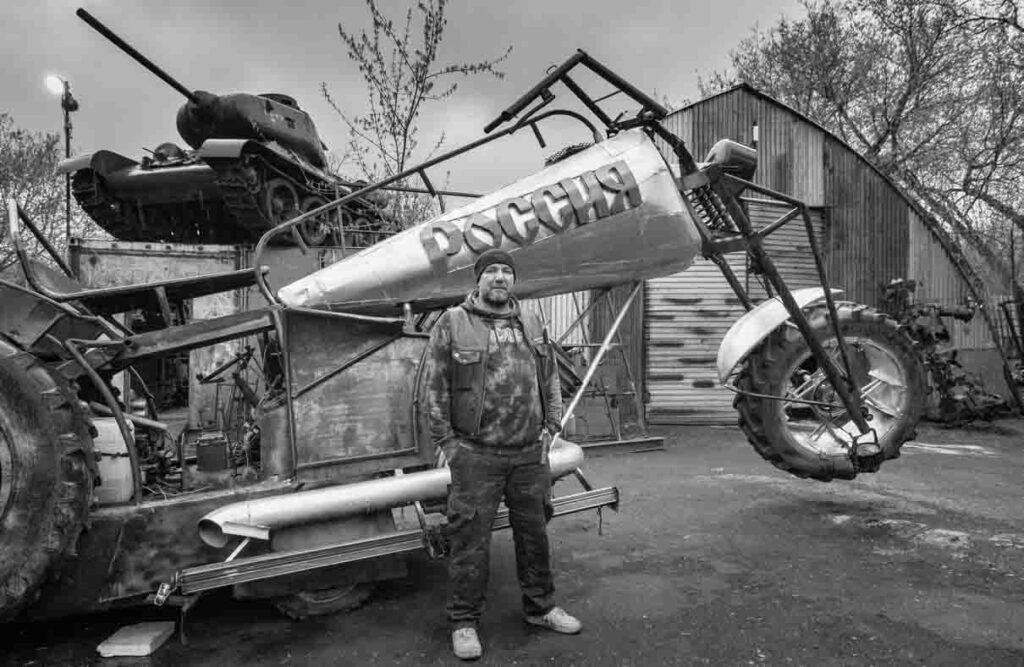
When the Night Wolves appeared in Russia in 1989, the motorcycle club system as understood in the West did not yet exist here. Western motorcycle clubs saw a big market opening up, recognised its potential and offered the Night Wolves cooperation. At first, they accepted the Western rules of the game. But over time, the club’s founders decided that their movement should be based on different values. We cannot be a gang on motorcycles, engaged in crime. We do not use drugs; we believe in God. That is why when people ask me: ‘Are you a biker?’ I answer: ‘No, I am a Russian motorcyclist.’
– Like many foreigners in Russia, you eventually came to Orthodox Christianity. Why?
– I had a feeling that I already had everything I needed in life. Yet something was still missing. I have always loved going to churches. And one day an Orthodox priest asked me why I was so sad. I told him my thoughts, and he remarked: ‘To be happy, you lack faith.’ And he turned out to be right. I had lost faith – in myself, in humanity. One of the reasons I left Germany was that I trusted nobody. But ever since I have been living in Russia, I have been rediscovering myself every day. I will be eternally grateful to the Russian people for helping me become who I am. That is why I will always try to repay this debt.
The most precious thing I always carry with me is my Russian passport. Russian citizenship for me is confirmation that I have been doing everything right, since I have earned the trust not only of my loved ones but of all of Russia. Here I learned to love my home. Before I moved, home was wherever I happened to be. And in Egypt, I first heard Russians say: ‘I miss home so much!’ And only in Russia did I understand what they meant. When I last visited Germany, in 2019, I could no longer be among Germans; they were strangers to me.
– As a school teacher, you hold ‘courage lessons’ and ‘Talks about What Matters’ with your students. What do you discuss?
– I have been to Donbass and I continue to deliver humanitarian aid there. Everyone must understand: being able to just sit in a café and chat with friends is a luxury. It exists only because there are people who protect us, who fight, enabling us to live ordinary lives every day. Once I was invited to give a ‘Talk about What Matters’, but they asked me: ‘Don’t talk about the war.’ I answered: ‘Then I won’t come.’ And I didn’t go. We must at least respect those who die so that we can live.
As a Westerner, there is much I cannot understand. For example, I don’t understand how the Russian people survived the 1990s. And during the ‘Talks about What Matters’, I want to show my students the inner strength and power that you Russians have. I have often been told: ‘Abroad, we try to speak English so that no one will know that we are Russian.’ I was outraged: ‘Have you lost your mind? You should be proud of your country.’ I am absolutely convinced that Russia is an ark.
– What do you mean by that?
– I see many large families who have moved here from Western countries. Recently I met one such family with ten children. They moved to Russia because they do not want to live in a society where there are a hundred genders. This shows that Russia has done everything right.
In Russia I feel freer than anywhere else. But in the West they believe that in Russia people cannot express their thoughts openly, because they will be locked up immediately. The propaganda machine has done its work. I am tired of trying to convince them, but I understand that this is my part of a larger common effort.
– When your acquaintances from Europe come to Russia, do they change their point of view?
– Of course. But there are very few of them. I always tell them: ‘Come, see for yourself.’ You have no idea how much outright nonsense I hear in response. But if a person does come, his opinion of Russia changes radically. The picture that Western media had painted for him crumbles. One acquaintance of mine came here on a motorcycle. And when he saw the reality, he was in complete shock. It took me three days to bring him back to his senses.
– What caused such a shock?
– The difference between what he had been hearing daily in the media in his own country and what he actually saw. What causes the shock is that life in Russia is just like it is in the West – even better. And people there have been so frightened that they are simply afraid to come here. Of course, none of them know that Russia has 13 seas of its own. That it’s not eternal cold here. That you can go on holiday wherever you like. That you can just go to a river and fish. They don’t understand that Moscow is part of Europe. They think St. Petersburg is in Asia! They don’t understand that Kaliningrad looks like a typical German city. I’m not the only one showing them the country as it really is. Many foreign bloggers do the same. But their voices are being silenced as well. Not long ago I gave an interview to Tim Kirby’s Russian Road project. His YouTube channel was deleted the first time when it had 1.5 million subscribers!
– Do you think we will ever return to mutual understanding with Europe?
– The West does too good a job at vilifying Russia; it has funded and continues to fund Russophobia. Russia has never acted that way, believing that information is something intangible and that it is better to invest money in the economy. But the West realised that it cannot win on the battlefield and has launched a psychological war. They believe they can insult Russia and get away with it. That is their mistake. And our mistake is that we are too kind.
Once in Mariupol, I once again realised how far I still am from understanding the Russian people. When the Special Military Operation began, I, like all my friends, said: ‘Finally.’ And in 2022 I went there to see everything with my own eyes. I arrived in Mariupol, saw that nightmare, talked to people, and kept asking everyone the same question: ‘What would you say to the West if you could?’ And one person answered: ‘We wouldn’t say anything.’ I was outraged: ‘What? Look, all this misery, death, destruction – it’s all the West’s doing.’ And I started to get angry because I couldn’t understand the point of his answer. But he said: ‘Yes, it hurts. Our homes are destroyed. We live in a basement, we have no water, we have no food. But houses can be rebuilt. The sickness that’s in their heads, however, is incurable. That’s why we pity them.’
The entire road from Mariupol back to Donetsk – about 100 kilometres – I cried. Because I realised that I am a bad person – such thoughts would never have occurred to me. In the West, they understand the Russian World as a desire to seize territories. They literally picture it as ‘the hand of the Kremlin’ reaching beyond Russia’s borders. They don’t understand that the Russian World is what is inside. It is culture, language, faith, history. They think that Russia wants to take something for itself. But for us, to preserve the Russian World, as I see it, means to protect all the good that already exists within our borders. It is multinationality, different dialects and languages, different faiths. Our ark.
Translated by Grigory Litvinov.