 Irina Lukianova
Dostoevsky was perhaps the first true tragedian in Russian literature. The first writer to be so comprehensively unhappy, the first to open a door into the dark depths of the human soul. Even the words in the titles of his works form a chilling litany: Humiliated and Insulted, The House of the Dead, Notes from the Underground, Demons, Crime and Punishment, The Idiot… It is as if he opened a hatch into an underworld teeming with unclean forces—and suddenly discovered that it was a part of himself.
Dostoevsky’s childhood was cheerless. His father was a physician at the Mariinsky Hospital for the Poor; biographers like to repeat that he spent long evenings poring over the “mournful lists” of the poor who had died there. In the hospital’s left wing, one can still see the apartment where the family lived — and the room where the older boys, Fyodor and Mikhail, slept: a gloomy nook partitioned off from the entryway. The furnishings were of the simplest, reduced to a bare minimum.
The family was educated and cultured. The many children—there were eight in all, though the youngest died early—had nurses and wet nurses. Their mother taught the children to read from the Bible, and the first book to make a deep impression on little Fyodor was the Book of Job. Among the early impressions that lodged in Dostoevsky’s soul, he later recalled visits to the Kremlin and its cathedrals, family outings to the theater, and readings at home—the family read widely and eagerly. Fyodor Mikhailovich once wrote: “Without something sacred and precious, carried into life from the memories of childhood, a person cannot live… These memories may even be painful, bitter, but even suffering endured can later turn into a sanctuary for the soul.” In his childhood recollections, joy and suffering are inseparably intertwined.
His mother suffered from tuberculosis; his father worked hard and drank heavily. He shouted at the children and at his wife, tormenting her with groundless jealousy. Once the father had acquired noble status and the right to own land, he bought an estate in Tula province. But the Dostoevskys made poor landowners: the family was mired in poverty, and the manor house itself was a modest wattle-and-daub cottage. As master of the estate, Dr. Dostoevsky was severe, flogging peasants for the slightest offense. A year after the purchase, a great fire swept through the property, leaving only the main house standing.
The older children studied at home at first, then at a day school run by a Frenchman named Sushard, and later at the prestigious Chermak boarding school. As a boy, Fyodor Dostoevsky was serious and introverted. He read extensively and wrote fantastical tales, which he called his “arabesques.”
When his mother died of tuberculosis in 1837, the family came apart. The mother’s sister took in two of the children; the father kept the younger ones with him on the estate; and the older boys were sent to St Petersburg, to the Main Engineering School. Dostoevsky considered his father’s choice of institution a terrible mistake: he felt no attraction to military or engineering careers, was weighed down by the drill, and among his subjects cared for little besides literature, art, and architecture. “Man is a mystery,” he wrote at the time. “It must be solved, and if you spend your whole life solving it, do not say that you have wasted your time. I concern myself with this mystery because I want to be a human being.” Naturally, he kept writing—mostly historical dramas that have not survived. What drew him were exceptional characters, power, and might.
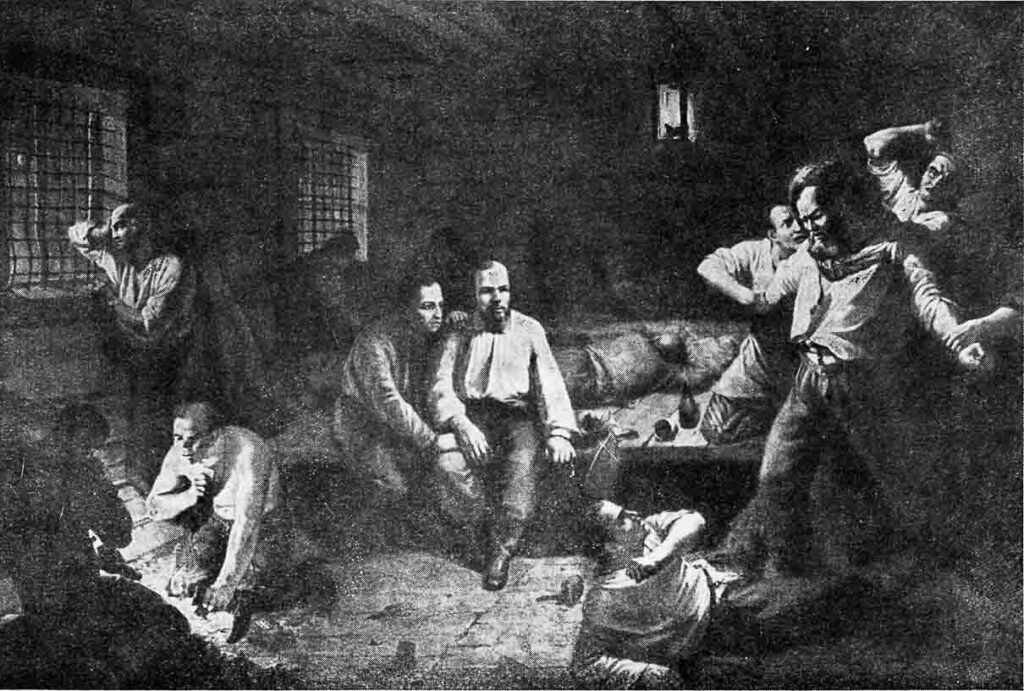
In the summer of 1839, Dostoevsky’s father was killed by peasants on his estate—whether because he had drunkenly insulted them once too often, or because they were avenging daughters he had violated, no one knows for certain. When Fyodor learned of his father’s death, he suffered his first epileptic fit.
The reluctant engineer
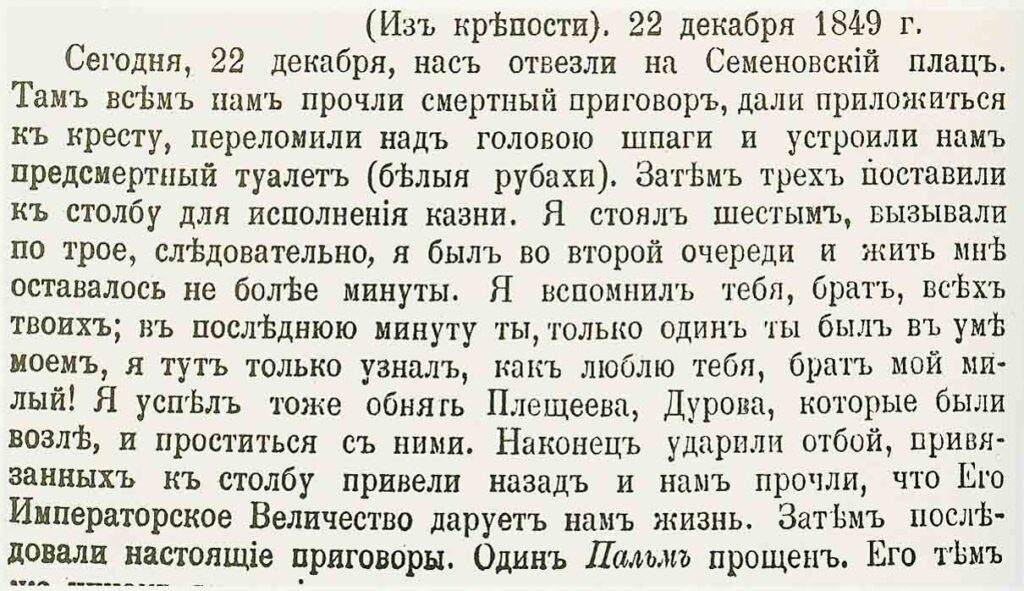
In 1841, after receiving the rank of ensign in the engineering corps, Dostoevsky moved into a rented apartment of his own and finished his course as an external student two years later. Free, solitary, dreaming of glory, perpetually penniless due to his impracticality and his taste for gambling, restaurants, and carousing with friends, he worked as a lowly draftsman. His salary was insufficient to live on; the money sent by relatives was either spent on food or gambled away. Before long, Dostoevskyturned to moneylenders. Pawning his personal belongings would remain a way of life for years.
He left the engineering service in 1844, a year after completing his studies, resigned, and turned to literature. Soon, his translation of Eugénie Grandet appeared in print. “An incomparable translation,” he “modestly” wrote to his brother. He was convinced of his own genius, and his friends and fellow writers from the Belinsky circle could not forgive him this conviction. After the success of his first novel, Poor Folk, they had exalted him, and then suddenly, unexpectedly for him, they turned on him. It became received wisdom that Dostoevsky had written himself out. Ivan Turgenev went so far as to call him “a pimple on the nose of Russian literature.”
Dostoevsky’s break with the Belinsky circle was final. His next work, The Landlady, was rejected by the public, dismissed by the literary world, and eventually fell out of favor even with the author himself. It is difficult to imagine how Dostoevsky’s literary fate might have unfolded had catastrophe not intervened.
Conspirator
In the spring of 1846, a stranger in a wide-brimmed hat approached Dostoevsky and asked what his next work would be about. That was how the writer met Petrashevsky, the founder of the first socialist circle in Russia. The members of the Petrashevsky circle read papers to one another on socialism and atheism, discussed questions of reforming Russia and emancipating the peasants. Dostoevsky harbored no thoughts of overthrowing the ruling order. What drew him, rather, were ideas of universal happiness and sympathy for the victims of arbitrary power. Many remembered how passionately he spoke about a sergeant-major made to run the gauntlet. Dostoevsky took the most active part in literary discussions; among other things, at one gathering of the circle he read aloud the famous letter of the recently deceased Belinsky to Gogol, although he did not share many of the author’s ideas.
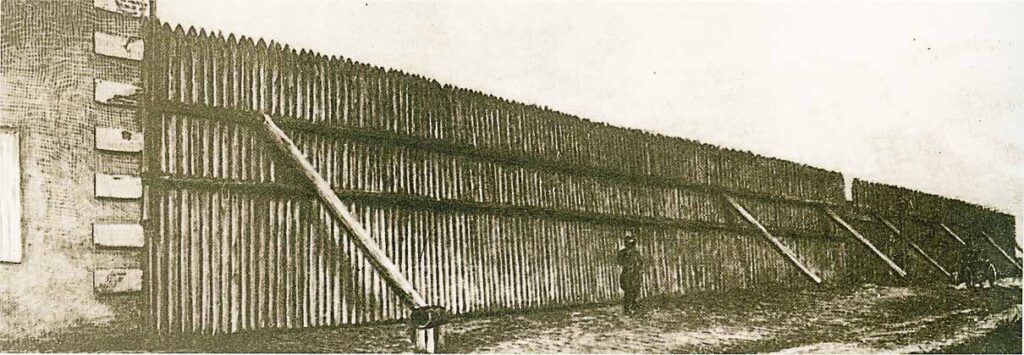
Yet it was the reading of this letter that proved fateful for Dostoevsky. In 1848, the world was shaken by events in France. Fearing for the future of the monarchy in Russia, the Tsar demanded the eradication of sedition within the country. The Petrashevsky circle was one of the first victims of this campaign. The public reading of Belinsky’s letter was deemed sufficient grounds to sentence Dostoevsky to death. What followed was solitary confinement in the Alexeyevsky Ravelin of the Peter and Paul Fortress, and a mock execution on Semyonovsky Square: the prisoners were informed that the sentence had been commuted to penal servitude only after the first three had been tied to the stakes and the soldiers had taken aim.
One of those first three, Grigoryev, who had already begun to lose his mind in prison, now went completely insane. Dostoevsky, by contrast, remained almost calm. Few Russian writers have been made to experience their own death so directly. And Dostoevsky would relive this plummet into oblivion every time he suffered an epileptic seizure. After these attacks, he would remain unable to regain his composure for a long time, languishing in a state of profound darkness.
But the sudden happiness of being spared from execution proved so uplifting that he endured even penal servitude with relative ease. And his Notes from the House of the Dead — calm, balanced, deeply humane.
Dostoevsky studies those around him with painstaking attention: what sort of people are they? What lurks in their souls? Why does one repent while another is certain he is right? Why is penal servitude a punishment for one, yet a normal way of life for another? What is it in a person that turns him into a killer? Can punishment reform a human being? He poses all these questions for himself, like marks carved on tree trunks: come back here again; think this through once more. Time and again, he will return to this human hell, descending not only to the social depths but into the depths of his own soul, tormented by pain, jealousy, vanity, anguish, fears, and infirmity. And each time, to emerge from the abyss, to ascend like Orpheus from Hades, and even to attempt leading lost souls out with him.
Read Notes from the House of the Dead, and it becomes clear why he himself did not sink, lose his bearings, or go mad. He did write, “This long life, physically and morally arduous and colorless, broke me…”—and yet it did not. It becomes clear, too, why the slander accusing him of pedophilia, of a love for little girls, is utterly false. The rumor, launched by Strakhov and furiously denied by Dostoevsky’s widow, proved astonishingly durable. But no: the book makes plain that darkness—his own, other people’s, the terrible darkness of the social order—can be overcome only by the soul’s clear light.
Love
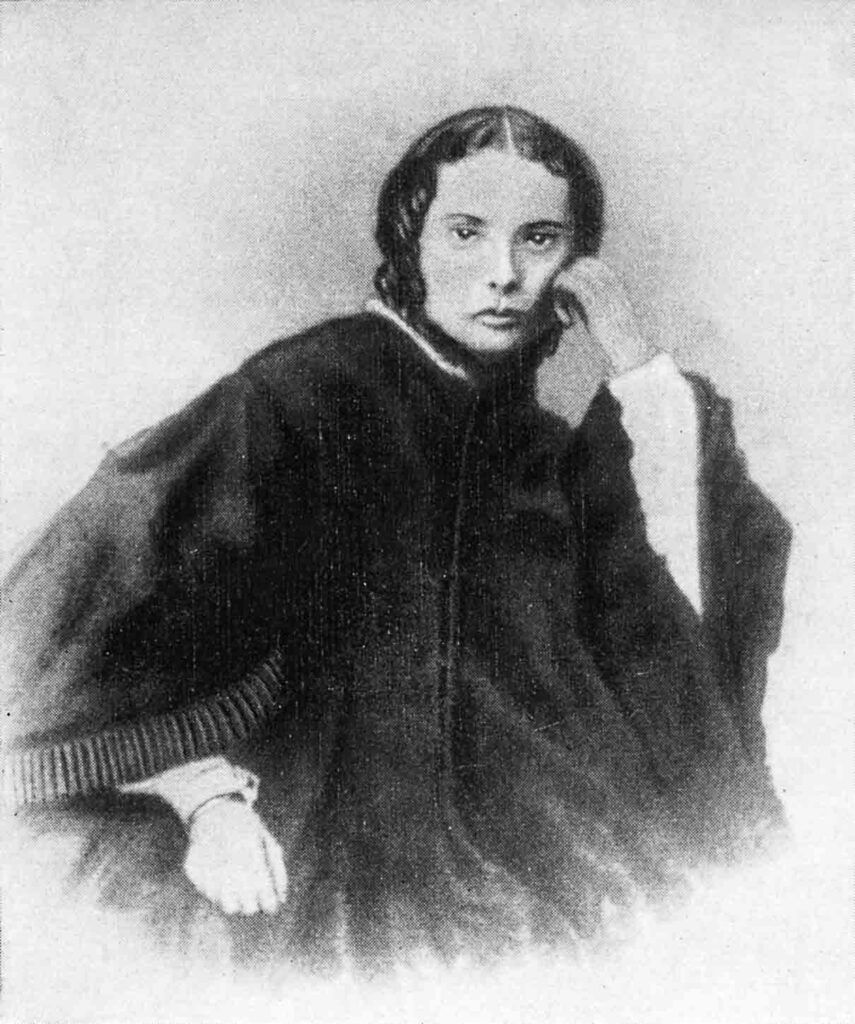
Out of penal servitude and the exile that followed, Dostoevsky brought love back with him. He met Maria Isaeva in Semipalatinsk; she was married and had a six-year-old son. Dostoevsky fell in love with her, and the feeling seems to have been mutual. A year later, her husband was transferred to Kuznetsk, where he soon died. Yet the impassioned Maria, already suffering from tuberculosis, fell in love with a local schoolteacher. The drama dragged on: unable to choose between the two men, she hesitated all the more because Dostoevsky was poor, ill, and deprived of his rights.
Through friends he managed to have his noble status restored and to obtain the rank of non-commissioned officer. His rival served as best man at their wedding. Their seven years of marriage were agonizing for both, though Dostoevsky cherished home and family, took his stepson in as his own son, and was devastated by Maria’s death from tuberculosis. Just as his parents’ home had lacked simplicity and peace, so too did his own family lack them. Just as there had been no simplicity or peace in his parents’ house, there was none in his own: there was jealousy—no wonder the narrator of Notes from the House of the Dead is a murderer driven by jealousy—there was mutual torment, and after his wife’s death a sense of utter desolation.
It seems he neither could nor knew how to love without tormenting the woman he loved and being tormented himself. More painful still was his love for Apollinaria Suslova, with whom he left for Europe, abandoning his gravely ill wife. Suslova loved him sincerely, even worshipped him; then she came to hate him, recalling her grievances and sufferings.
He even managed to torment his third and final great love, his second wife Anna Dostoevskaya, who was entirely devoted to him, subjecting her to cruel reproaches, wildly jealous of every man she encountered. It seems this marriage was saved again and again only by her extraordinary capacity for patience and forgiveness.
In haste
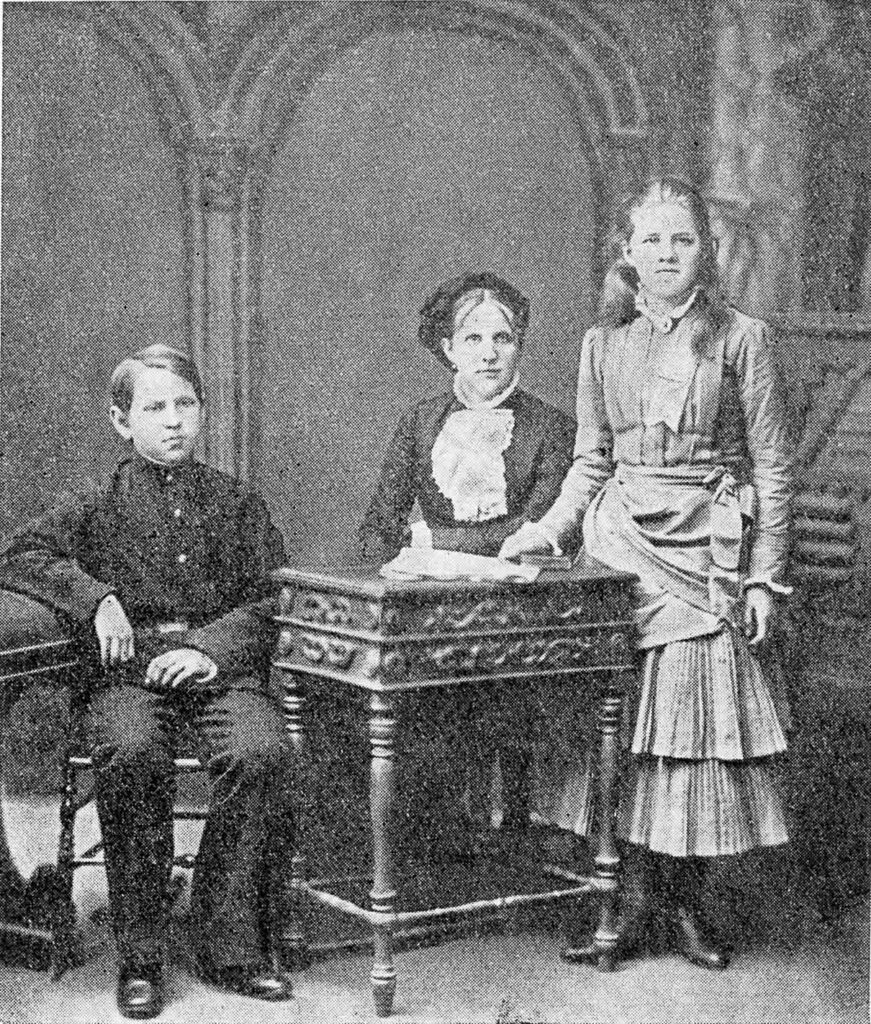
Literary fame was returning to him, but his life was spiraling out of control. In Europe, he took to playing roulette, lost all his money, and was forced to beg Suslova for a loan. When he returned, his wife died. Soon after, his brother Mikhail died as well. The journal they had tried to publish together perished—first Time, then Epoch—leaving Dostoevsky with crippling debts. He was left with a large family he tried to support—his stepson, siblings, his brother’s widow with her children. Money seemed to slip through his fingers like water; he barely had time to write, delivering chapters to the publisher before the ink was dry. Time and again, he openly envied Tolstoy and Turgenev, who had the material means to write unhurriedly and “polish” their works. He met his wife Anna only because he had to deliver a manuscript urgently—and therefore needed a stenographer.
He wrote feverishly, in haste, constantly occupied with other people’s affairs and debts, losing friends—not everyone understood or accepted his turn toward conservatism and his disillusionment with socialist ideas—he lived on credit, lost money gambling, and pawned his belongings… Everything was spiraling out of control, yet he continued to publish his works. His life only gained some semblance of stability after his second marriage, although even in this union he tormented his wife and lost everything at the gaming tables. He may have become calmer—his seizures even troubled him less frequently—and perhaps even somewhat happier, though life continued to rain down new misfortunes upon him: his children Sonya and Alexei died, and calamities plagued his wife’s family…
Only in old age did he finally gain some measure of financial stability, a good, reliable, warm family haven, universal acclaim, and mass expressions of love—when he delivered his famous Pushkin Speech. He had lived to see it all, but was already incurably ill with emphysema, which brought him to the grave at the zenith of his fame.
How does he know everything?
Despite Dostoevsky’s late fame, his contemporaries would have been astonished to learn that in the minds of later generations he would completely eclipse Turgenev, almost cancel out Goncharov, and substantially overshadow Tolstoy. To confess to loving Dostoevsky was not quite decent; it could even be risky for one’s reputation. No one doubted the greatness of his talent or the abyss he opened up, and yet there still seemed something strange about “loving” him. Konstantin Raikin once said in an interview that this was how he came to the idea of a one-man stage adaptation of Notes from Underground. He had always respected Dostoevsky, but from a distance, with no wish to draw closer.
Then one day he broke his leg during rehearsal and, with nothing else to do, happened on Notes from Underground and started reading—with growing amazement, with horror. The author knew everything about him, including the most shameful things. When he came to the words “I was only twenty-four years old,” Raikin, who was twenty-four himself, gave a genuine start. “All right,” he thought, “but at least he doesn’t know THIS about me”—and on the very next page he found that same most hideous memory of his own. He hurled the book at the wall, then spent a long time trying to rake it back with his crutch.
We need, at last—if only to ourselves, if only silently—to explain the secret of this ambivalence toward Dostoevsky. Plenty of writers have written convincingly about horror; the nineteenth and twentieth centuries are full of pulp and second-rate literature stocked with every imaginable psychic pathology. Nor is style the issue, although the charges most eagerly brought against Dostoevsky are precisely stylistic ones: sameness of dialogue, excess, verbosity, hysteria, implausibility.
All of that may be true, but Tolstoy’s Gallicisms jut out from his prose too, and his awkwardness—deliberate though it may be—was the target of countless parodies. It is obvious that in Dostoevsky’s case style is merely a pretext, an excuse for carping. To fault him for excess or hysteria is like faulting Bosch for phantasmagoria or Goya for cruelty: it is a feature of the style, a matter of intention, not accident. The real objection to Dostoevsky lies deeper. We prefer not to voice it, and probably would not admit it even to ourselves: we do not love Dostoevsky—or we fear him—for the very same reason that Nietzsche did. Or Camus.
Because he grasped the exhaustion of human nature, because he intuited that man in his old form was finished, that the old restraints no longer work and new ones must be invented—with no guarantee that they can be.
Many complain that in Crime and Punishment Raskolnikov’s theory is more convincing than all attempts to expose it. It is a sharp remark, but a false one. Raskolnikov’s theory is speculative—and as speculation it has the neat persuasiveness of any abstract construction. Its refutation, however, is artistic, and therefore operates selectively, as all genuine art does. Yet the artistic is stronger than the speculative—if the reader knows how to read. For such a reader, the sight of Raskolnikov crushed by his own crime outweighs all his theoretical reasonings, however airtight and rational they may seem.
This is Dostoevsky’s great phenomenon: he takes his characters through the literal, practical enactment of their abstract theories. And what he shows is that the human being of the new age—the age of final challenges and great crises—can only be the one who performs a vast experiment on himself, the one who, in Raskolnikov’s own word, “transgresses.” Sonya transgresses too, because a crime against oneself, even for the noblest of reasons, remains a grave sin. According to the reconstruction proposed by the scholar Igor Volgin, Alyosha Karamazov too was meant to transgress—by subjecting himself to a terrible experiment and volunteering for regicide. Suslova once confessed to Dostoevsky that she had wanted to kill the tsar, and he questioned her at length, with great curiosity, about what had made her change her mind. Nothing short of personal experience and personal sacrifice can defeat or unmask destructive ideas.
That is why Porfiry Petrovich, having grasped the fatal essence of the superman ideal, calls himself a “finished man.” The pattern is evangelical: unless a grain of wheat falls into the earth and dies, it remains alone; but if it dies, it bears much fruit. All of Dostoevsky is about the need to die—or at the very least to burn away within oneself the present, limited, former human being.
He seems to have sensed this instinctively from youth, and that is why he subjected himself to such an experience. Dostoevsky’s entire adult life is, in essence, an afterlife. After the mock execution, four years of penal servitude, and then two years as a common soldier, he was truly reborn. The point is not that he acquired some boundary experience, but that he traveled the destructive path all the way to the end. Paying for that new knowledge with years of his life, he came to understand the vanity of external transformations, of superhuman ideas, and of the pride from which he himself had suffered so much. His “new man” is above all one who has lived in the neighborhood of death—or mortal illness, like Myshkin—and in the face of those ultimate trials has found values that cannot be revoked.
Indeed, Christ after the Resurrection is the ideal of such a being—if “being” rather than “man” is now the word—for whom neither outward humiliation nor vanity nor lust nor hopes of transformation nor progress have any meaning. Such a person knows the true measure of all things, and therefore yields neither to sectarianism, nor to the absolutizing of his own rightness, nor to abstract crime—the most ruinous temptations of all. He knows that there is no truth except mercy and no salvation except sacrifice. He is without fear. He has no vanity.
Strakhov recalled that after his seizures Dostoevsky was “like a man fresh from the bathhouse”; he spent his whole life as though simmering in a cauldron of hell. Dostoevsky brings us a terrible message: that man as he is is not enough, that he must do something greater with himself than he ever imagined even in his darkest or most vainglorious dreams. Dostoevsky—like Nietzsche after him—calls on man to ascend to the next stage. And the terror of that next stage is such that the reader naturally finds it easier to shelter behind objections of style.
And yet, as Chingiz Aitmatov once said, literature exists precisely so that human beings need not perform such self-destructive experiments on themselves. It is enough to read certain books—and all of Dostoevsky belongs among them.
Translated by Grigory Litvinov.