 Irina Ivina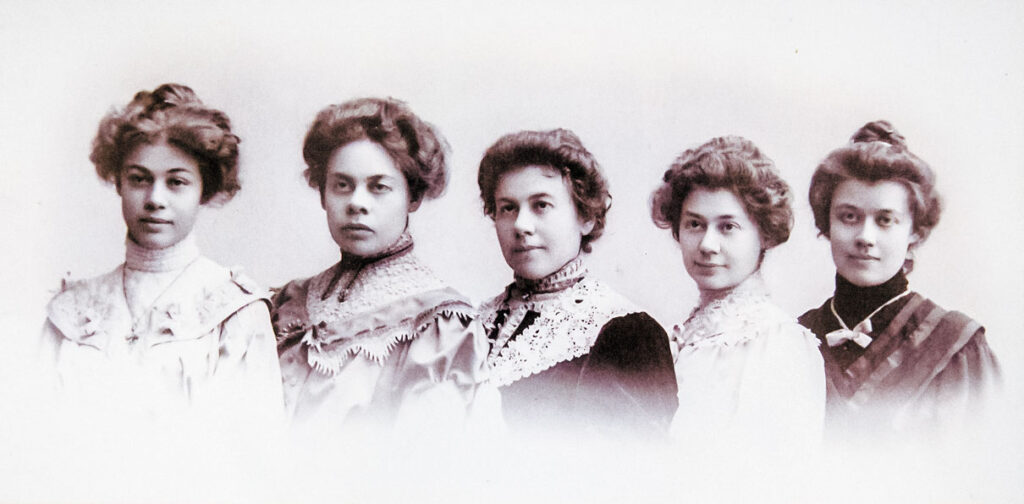
Aram Khachaturian, Mikael Tariverdiev, David Tukhmanov, Iosif Kobzon, Lyudmila Zykina, Lyubov Kazarnovskaya, Filipp Kirkorov, Valeriya, Polina Gagarina, and Shaman. All these and hundreds of other famous musicians share one thing: they studied at the legendary “Gnesinka.” In 2025, the Gnesin Russian Academy of Music marked its 130th anniversary.
The history of this renowned institution, which today comprises a music academy, a college, and seven-year and ten-year schools, is closely linked to the Gnesin family. In 1895, they started with a small music school, teaching students right in their own home. In time, what they built from the ground up would immortalize the names of its founders.
Musical family
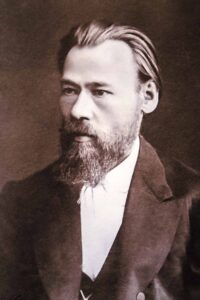
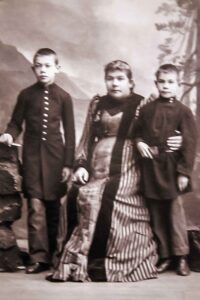
The Gnesins came from Rostov-on-Don, where their father, Fabian Gnesin, an official rabbi, and his wife Bella (née Fletzinger) had moved from Vilna. Fabian grew up in a poor Jewish shtetl in Minsk Province. Bella’s family, however, was quite well known in the city: her father, Shaya Fletzinger, was a folk singer and improviser (the name Fletzinger means “flute player” in German). Three of Bella’s sisters studied music professionally, and she herself was musically gifted as well.
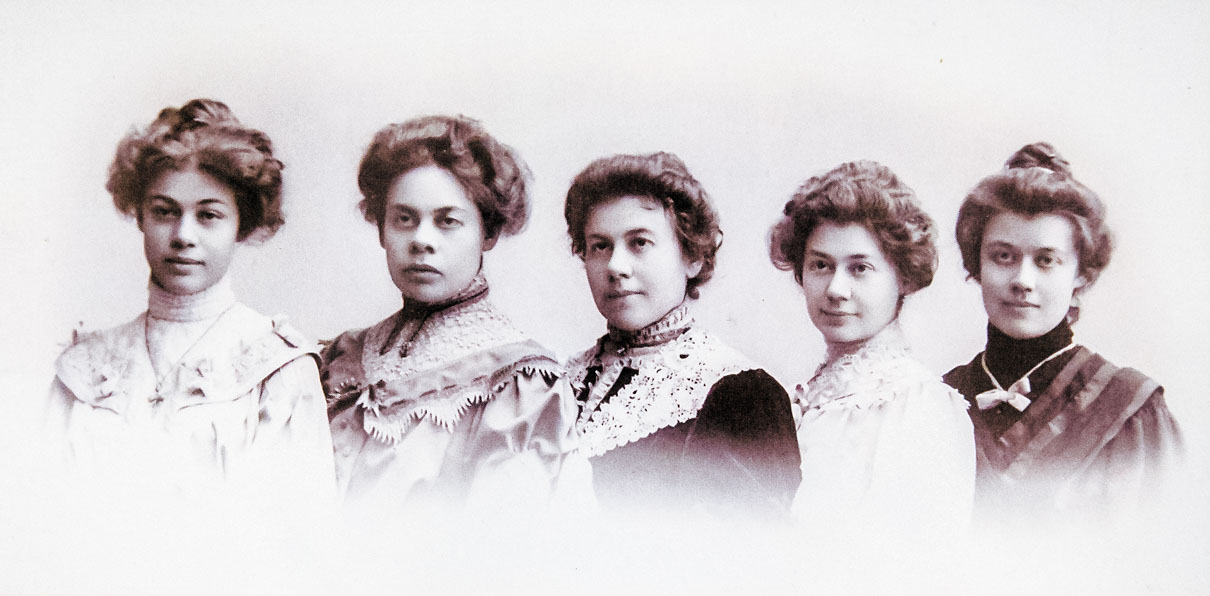
Of the twelve children born to the Gnesins, nine survived — four boys and five girls. After receiving their early education in Rostov-on-Don, the three eldest sisters, Evgenia, Elena and Maria, followed one another to Moscow, where they continued their studies at the conservatory, all three studying piano.
Evgenia graduated from the conservatory in 1889 with a silver medal. Her sister Elena, exceptionally gifted, was transferred directly from the junior to the senior division, into the class of pianist Vasily Safonov, who became director of the conservatory in 1890. Her fellow students included Sergei Rachmaninoff and Alexander Scriabin, with whom she remained friends for life.
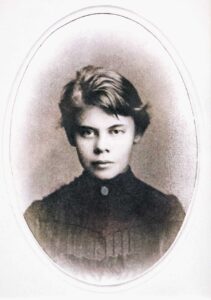
Upon becoming director, Safonov was obliged to part with his students; he entrusted Elena Gnesina to a visiting teacher, Ferruccio Busoni, who had just won the First International A.G. Rubinstein Competition. The young Italian pianist called Elena Gnesina his most talented pupil, promised her a brilliant career, and, when he left for the United States in 1891, invited her to join him for concerts. But Elena, then nineteen, did not dare undertake such a long journey. (She was born in 1872, but later changed her documents to 1874, which often causes confusion about her age.)
In October 1891, tragedy struck the Gnesins: Fabian Gnesin died, leaving the family with no means of support. In dire straits, Elena began looking for work and eventually found a position teaching music at the Arsenyeva Gymnasium. This marked the start of her remarkable teaching career — one that would span an extraordinary seventy-six years.
Little conservatory
When Elena Gnesina graduated from the conservatory in 1893, her sister Evgenia had already conceived a plan to open their own music school for children and adults. They waited for Maria to complete her studies, and on February 15, 1895, opened their doors to students — right in the apartment on Gagarinsky Lane where they lived.
Vasily Safonov warmly supported the idea of opening a school; as director, he often sent talented students to the sisters. Many applicants who failed the conservatory entrance exams were admitted the following year, having been prepared by the Gnesin sisters. Later, the sisters’ school came to be known as the “Little Conservatory.” Elena obtained permission from the city authorities to establish an official educational institution. From that point on, she became its unofficial head, taking charge of organizational matters.
Initially, the Gnesins did not have a fixed curriculum, but as the number of students grew, they had to develop one. Various classes appeared: theory, choral, and ensemble, with each sister choosing the subjects she preferred to teach.
The philanthropist and factory owner Alexander Kaverin helped them purchase a piano — the Gnesins had begun with only one instrument, though teaching classes were required to have at least two. The sisters kept their fees modest, and some needy but talented students were taught on reduced terms or entirely free of charge.
Among the first graduates of the school was the youngest Gnesin sister, Olga. The sisters decided there was no point in paying for a conservatory course and taught her themselves. The fourth-born sister, Elizaveta, was a violinist and did graduate from the conservatory. When she joined the school in 1901, a new violin class was established. Elizabeth would later play a key role in teaching other string instruments as well.
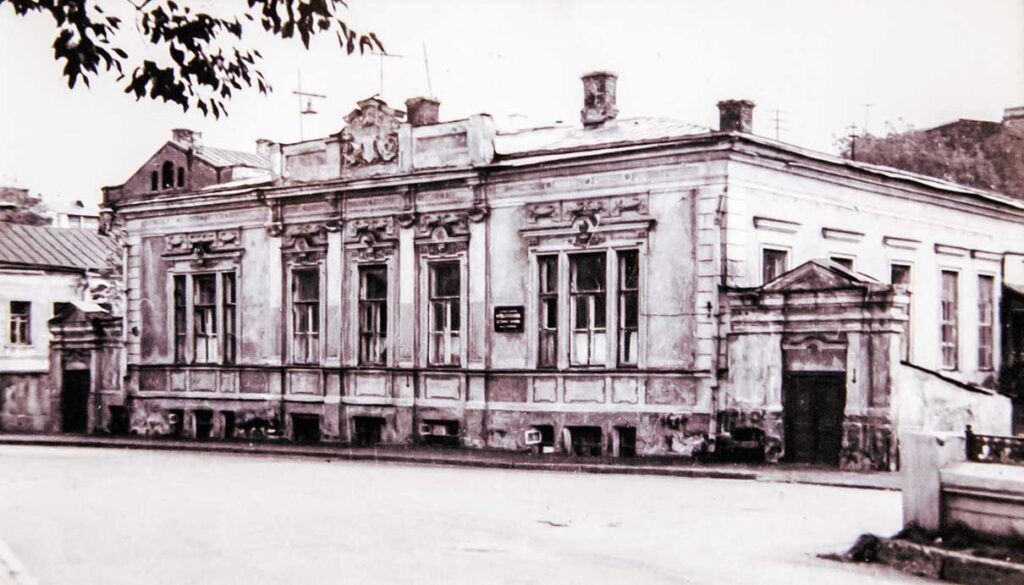
At the beginning of the 20th century, the Gnesins began hiring teachers. Among the first to join the faculty were the young Reinhold Glière and Alexander Grechaninov; later, teachers were also recruited from among the school’s graduates. The building on Gagarinsky Lane was becoming too cramped, and in 1900 the Gnesins moved to a more spacious house on Sobachya Ploshchad, an area that later became part of New Arbat. One day, while walking along the Arbat, the sisters noticed a building with five large windows surmounted by bas-reliefs of five female heads. They decided to rent it on the spot: “We thought—there are five of us sisters. It was fate itself that led us to this house!” Elena recalled.
As before, the unmarried sisters lived in the same building where they taught. This occasionally led to curious incidents: once, over morning tea, Elena heard someone upstairs in a classroom play a wrong note. She immediately rushed off to find out which teacher had a student playing so badly.
Joys and sorrows
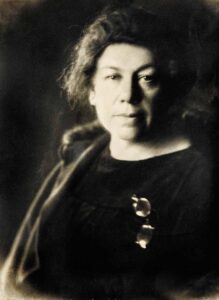
Once the younger Gnesin brothers had grown up and left Rostov-on-Don, the sisters brought their mother, Bella, to Moscow.
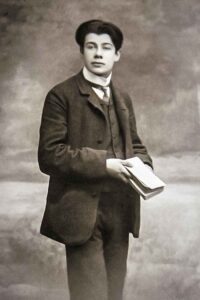
Mikhail Gnesin, who tried to enter the Moscow Conservatory in 1900, was unable to gain admission due to the quota system for Jewish students. Unlike his sisters, he refused to convert to Orthodoxy. The following year, he enrolled in the St. Petersburg Conservatory, where he studied composition with Nikolai Rimsky-Korsakov. Grigory, the youngest of the Gnesin brothers, had a passion for travel and wandered from city to city, from country to country, as an itinerant performer. His fate was tragic: for his involvement in anti-government activities, he was arrested twice, in 1905 and 1908, and subsequently sent into exile. Under the new regime, however, things were no better: in 1937, on charges of espionage, Grigory was sentenced to death by firing squad.
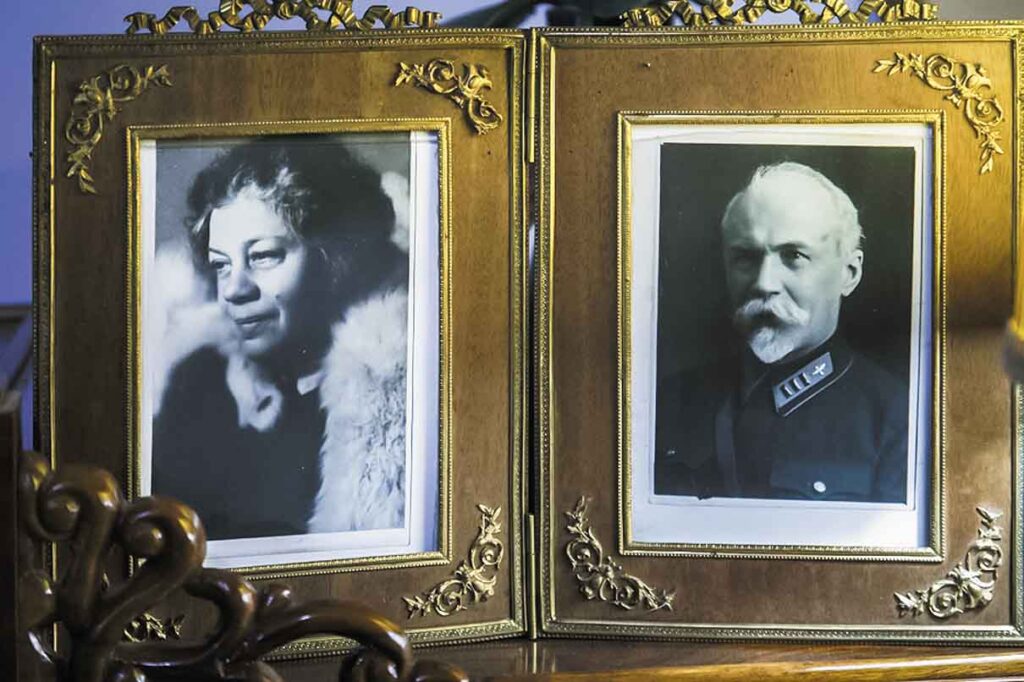
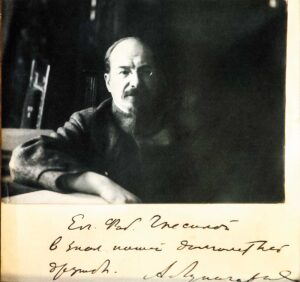
Three of the five Gnesin sisters started families of their own. Evgenia married Alexander Savin, a historian specializing in the Middle Ages, while Olga married Dmitry Alexandrov, a professor at the Zhukovsky Air Force Engineering Academy. The Alexandrovs adopted Elizaveta Kudryashova, the young orphaned daughter of a janitor; she later studied piano with her adoptive mother, taught at the seven-year school, and remained with the Gnesins her entire life. After their deaths, she became the keeper of the sisters’ museum. Only Elizaveta had children of her own: from her first marriage, to the violinist Alexander Vivien, she had a son, Alexander; from her second, to the violin maker Evgeny Vitachek, she had a son, Fabiy, who became a noted composer.
Elena, however, never started a family of her own. She devoted all her energy to her many students, but her deepest attachment was to her nephew and godson, Alexander Vivien. The boy possessed extraordinary musical talent and tried his hand at composition. Elena wrote that “his talent bordered on genius.” Once, his aunt brought the seven-year-old boy to see Sergei Rachmaninoff. Before they entered, she warned her nephew that he was about to meet a great composer. The boy looked up at her in surprise: “But aren’t all great composers dead?” Rachmaninoff, already opening the door, overheard this innocent question. “I’m still alive, dear boy,” he said with a smile to his guests.
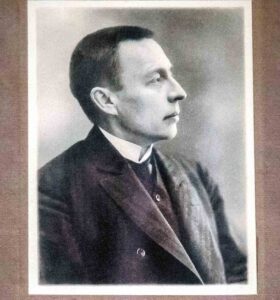
Sadly, soon after that meeting, little Alexander was gone. He died suddenly at the age of eight, consumed by diphtheria in just two days. His death was a terrible blow to Elena, one from which she never fully recovered: within hours, her hair had turned gray, and for some time she could not even bring herself to touch the piano. Only work and lessons with her students helped her cope with the grief.
The family’s losses did not end there. That same year, Bella died, and in 1918, Maria passed away. After the Revolution, their brother Vladimir disappeared without a trace; the Gnesins believed he had perished, but in 1922 they learned that he had made his way to the United States via Constantinople, where he lived for many years without maintaining contact with the family. In 1915, at the height of his powers, their close friend, the composer Alexander Scriabin, died suddenly.
Exceptional institution
After the 1917 Revolution, the Gnesins decided to transfer their school to the new authorities and submitted a petition to the People’s Commissariat for Education. The favorable outcome of this matter was greatly aided by the Gnesins’ long-standing acquaintance with the Commissar, Anatoly Lunacharsky. During the Civil War, desperate for money and food, Elena resolved to go to him at the Kremlin — and in his visitor, Lunacharsky recognized the young woman he had met in 1901 while vacationing at the Goncharov estate, Polotnyany Zavod. Lunacharsky became a patron of the Gnesins, declaring that their school was “a truly exceptional institution.”
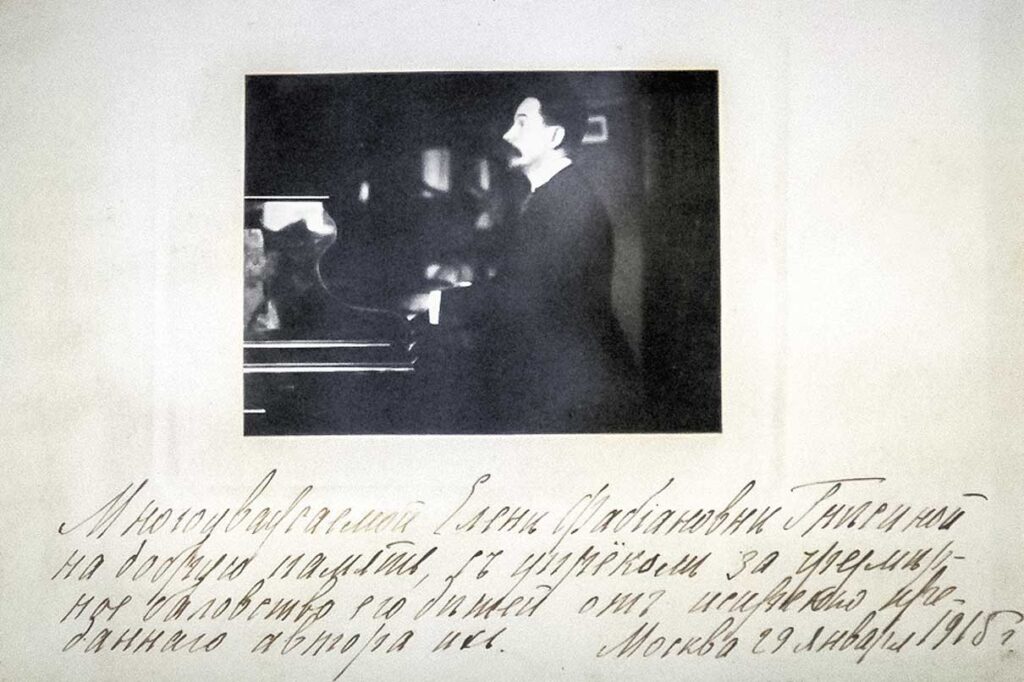
In July 1919, the newly nationalized Gnesin School was renamed the Second Moscow State Music School, with Elena as its director. Tuition was abolished. The following year, on the school’s twenty-fifth anniversary, it was reorganized as a model institution: the junior division became a children’s music school, while the senior division became a state music college. The Gnesins joined the Music Section of the People’s Commissariat for Education, taking part in the reform that established the country’s three-tier system of music education: school, college, conservatory. Evgenia Savina-Gnesina became one of the main authors of the children’s music school curriculum adopted throughout the Russian Republic. Elena was appointed to administrative posts within the education commission and served as deputy chair of the local music schools committee.
In these years, enrollment in both the school and the college grew significantly. Elena wrote to Rachmaninoff in 1921: “The school is overflowing — we now have 387 students! As soon as the school became state-run and therefore free, all of Moscow wanted to send their children only to our school.” The faculty had to make the entrance exams more demanding in order to limit admissions.
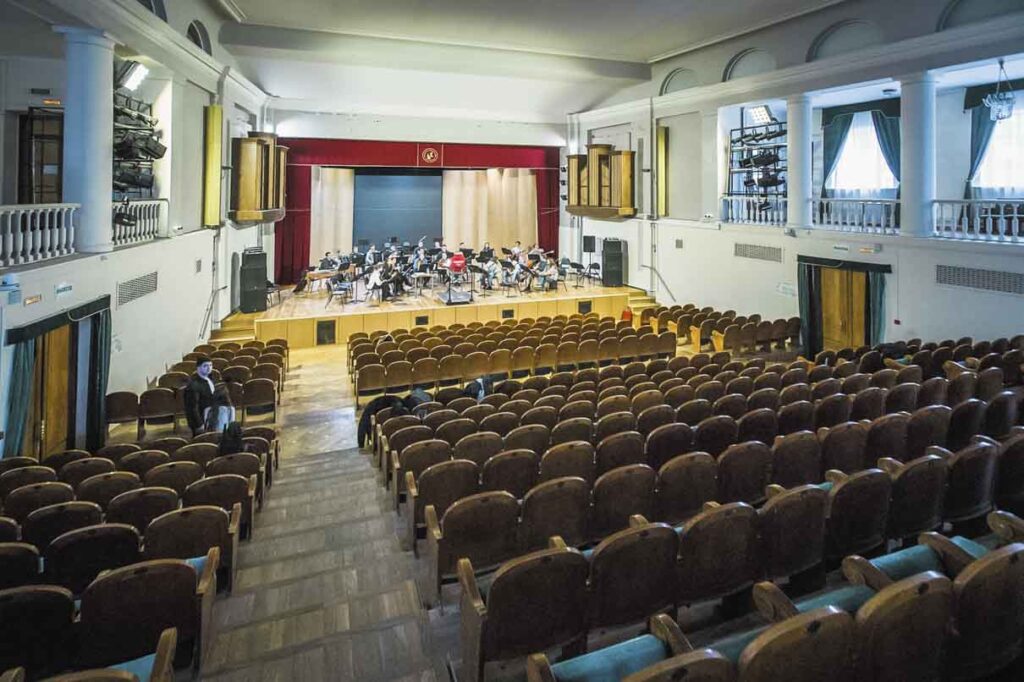
In 1923, a composition department was established at the college, attracting composers and music theorists; it was headed by Mikhail Gnesin. He had long hesitated to move to Moscow. After graduating from the St. Petersburg Conservatory, he had lived in Rostov-on-Don for over a decade and had even contemplated emigrating to Palestine. But in the end, he came to join his sisters. One of his most distinguished students was the composer Aram Khachaturian. What is remarkable is that the Gnesins were the ones who recognized the talent in the nineteen-year-old young man who had come from Tiflis, ready to take up any instrument — even the drums — but unable to read music. After examining Khachaturian, Elena delivered her verdict: the applicant had an impeccable ear, but would need to start from the very basics. She later placed him in her brother’s composition class. Incidentally, when Gnesin retired, it was Khachaturian who took over as head of the department, mentoring a brilliant generation of students, the most famous of whom was probably Mikael Tariverdiev.
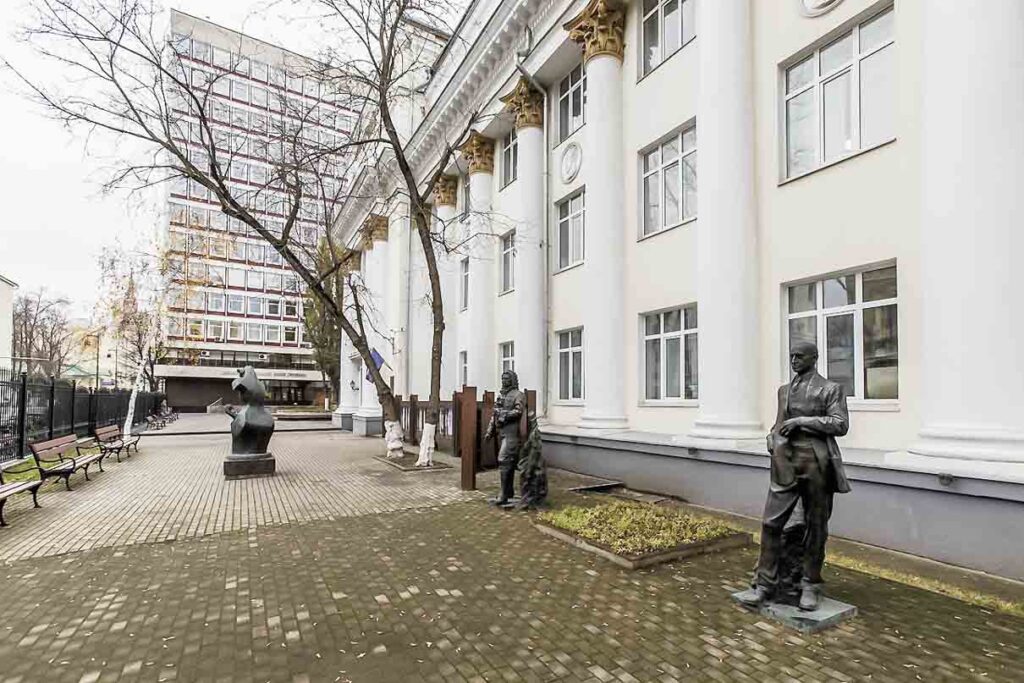
In 1925, the institution was granted the right to add “Gnesin” to its name — the family’s achievements were now officially recognized. But the Gnesins also had no shortage of detractors. They first came under serious attack in the late 1920s from the Russian Association of Proletarian Musicians (RAPM). The association’s journals, Proletarian Musician and For Proletarian Music, began a campaign of persecution against the family, with Mikhail Gnesin bearing the brunt of it. In 1929, Elena was forced to step down as director of the college and became head of academic affairs. The harassment ceased only with the dissolution of RAPM in April 1932. Elena not only returned to the helm but also managed to persuade the authorities of the need for expansion. At her request, the college was given the neighboring building on Sobachya Ploshchad.
“Give me nails!”
By the late 1930s, it had become clear that the Gnesin institution needed a new building: enrollment had swelled beyond capacity. Elena began campaigning — a site had to be found, an architectural plan developed. And with it came hope: the new building might finally house a third tier of music education — an institute on a par with the conservatory.
Elena found a suitable site for construction not far from their previous location — on Vorovskogo Street (now Povarskaya Street). The new building, designed by architect Alexei Tishin, was to include a large educational complex, a concert hall, and living quarters for the Gnesin sisters, who again wished to live where they worked. Construction began in 1937 but came to a halt with the outbreak of World War II.
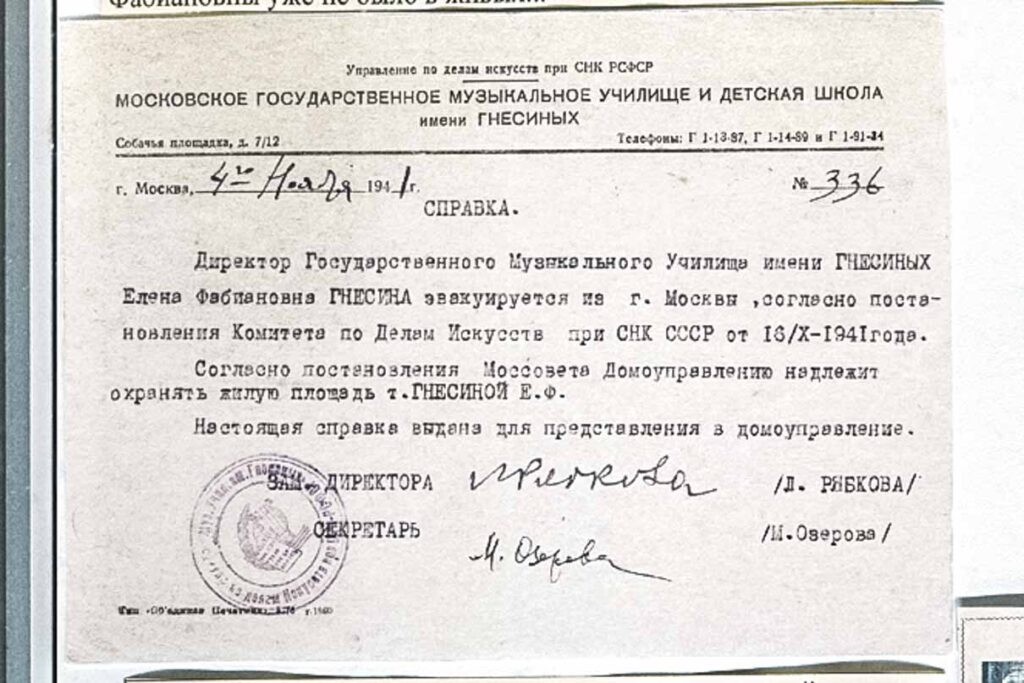
Elizaveta, Olga, and Mikhail Gnesin were evacuated from Moscow and worked at music institutions in other cities (Evgenia had died in 1940). Elena, however, refused to leave the capital and the school. Despite an official order to suspend classes, the remaining teachers continued to work unofficially. In October 1941, a state of siege was declared in Moscow, and Elena, as a member of the city administration, was forced to evacuate to Kazan. That same month, however, the school reopened. The teachers who stayed behind in the capital, suffering great hardship and freezing without firewood, gathered at Sobachya Ploshchad for night duty, threw incendiary bombs off the roof, mended linen for the wounded from a nearby hospital, sewed shirts, and worked as nurses.

When Elena learned that the school was still functioning, she obtained permission to return to Moscow and set out for the capital in January 1942. In the freezing cold, the seventy-year-old woman made her way on foot from Kazansky Station to the Arbat, surprising the faculty with her unexpected appearance. With her return to work at the school and to the city administration, where she served as a deputy, life for the Gnesin community improved: food, firewood, and even some clothing began to appear. The director also organized numerous concerts by her students in hospitals and at the front.
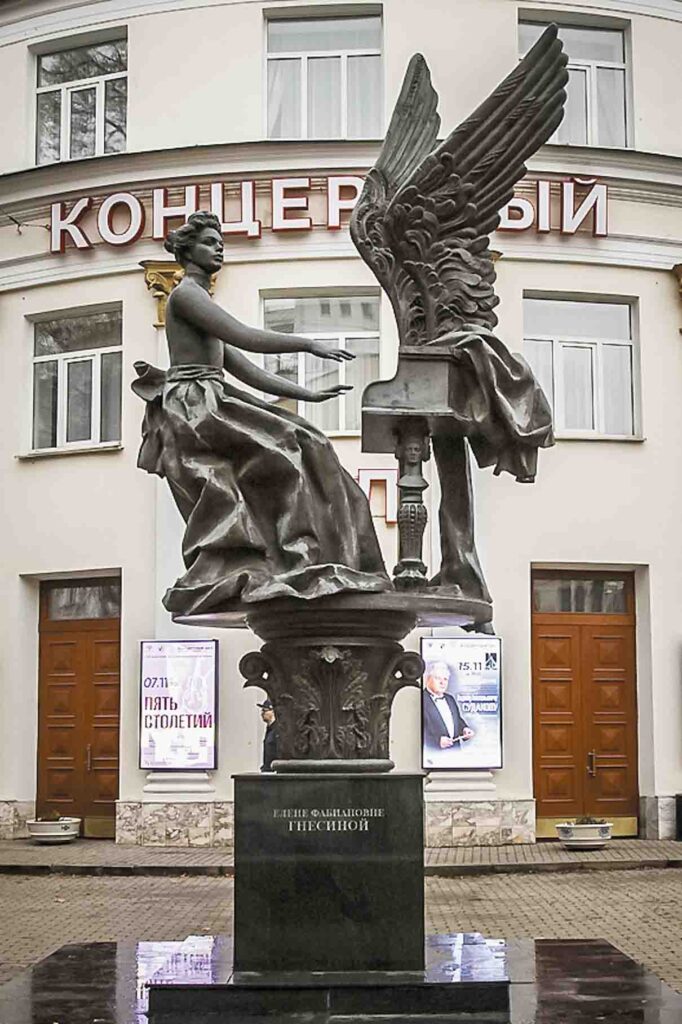
In 1944, a decree was issued establishing the Gnesins State Musical and Pedagogical Institute, and on September 1, the new institution welcomed its first students. The educational complex retained its middle (college) and lower (music school) levels. The following year, at the celebration of the school’s fiftieth anniversary, just months before Victory Day, Elena addressed the gathering in the presence of distinguished guests, urging them to speed up construction of the new building. “Give me nails!” she pleaded. And she got her way: in 1946, the first phase of the building on Vorovskogo Street was completed. With the new space, it became possible to open another tier in the Gnesin educational system— a ten-year special music school for gifted children.
A life lived to the full
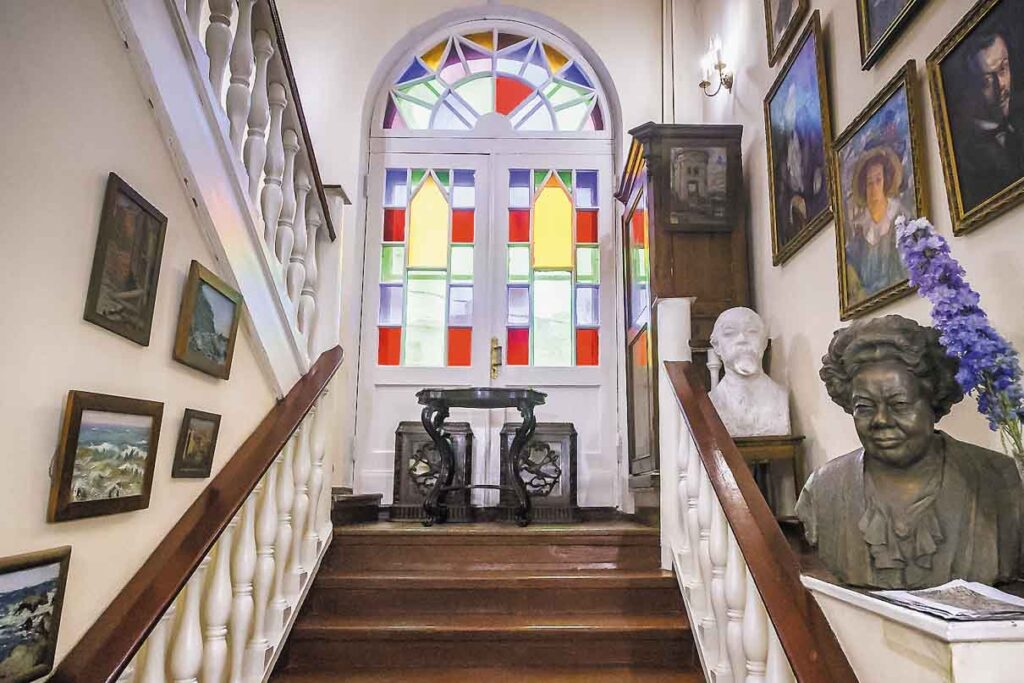
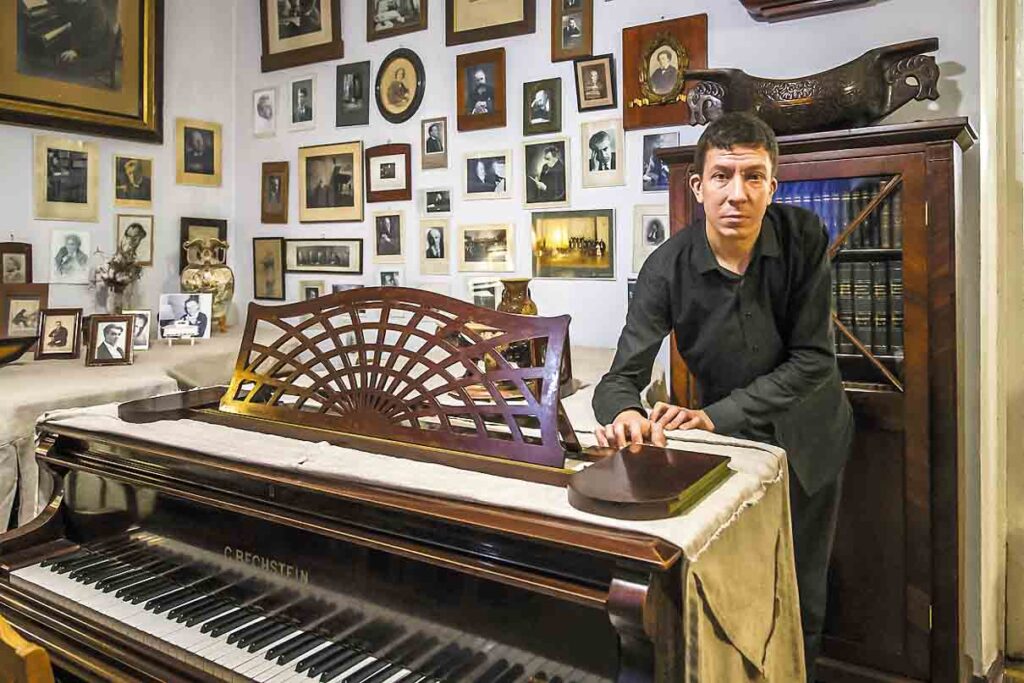
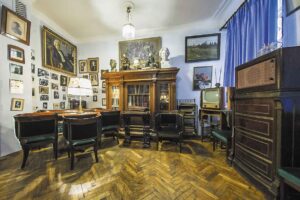
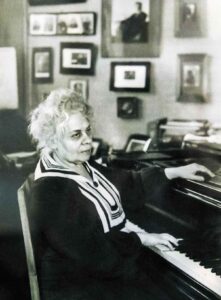
Once the new building was completed, Elena and Olga Gnesin, who had continued living in their old house on Sobachya Ploshchad, moved into the institute on Vorovskogo Street. They were joined in their new apartment by Olga’s adopted daughter, Elizaveta Kudryashova, and their beloved cat, Pchelka (Little Bee). For Elena, now seventy-five years old, the move was not easy. The new apartment had been designed to resemble the old one: even the furniture was arranged just as it had been on Sobachya Ploshchad — bookcases and music cabinets, shelves, a writing desk, an aquarium, and two grand pianos, one of which Rachmaninoff himself had once helped Gnesina choose.
In the postwar years, the Gnesins faced yet another wave of persecution: the family was accused of cosmopolitanism, denunciations were written against them, and demands were made for their removal from their posts. To preserve the composition department at the institute, Mikhail Gnesin was forced into retirement. Elizaveta Gnesina was dismissed without Elena’s knowledge. The attacks on the Gnesins ceased only with Stalin’s death in 1953. After that, Elena stepped down as director and became the artistic director of Gnesinka.
Elena outlived all her brothers and sisters. In her final years, after breaking her leg, she could no longer move about on her own. But she would scold anyone who tried to restrict the hours during which people could visit her or urged her to think of her health. She lived to be ninety-five and left behind an entire musical empire.
After Elena’s death in 1967, her apartment, as she had stipulated in her will, was turned into a museum. It opened to visitors three years later and became the only memorial museum in Moscow located within an educational institution. A special tradition has even grown up around it: students come here for their initiation ceremony. Anyone can visit the museum, but only by appointment.
After the Gnesins
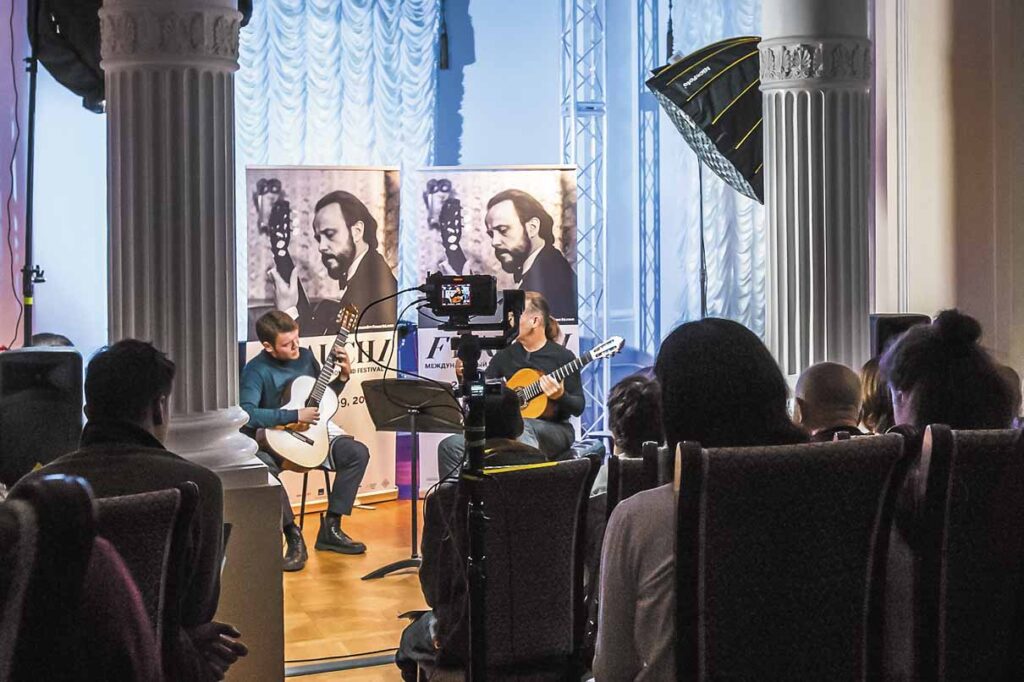
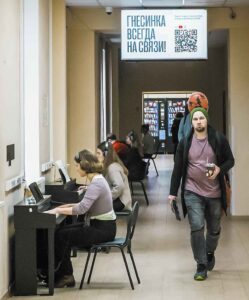
In the 1970s, the institution reached an international level: teachers and students began going abroad for internships, and foreign students started coming to Moscow to study. Today, students from fifty countries study at Gnesinka.
More and more Gnesinka graduates were appearing as singers on Soviet television. The institution had always been less formal than the conservatory. It was the first in the country to introduce specializations far from the traditional conservatory model. In 1984, a pop music department was opened, followed later by other popular programs: sound engineering, music management, musical theater and show production.
Since 1992, the higher education division of the Gnesin school system has been known as the Russian Academy of Music. It still bears, of course, the Gnesin name.
Translated by Grigory Litvinov.