 Vassili Golovanov
 For me, the appearance of Lewis Carroll’s Russian Journal was something completely out of the blue. The image of the storyteller was so firmly linked in my mind with Victorian England that I simply could not picture this modest Oxford clergyman, lecturer in mathematics and logic, as a traveller–least of all in Russia!
I could hardly believe that the author of Alice in Wonderland had once sipped tea somewhere on Nevsky Prospekt or Tverskaya Street, had shopped for icons in New Jerusalem, and, without even knowing the language, had hurried to a theatre in Nizhny Novgorod. I reread the Alice books, secretly fearing that the method of absurdity which Carroll had used so successfully to turn the world inside out would now be applied to his description of Russia as well. After all, there was always plenty for a Westerner to criticise and mock in Russia. To my disappointment–or relief–Carroll’s Russian Journal turned out to be an ordinary, slightly tedious travelogue, yet one full of sympathy for everything he saw. So what, then, did the Englishman discover? What caught his attention?
Dodgson of Cheshire and Carroll of Christ church
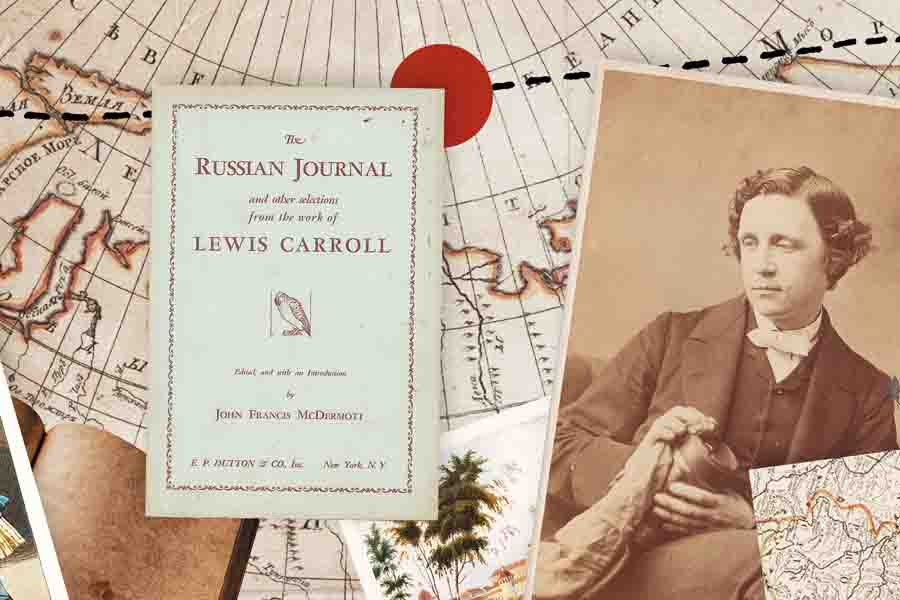
Lewis Carroll was the pen name adopted by Charles Lutwidge Dodgson, the son of a poor clergyman from Cheshire. He was a young man with a slight stammer and a shy disposition. Eventually, fortune smiled on him: at the age of eighteen, thanks to his mathematical abilities, he entered Christ Church, Oxford – one of the most prestigious colleges at the university. He remained within this academic milieu for the rest of his life: after taking his Bachelor’s degree, he won a lectureship at Christ Church. According to the college’s regulations, he was required to take holy orders – and he did so, contenting himself with the position of deacon, which allowed him to preach but did not bind him to parochial duties.
In 1856, a new dean appeared at the college–Henry Liddell, who arrived with his wife and five children. Among them was four‑year‑old Alice Liddell. What followed is, in essence, well known: after becoming acquainted with the Liddell family, Alice became Dodgson’s favourite. In our own day, such an attachment to a little girl would inevitably have aroused suspicions of something improper; but fortunately, Dodgson was so innocent, so much a child himself, that such suspicions were simply inapplicable to him. He simply loved children–and children loved him.
One day, when Alice was ten, Dodgson set off with his little friend on a boat trip up the river. And suddenly they saw a rabbit. Or rather, they saw a talking rabbit in a waistcoat, who ran past them, glanced at his watch, and muttered: “Oh dear, oh dear! I shall be too late!” He popped into his burrow, and Alice, without a moment’s hesitation, popped in after him–and thus found herself in Wonderland. Dodgson was positively bursting: in the space of a few hours, he told his little friend such an extraordinary tale that she herself begged him to write it down…
In 1865, the book appeared as a separate edition. The critics were utterly unreceptive to it. Nevertheless, the first print run quickly sold out. So did the second. Carroll began to receive royalties. He was on the threshold of world fame when his friend from Christ Church, Henry Parry Liddon–already an influential theologian at that time, who had attracted the attention of the Bishop of Oxford, Wilberforce–invited him to travel with him to Russia.
Gilbert Chesterton, in his essays on Carroll, repeatedly uses the word “holidays.” Alice burst forth in Dodgson’s mind on 4 July, at a time when the holidays were indeed in full swing. But Chesterton meant something else as well: the “holidays,” for him, signified the entire Victorian era. It was in such an age, that nonsense literature could be born. And it was Chesterton who first called Alice “a fairy tale for adults” and even “a fairy tale for scholars.”
Why Russia?
Incidentally, when setting off for Russia, Carroll was still the Rev. Charles Lutwidge Dodgson: fame had not yet caught up with him, and the second brilliant fairy tale, Through the Looking‑Glass (1871), had not yet even been written. Charles Dodgson had only just begun to feel himself a man of means, thanks to his royalties and modest salary. The initiator of the Russian journey, therefore, was Henry Liddon. This placed certain obligations upon him. The point was that 150 years ago, fairly active debates were being conducted between the Orthodox and Anglican Churches about a possible unification. Time would later show the futility of any such attempts: more often than not, they run up against banal nationalism, yet even today the idea of Christian unity has not exhausted itself. In 1867, however, the age of disillusionment had not yet arrived; on the contrary, everyone was full of hope, and Liddon, among other things, carried letters from the Bishop of Oxford, Wilberforce, to Metropolitan Philaret of Moscow and Kolomna, the greatest Orthodox theologian of the nineteenth century. Liddon thus had a mission. Dodgson travelled with him in the capacity of companion.
But we would look in vain in Carroll’s diary for tales of thrilling adventures in Russia–that was not why they had come. Besides, one should not forget that it was the Reverend Charles Lutwidge Dodgson who travelled to Russia with Liddon, not the genius Carroll. This explains why, in every city, the friends made a point of visiting as many churches as possible, attending services, listening to church singing, and conversing with clergymen. In short, they saw what one would have expected to see in the 1860s: the upsurge and public enthusiasm generated by the abolition of serfdom, the rapidly developing industry, the railways, fairs, taverns, the abundance of goods in the markets, and their fellow Englishmen hastening to start businesses in Russia…
Through the looking‑glass
Russia has always been a kind of looking‑glass world for Europe: while participating in European affairs, it was at the same time more focused on its own internal problems. Being (especially in the capitals) a country of undeniably European culture, it had also absorbed much that was Asian in the course of its formation. The Russian aristocracy spoke English and French with ease, while all around the capitals stretched the vast, uncharted territory of the Russian language, of which Europeans had not the slightest notion. The language seemed so difficult that mastering it was thought hardly possible.
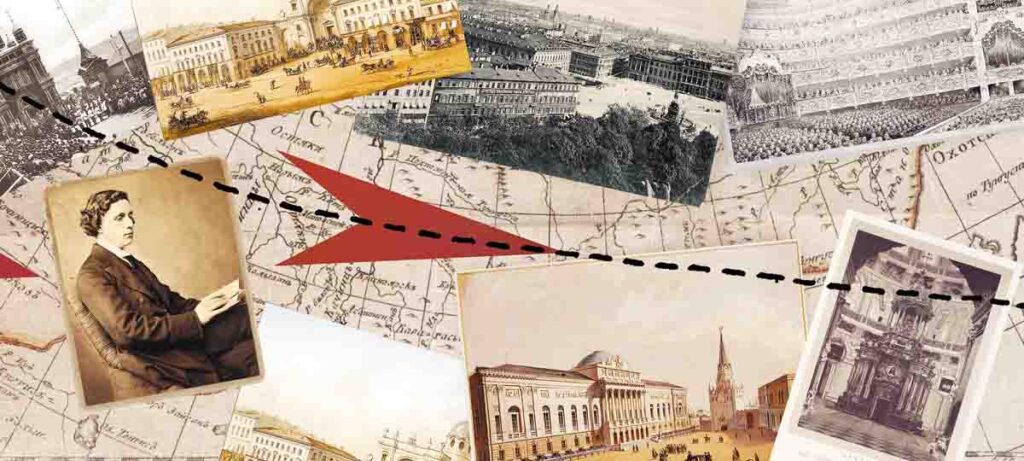
It is no accident that in the train, when the travellers’ companion turned out to be Andrew Muir, one of the co‑founders of the firm “Muir & Mirrielees” (which later built the famous department store in Moscow–today’s TSUM), his first act was to terrify his friends with the complexities of the Russian language. Carroll writes:
“He was most kind in answering our questions, & in giving us a great many hints as to seeing Petersburg, pronouncing the language, &c. but gave us rather dismal prospects of what is before us, as he says very few speak any language but Russian. As an instance of the extraordinary long words which the language contains, he spelt for me the following: ЗАЩИЩАЮЩИХСЯ which, written in English letters, is Zashtsheeshtshayoushtsheekhsya: – this alarming word is the genitive plural of a participle, and means ‘of persons defending themselves.'”
Then there were the vast expanses of Russia! On the first day of their journey, the friends had managed to travel from Dover (England) to Calais (France) and on to Brussels (Belgium). But the leg from the Prussian border to St. Petersburg took them 28½ hours. There was reason to be awestruck! At only one station–”where we paused for lunch”–Carroll records the following:
“…there was a man playing a guitar with panpipes fixed at the top, & bells somewhere about it, all of which he managed to play in tune & time: this place was also remarkable for our first tasting the native soup, Щи (pronounced shtshee), which was quite drinkable, though it contained some sour element, which perhaps is necessary for Russian palates…”
The friends found St. Petersburg itself no less striking. Carroll writes:
“We had only time for a short stroll after dinner, but it was full of wonder and novelty. The enormous width of the streets (the secondary ones seem to be broader than anything in London), the little droshkies that went tearing about, seemingly quite indifferent as to running over anybody […] the enormous illuminated signboards over the shops, & the gigantic churches, with their domes painted blue & covered with gold stars–& the bewildering jabber of the natives–all contributed to the wonders of our first walk in St. Petersburg. […] It is so utterly unlike anything I have ever seen, that I feel as if I could and should be content to do nothing for many days but roam about it. We walked the whole length of the Nevski, which is about 3 miles long, with many fine buildings along it, & must, I should think, be one of the finest streets in the world: it terminates in (probably) the largest square in the world, the Admiralty Platz […] There is a fine equestrian statue of Peter the Great near the Admiralty. The lower part is not a pedestal, but left shapeless & rough like a real rock.”
Moscow, where the travellers departed after a week in St. Petersburg, seemed more proportionate. On the very morning after their arrival, Liddon and Carroll set out in search of the Anglican chaplain, Mr. Penny. He proved to be the kindest of men; they soon became friends, and dined at his house nearly every day. Mr. Penny did them a great service by introducing them to Bishop Leonid, the vicar of Metropolitan Philaret, whom they had been seeking to meet. In their free time, the friends explored the city. The most vivid impressions were these:
“We began with St. Basil’s church, which is as quaint (almost grotesque) within as it is without […] Next we went to the Treasury & saw thrones, & crowns, & jewels–until one began to think that those three articles were rather more common than blackberries. On some of the thrones, &c. the pearls were literally showered like rain.”
“Then we were shown through the palace, after which, I think, all other palaces must seem dwarfed & poor. I measured one of the reception‑rooms by stepping, & made it 80 yards long, & I should think, it would be 25 or 30 broad. […] all lofty, all decorated elaborately, from the floor inlaid with satin‑wood, &c. up to the frescoed ceilings–all profusely gilded–the dwelling‑rooms furnished with silk or satin instead of wall‑paper–& all furnished & decorated as if the wealth of the owner were simply boundless.”
Then came a trip to the Trinity Lavra of St. Sergius and a meeting with Metropolitan Philaret, during which the letters from the Bishop of Oxford were delivered to him. Philaret deeply impressed them. Liddon recorded in his diary:
“Philaret has an income of about 7,000 roubles a year, of which he gives away all but 200. His life clearly follows a strict and majestic pattern unfamiliar to us–in England he would probably be impossible, but here he exerts a boundless influence over people.”
Carroll, however, was more struck by the hermits who lived at the Lavra in underground cells. To both Liddon and Carroll–”reverend” men of the Western world–any form of asceticism seemed excessive.
And finally, a dinner at a Russian restaurant. Carroll writes:
“We dined at the “Moscow Traktir” on a genuine Russian dinner, with Russian wine… Here is the bill of fare.
Супъ и пирошки (soop ee pirashkee)
Поросенокъ (parasainok)
Асетрина (acetrina)
Котлеты (kotletee)
Мороженое (marojenoi)
Крымское (krimskoe)
Кофе (kofe)
The soup was clear, containing chopped vegetables & legs of chickens, & the “pirashkee,” to eat with it, were patties consisting chiefly of hard‑boiled eggs. The “parasainok” was a piece of cold pork with a sauce made apparently of pounded horse‑radish & cream. “Acetrina” is sturgeon: this was another cold dish–the “fixings” being crawfish, olives, capers, & a sort of thick gravy. The cutlets “Kotletee” were veal I think–”Marajensee” means “cream‑ices”–these were delicious: one lemon, one black‑currant, a kind new to me. The Crimean wine was also very pleasant, in fact the whole dinner (except perhaps the sturgeon concoction) was a very good one.”
Entertainment industry
Since the entertainment industry did not yet exist in Russia in 1867–apart, perhaps, from fairground carousels and circuses–the friends had to entertain themselves according to their own tastes. Since there was no Tretyakov Gallery, nor indeed any other museums in Moscow except the Palace of Facets, nearly every day of Liddon and Carroll’s stay began with a visit to some church. For instance, the Simonov Monastery, destroyed in the 1930s, was described by Carroll as follows:
“the chapels were beautifully decorated with frescoes &c. & one of them contained a curious picture, almost grotesque, of the beam & the mote–and we tasted the monks’ brown bread, which was certainly eatable, though not inviting…”
At the same Simonov Monastery they also listened to “a very long but very beautiful service.” Then came a stroll through Moscow.
“Mr. Penny kindly came with us round the Dvor (or Market) to show us where to get the best Eikons, &c.”
The following day they visited the Petrovsky Palace.
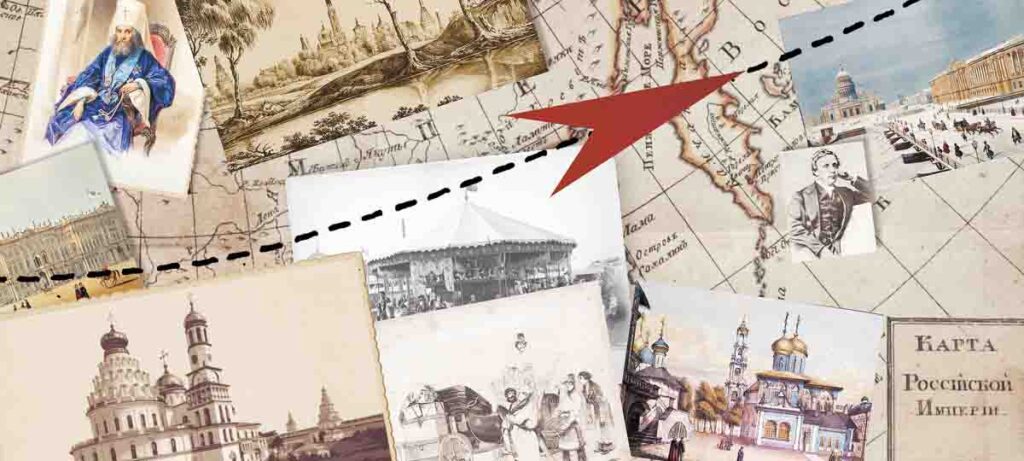
During their week in St Petersburg, Liddon and Carroll managed to visit St Isaac’s Cathedral, the Gostiny Dvor (Arcade), the Peter and Paul Fortress, the Hermitage, and Peterhof. During the two weeks they spent in Moscow, they made two trips to the Trinity Lavra of St Sergius, and also visited New Jerusalem and Nizhny Novgorod.
In Nizhny Novgorod, where the friends went to the famous fair, Carroll was especially struck by an unexpected encounter with the East. He describes it thus:
“…but all the novelties of the day were thrown into the shade by our adventure at sunset, when we came upon the Tartar Mosque (the only one in Nijni), exactly as one of the officials came out on the roof to utter the or call to prayer. Even if it had been in no way singular in itself, it would have been deeply interesting from its novelty & uniqueness–but the cry itself was quite unlike anything I have ever heard before. The beginning of each sentence was uttered in a rapid monotone, & towards the end it rose gradually till it ended in a prolonged shrill wail, which floated overhead through the still air with an indescribably sad & ghostlike effect: heard at night it would have thrilled one like the cry of the Banshee.”
In the evening Carroll went to the Nizhny Novgorod theatre, which pleased him so much that he later preferred it to Moscow’s Maly Theatre. He writes:
“The first & best piece was ‘Aladdin and the Wonderful Lamp,’ a burlesque that contained some really first‑rate acting, & very fair singing and dancing. I have never seen actors who attended more thoroughly to the drama & the other actors, & looked less at the audience.”
Carroll was an avid theatre‑goer, and he managed to familiarise himself with the theatrical repertoire of Nizhny Novgorod, Moscow, St Petersburg, and several West European cities, as far as Paris. This was an important part of his “entertainment industry.”
Trial by reality
Liddon and Carroll’s journey ran smoothly along well‑worn rails, until one day, on a trip to the New Jerusalem Monastery, things went awry. Carroll writes:
“We had thought it could easily be done in a day but this proved to be entirely a delusion. The railway part of the journey lasted till about 10. We then hired a ‘tarantas,’ (which is the form that an old barouche would assume if the body were made nearly twice as long & the springs taken away), & in this we jolted along over 14 miles of quite the worst road I have ever seen. It abounded in ruts & ditches & deep mud, & the bridges consisted of rough logs laid together any‑how. Even with three horses, it took us nearly 3 hours to do the distance.”
In short, Carroll encountered a typical Russian reality: bad roads. It was impossible to return the same day; the horses were exhausted, and the innkeeper where the travellers had stopped said they could not leave until dawn. But God was merciful. He sent the friends a monk who spoke fluent French, and they spent the whole day exploring the New Jerusalem Monastery complex. In the evening, the monk invited them to his quarters:
“…instead of a cell with skull, cross‑bones, &c. we found a comfortable parlour with a little tea‑party going on, consisting of 2 ladies, mother and daughter, & a gentleman who I think must have been the father. The elder lady spoke French fairly, & the younger English extremely well. She told us she was engaged in teaching French in one of the ‘Gymnases’ of Moscow, & she was evidently well‑educated & clever.”
However, for the night Liddon and Carroll had to return to the inn, where not a soul knew a single word of any “civilised” language. But then–a miracle! During their absence, a new guest had arrived who spoke French. They fell into conversation and sat talking until midnight. The innkeeper kept rushing into their room, laughing heartily and shaking their hands, assuring them of his devotion. The poor man had lost his mind after losing a fortune of a million roubles…
Up at three. Off at four. Carroll kept his spirits up. He writes:
“…& set out at 4 for another 3 hours of jolting–somewhat consoled by the spectacle of a beautiful sunrise, & by the music of the horse-bells belonging to a cart which followed close behind us nearly all the way.”
On arriving in Moscow, they called on Mr. Penny and, that same day (despite having had only three hours of sleep), set off to see the foundling hospital, which housed orphaned children. Since most of the older children were in the country at the time, Carroll notes:
“…we saw little else but a long series of gigantic corridors, full of beds, nurses, & an unlimited number of babies. The little children all seemed to be clean, well cared for, & happy.”
In the evening, the friends also “drove to the Petrovski park, & staid a short time listening to a military band.”
It is striking how little sleep people of that time could get by with. They did not merely go to bed early and rise early–they could go to bed at midnight, get up at three in the morning, and still get through the following day fully alert. Their nerves were stronger. Life was healthier and calmer.
18 August: the last night in Moscow. Carroll writes:
“…on our way home passed through the Kremlin, & so got our last impression of that most beautiful range of buildings, in perhaps, the most beautiful aspect of which it is capable–a flood of cold, clear moonlight, bringing out the pure white of the walls & towers, & the glittering points of light on the gilded domes, in a way that sunlight could never do–for it could not set them, as we saw them, in the midst of darkness.”
Back in St Petersburg, from where they were to set out on the return journey to Europe. Kronstadt. The Alexander Nevsky Lavra. Carroll writes:
“One piece in particular, which was repeated many times in the course of the service (that is, the music was: the words may have been different) was so lovely a piece of melody that I would gladly have listened to it many times more.”
It is curious that, on leaving Russia for Prussia, Carroll nevertheless breathed a sigh of relief. He writes:
“It was pleasant to see the country growing more & more inhabited & cultivated as we got further into Prussia–the fierce, coarse-looking Russian soldier replaced by the more gentle & intelligent Prussian–the very peasants seemed to be of a higher order, more individuality & independence: the Russian peasant, with his gentle, fine, often noble-looking face, always suggests to me a submissive animal, long used to bearing in silence harshness & injustice, rather than a man able & ready to defend himself.”
After this trip, Lewis Carroll never again left England. Russia is absent from his later work. Since the travel diaries were never intended for publication, they were neither a revelation nor a manifesto. They were first published in 1928 by the American collector Morris L. Parrish, in a limited edition of 66 copies. Since then, several other editions have appeared, but all contained errors, especially in the spelling of Russian words. It was only in 1999 that the researcher Edward Wakeling, who prepared the complete edition of Carroll’s diaries for the Lewis Carroll Society, published a carefully verified text of the Russian Journal.
It does indeed stand on the fringe of Carroll’s work. The infinite “looking‑glass” of Russia could not be fitted into the strictly logical, chess‑board pattern of Alice’s Looking‑Glass. Only one phrase strikes us with its strange resonance: remember? “Then we were shown through the palace, after which, I think, all other palaces must seem dwarfed & poor.” It is echoed in Looking‑Glass by the Black Queen: “I’ve seen hills, compared with which that’s a valley!” Chesterton shrewdly observed that on this one phrase alone “one might construct a dozen lectures against the heresy of simple Relativity.” The “games of the mind” in which Carroll indulged meant immeasurably more to him than Russia did.
He undoubtedly brought back something important from Russia, but he did not wish to share it. Perhaps because there was so little of it. So very little. Of love. One does not share small things… He kept it for himself:
“…& spent the evening in strolling along the river-side, & saw the Nicholas bridge in all the glory of sunset…”
Translated by Grigory Litvinov