 Ekaterina Zhiritskaya
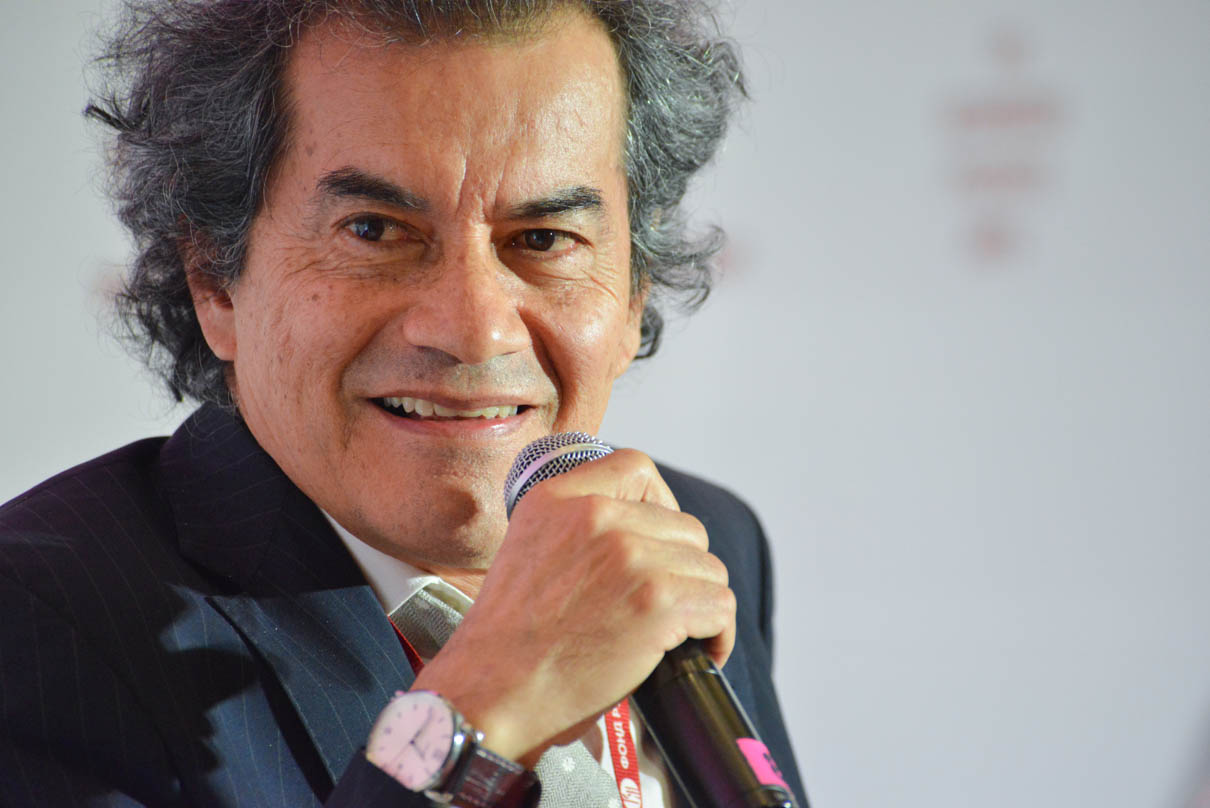
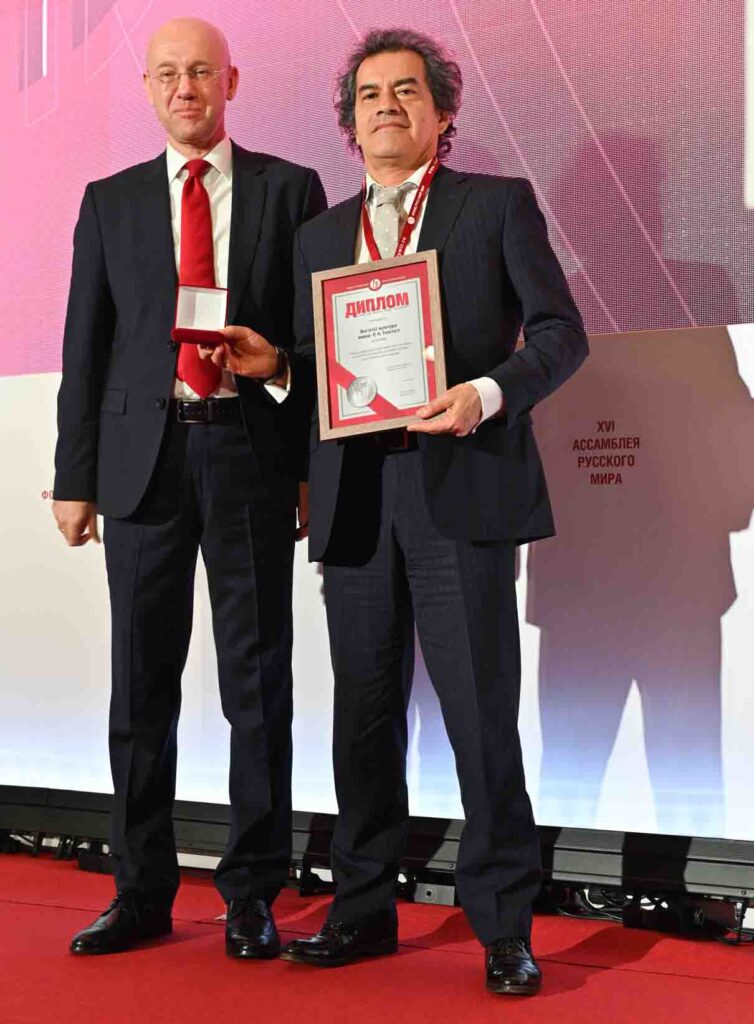
We first met Rubén Darío Florez Arcila last year at the Russkiy Mir Assembly in Moscow. For his significant contribution to the promotion of the Russian language in the Republic of Colombia and on the occasion of the 80th anniversary of the Tolstoy Institute of Russian Culture in Bogotá, he was awarded a medal and a diploma by the Russkiy Mir Foundation. As he stepped onto the stage, a lean, dark-eyed man with a thick mane of dark hair lightly touched with grey appeared before us. Rubén Darío Florez Arcila — President of the Tolstoy Institute, an adjunct professor at the National University of Colombia, writer, poet and translator, Rubén Darío Florez Arcila has translated Alexander Pushkin’s Eugene Onegin into Spanish, and has introduced the poetry of Anna Akhmatova, Boris Pasternak and Arseny Tarkovsky to readers in Colombia, Argentina, Mexico, Spain and Chile. Deeply devoted to Russian literature and culture, the Colombian professor proved to be as engaging and fascinating a conversationalist as one might expect.
— Mr. Arcila, how and when did you first encounter Russian literature?
— My first encounter with Russian literature came through War and Peace. My father had a fairly large library, and one evening I came across a volume bound in red leather. On the cover was an inscription in gold: “The Complete Works of Count Lev Nikolayevich Tolstoy, Spanish translation.” That was my first immersion into the complex and beautiful world of the Russian classical novel.
In War and Peace, I was immediately drawn to the figure of Mikhail Kutuzov. At that time, I knew nothing about this remarkable commander, so I decided to find out more about him. At home we had a wonderful encyclopedia in Spanish, published in France — extremely detailed and thorough. It is still quite popular in Colombia, by the way. Imagine my surprise when I did not find a single mention of Mikhail Kutuzov in it! The authors of that multi‑volume work simply ignored his existence! I found this very strange. My first encounter with Russian literature also became my first brush with stereotypes about Russia — stereotypes that Western Europe has been creating for centuries. At that time, I still knew nothing about the antagonism between Western elites and the Russian people. This immediately raised a question for me: “Why does an encyclopedia containing vast amounts of information about the great figures of France, Spain, Britain and America contain no information about a historical figure as important as Kutuzov?”
As for the novel itself, it literally captivated me. It was as if I had become part of the world Tolstoy created: I followed the course of the Battle of Borodino, listened to the discussion of the coming battle at the famous military council at Fili, watched Moscow’s inhabitants abandon the city, saw it set ablaze. The characters themselves were no less striking. Yes, they were figures in a work of fiction, but for me they turned into real people.
I remain convinced that world literature has no more talented realist storyteller than Lev Nikolayevich Tolstoy. To this day, I have found in no other writer such magic, such mastery in conveying the authenticity of life. I understand that this approach is often criticized. Many say that literature is merely a play of words, a constructed, imaginary world that cannot replace reality. Incidentally, this was a view passionately defended by the Russian writer Vladimir Nabokov. He believed that if a reader becomes so immersed in the narrative that he no longer distinguishes himself from it, this reduces the depth of the reading experience. But I share the view of the ancient Greek philosophers, who emphasized the interconnection between the individual and language. After all, language, through the images it creates in our imagination, shapes a person, forms his character and beliefs, and shapes one’s worldview. Without language, there is no personality — and vice versa. Lev Nikolayevich, with the power of his talent, was able to demonstrate that the logos — “word” in Greek— is one with life, one with the human being. Tolstoy’s gift lies in his ability to describe a phenomenon in such a way that you perceive it as reality, whether it be a battle or a peaceful scene. The impressions from my first reading of War and Peace have stayed with me for a lifetime.
— Why, in the novel, did the figure of Kutuzov in particular draw your attention?
— The portrait of this talented Russian commander is drawn in the novel with subtlety and realism at the same time. In Tolstoy’s interpretation, he is nothing like a romantic warrior-hero, even though this field marshal plays one of the main roles in the largest European war of its time. What impressed me most was this remarkable combination in Kutuzov: a figure of historical significance and, at the same time, an ordinary man
Thus, through War and Peace, I entered the universe of Russian culture. It seems to me that Tolstoy remains deeply relevant even today. Take, for instance, Napoleon’s reflections as he surveys the architectural monuments of Moscow and dreams of replacing them with more “civilized” buildings. This, after all, reflects the general attitude of Europeans toward the cultures of other peoples — an attitude that would later be called colonialism. A similar view of Russia on the part of Western European elites can be traced over the course of several centuries.
— So you read Tolstoy’s novel in Spanish translation. Which book did you read first in Russian?
— It was Eugene Onegin.
— That is a remarkable choice for a foreign student who had just enrolled in the preparatory faculty at the People’s Friendship University of Russia…
— I set myself the task of reading Eugene Onegin in Russian. It was my Russian teachers who suggested it — they recommended that I read one chapter of the novel. But I decided I would read the whole work. I equipped myself with dictionaries, including Ozhegov’s, and every day I read one chapter. I noted down every unfamiliar word on a separate card, noting down its definition from the dictionary and the Spanish translation. By the time I finished the novel, I had compiled my own catalog of all the unfamiliar Russian words in the novel, complete with Spanish translations and Russian dictionary definitions. Later, when I read Eugene Onegin again, I no longer needed to use a dictionary — I simply looked at my cards.
Many philologists spoke about the impossibility of translating this work, about the difficulty of understanding Pushkin’s novel when read in a different language. They believed that Eugene Onegin was a self-contained phenomenon within the Russian language. I found this strange, because Pushkin himself wrote poetry and prose in French. He drew on literary genres that originated in Antiquity, and he continued and developed the traditions of eighteenth- and nineteenth-century European literature. Of course, he reworked these forms masterfully, shaping them into his own distinctive verse form. Pushkin’s sense of rhythm, the harmony and the sense of completeness in his works struck me deeply. I read Onegin aloud to better understand the melody of the Russian language, and I was captivated by it. The phonetic qualities of Russian helped me feel the particular musicality of Pushkin’s style, and the way the novel brings together different registers of speechwas at times simply astonishing.
Besides, I was drawn to the story itself. A naive, pure provincial girl falls in love with a jaded dandy from the salons of St. Petersburg; she is captivated by his superficial elegance. And she receives a bitter rebuff from Onegin. Then everything changes: Eugene himself loses his head when he meets Tatyana in St. Petersburg. And she, now a married woman, turns him down, though she does not hide that she still feels the deepest love for him. I came to love this story. It fascinated me to see how a plot that had already appeared in European literature took on original forms in the Russian context.
— You took upon yourself the risk of rendering Pushkin into Spanish. But he is not the only Russian author you have translated. There were also Pasternak, Tarkovsky, Vysotsky, Akhmatova… Why did you choose these particular authors?
— That is too broad a question. If you will allow me, I would like to focus on one poet: Arseny Tarkovsky. What drew me to his work was the lyrical depiction of domestic life, of simple objects and phenomena — t through whose familiar surface deeper meanings emerge. For example, Tarkovsky has a poem, “How many leaves have fallen…” — a true gem. For him, leaves are at once the familiar “lungs of our trees” and “roofs of birds’ nests,” yet also “the summer sky’s support,” “ochre and purple of hope for a precious life, for quarrels and reconciliations.” “Leaves, my brothers, strengthen me in this life…” — so Tarkovsky pleads. He comes to understand the necessity of unity with nature by observing what seems at first an ordinary occurrence: how the leaves of trees turn from green to yellow and finally fall.
Tarkovsky has another poem, about an old house abandoned by its inhabitants. In these lines, one feels an immense grief that the people who once lived here, who celebrated birthdays, who knew joy and sorrow, are gone. The sense of time, the immense significance of the hearth and of the simple household objects that for so many years accompanied the inhabitants in joy and in sorrow… The beauty of everyday life, with all its virtues and imperfections… It is all so exquisitely rendered.
If nineteenth‑century Russian literature often showed how everyday life ensnares a person, draws him in, revealing the destructive power of the mundane, Tarkovsky discerns the poetry hidden within the ordinary. This realism of humanized objects also resonated with me. In his view of the world, Arseny Tarkovsky was continuing traditions exemplified by the writer Mikhail Osorgin, who in 1927 wrote a story called A Man’s Things. One might also mention Sergei Dovlatov’s collection The Suitcase, in which the objects from an old suitcase first serve as a pretext to recall the stories of different people — women, children, men, old and young — and then gradually become humanized themselves.
— Even female poetic lyricism did not deter you, although in that case you had to take on the role of a translator twice over: across different languages and cultures, and across the worlds of the feminine and the masculine.
— Russian literature has remarkable women poets — Marina Tsvetaeva, Bella Akhmadulina. But the poetry of Anna Akhmatova is particularly close to my heart. Like Tarkovsky, she could convey, with the utmost simplicity of language, the intricately constructed world of her lyrical heroine. This ability to show the complex through the simple fascinates me, because I am not only a translator but also a writer — my novel The Byzantine Coin was published last year. I love observing how other writers express the feelings of their characters, what words they use to convey their relationships. Akhmatova has mastered the art of conveying, in an extremely simple form, the complex dialectic of emotions — jealousy, nostalgia, melancholy, the joy of an unexpected encounter.
— What do Russian and Latin American literature have in common, and in what ways do they differ, in your view?
— I can say what it is about Russian literature that draws me in. It is universally recognized as a model of psychological depth, of profound insight into the inner conflict of a person facing a moral choice. Of a person who, metaphorically speaking, finds himself at a crossroads — and whose response to the dilemma must be an action, a deed.
Russian literature, like Latin American literature, seems to me deeply poetic. Literature should captivate with clear language, vivid characters. For example, like the heroes in Borges’s stories or in Pasternak’s Doctor Zhivago. These are ordinary people caught in extraordinary circumstances.
— What do you tell your students at the institute? What do they find most interesting about Russian culture?
— The capital of Colombia, home to about nine million people, is a city with a highly developed culture. Its historic center consists of quarters of Baroque and Neoclassical buildings. Our Tolstoy Institute of Russian Culture is located in one of those quarters, and many students from other Latin American countries come to Bogotá to connect with culture, including Russian culture. I tell them about the civilizational and cultural significance of the Russian language and Russian literature — a significance that grows as the world becomes more multipolar. Meanwhile, the historical significance of Western Europe continues to decline.
People come to our lectures of their own accord, so it resonates with them. But the interest of Colombians in Russian literature is also evident from other examples. For instance, my translation of a collection by the Dagestani poet Rasul Gamzatov was presented at the book fair in Bogotá last year, and an anthology of contemporary Russian poetry, which I also translated, appeared at the largest literature and poetry festival in Medellín.
— You first came to Russia nearly thirty years ago. Since then, you have visited it repeatedly. So you have seen our country at different historical stages. What are your impressions?
— In the late 1980s, when I was studying at the People’s Friendship University in Moscow, I took part, as a member of a student construction brigade, in the building of the Baikal‑Amur Mainline. We left Moscow; the train went on for a day, then another, then a third — it was a long, a very long journey to the settlement of Ust‑Kut, a very distant place. But it gave me the opportunity to see the astonishing beauty of Siberia, and those endless Russian landscapes made an unforgettable impression on me. So work trips like this, the experience of working alongside other students, helped me get to know your country better.
It seems to me that such construction brigades have not lost their significance even now, because it is important for a young person to feel not only as an individual, but also as part of a project greater than oneself. This matters for building character, for understanding that you are contributing your small share of labor to a common cause. This becomes especially acute when compared with modern Latin America, where people, alas, are fragmented. And, returning to the beginning of our conversation, I want to note: the way the Russian language describes Russian landscapes, the expressive resources it offers — all of this fosters a warm, heartfelt attachment to this land.
I found myself back in Moscow in 1996. It was a time of upheaval and chaos; the USSR no longer existed. We in Bogotá also took the collapse of the Soviet Union hard. It was unclear what would come next, whether the Institute of Russian Culture in the Colombian capital would survive — an institute that the Soviet government had traditionally supported. In the late 1980s, I had just returned from your country and become a teacher of Russian at the Institute of Friendship with the Soviet Union — and then, three years later, the USSR collapsed. It was a heavy blow to our beliefs. I personally took the changes in your country very hard. There was a feeling of confusion, disappointment, hopelessness — how to go on? Our institute held an emergency meeting at which only one question was discussed: would it be shut down, or would God and literature come to our rescue?
You know, in a way, Prince Myshkin and Don Quixote of La Mancha are kindred spirits. Russia is the literary birthplace of The Idiot, Fyodor Dostoevsky’s masterpiece. And Spanish‑speaking readers and writers all emerged from Miguel de Cervantes’ Don Quixote. So we, too, are idealists in a certain sense. That is why at that meeting we decided that we would never, under any circumstances, close the institute — Russian literature would save us. And indeed, the Tolstoy Institute of Russian Culture is still functioning to this day. So we were proved right not only from a practical point of view, but from a metaphysical one as well.
The first years of the twenty‑first century were difficult for us, because the new market economy in your country affected the cultural sphere as well. In Soviet times, the institute received support from the USSR — for instance, in the training of teachers. There was also a very positive attitude in Bogotá toward our students, because the Soviet Union set aside ten government‑funded places for them at its universities. From the standpoint of cultural policy, this was excellent publicity for the teaching of the Russian language. But after the collapse of the USSR, we lost that privilege, and without the support of the Russian state, it was hard for our institute to survive. The Tolstoy Institute of Russian Culture is well known in Bogotá; people regard it as the home of Russian culture. It was founded in 1944 through the efforts of Colombians who wished to express their admiration, respect and love for the country that had defeated fascism. And despite all the difficulties of a changing era, we continue to work to this day.
As for the second part of your question, I can state the obvious: in the current century, Russia has regained its important role in the world. I am neither a political scientist nor a historian, but it seems to me that it is time to remember the enormous historical role that Russia played in the nineteenth and twentieth centuries. Your country is, without a doubt, a recognized authority in the sphere of culture. At the same time, in full view of the entire world, Western civilization is in decline. Therefore, it seems to me that the twenty‑first century will be Russia’s century — in a new, multipolar world.
Translated by Grigory Litvinov.